In a bright factory hall, a machine the size of a railway carriage sits with its round door open. On a trolley in front of it lies a curved black shape — a piece of an aircraft wing, a section of a racing car body — made from layers of carbon fibre cloth, still soft. A technician checks the wrapping, the trolley rolls in, and the machine begins its work: heat, pressure, and hours of patience.
That machine is an autoclave, and the process it performs — autoclave curing — is among the most expensive steps in making advanced composites. A single large autoclave can cost tens of millions to buy and install, and every hour it runs costs thousands. The price is for the precision it delivers: parts lighter than aluminium, stronger than steel, and perfect enough to trust with lives.

Why Autoclave Curing Costs So Much
Autoclave curing is the step that turns a soft layup of carbon fibre and resin into a finished, flight-ready part. The layers are laid up by hand on a mould, wrapped in a vacuum bag, and placed inside the autoclave, where heat and pressure harden the resin over hours. The result is a part with almost no trapped air and a strength-to-weight ratio nothing else can match. If you want the full picture of how autoclave curing works, the recipe sounds simple — heat plus pressure plus time.
Materials: a pressure vessel built like a submarine
An autoclave is, at its heart, a pressure vessel — a steel tube built to hold several atmospheres of pressure at temperatures that would boil water. The shell is thick, high-grade steel, welded and tested to the same standards as a boiler or a submarine hull. The door is a massive steel disc with a locking ring that must seal perfectly every time it closes, because a leak at full pressure and temperature is a danger, not a nuisance. Inside, the heating system must warm a space the size of a room evenly, so every part cures at the same rate. Fans, heaters and insulation must survive constant thermal cycling without warping or failing.
Labour: hours of handwork before the machine starts
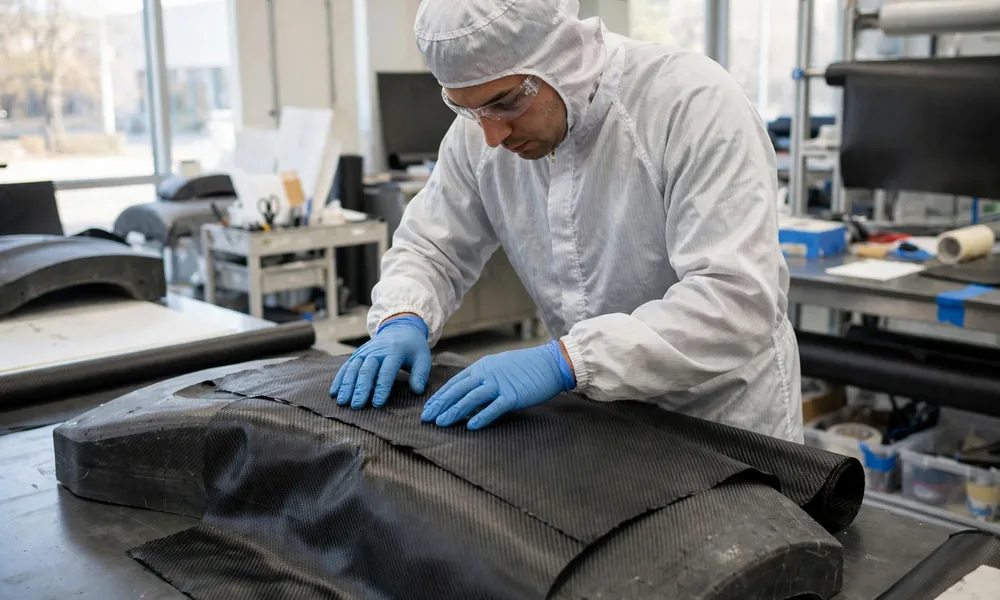
The carbon fibre layers are laid up by hand, one sheet at a time, by technicians who place each ply at a precise angle, smooth out every wrinkle, and check the layup against the design. A single large part can take days of handwork, and a mistake cannot be fixed once the part is cured — the whole piece is scrapped and the work starts again. Then comes the bagging: the part is sealed in a vacuum bag and leak-tested before it goes near the autoclave. The operators are specialists, trained to run cure cycles lasting six, eight or twelve hours. The labour is slow, skilled and unforgiving.
Rarity: few machines, few makers, long waiting lists
Few companies in the world build large autoclaves. The market is small — aerospace, motorsport, and a handful of other industries — and each machine is built to order for one customer, one size, and one range of temperatures and pressures. A buyer commissions one, waits months or years for it to be built, and pays to have it installed in a factory prepared to receive it. That scarcity extends to the parts: the components that come out of an autoclave are made in small numbers, so the cost of the machine is spread across very few finished pieces. The same logic makes a carbon fibre weave costly at the highest standard.
Testing: proving a part you cannot see inside
Once a part comes out of the autoclave, it must be proven — and proving a composite part is far harder than proving a metal one. Finished parts are inspected with ultrasound, X-rays and tap testing, and samples from every batch are cut open and tested to destruction. If a batch fails, the parts are scrapped, however much handwork went into them. The autoclave itself is tested constantly too: its temperature uniformity is mapped, its pressure vessel is inspected and certified, and every cure cycle is recorded. In aerospace, that traceability is the law, and the paperwork, inspection and certification are a large part of the cost.
Low volumes: one machine, a handful of parts
An autoclave is the opposite of a mass-production machine: it runs one cure cycle at a time, for hours, and the parts it produces are counted in dozens or hundreds a year, not millions. The factory that owns one has invested tens of millions, and that cost must be recovered from a small number of very expensive parts. Energy is a large running cost: heating a vessel the size of a room to curing temperature for hours takes an enormous amount of power. A single cure cycle can cost thousands of dollars in energy. It is why autoclave-cured parts are reserved for the jobs where nothing else will do, and why the autoclave curing specifications read like a promise.

Cost Breakdown: Where the Money Goes (Estimates)
The figures below are broad industry estimates for a large aerospace autoclave and the cost of running it. Real figures vary widely with size, temperature and pressure ratings, and location.
| Part of the cost | Estimated share of cost | Estimated price range |
|---|---|---|
| Autoclave vessel and door | About 40–50% of purchase price | $5–20 million |
| Heating, controls and installation | About 20–25% of purchase price | $2–8 million |
| Factory preparation and certification | About 10–15% of purchase price | $1–5 million |
| Energy per cure cycle | Running cost | $2,000–10,000 per cycle |
| Labour, layup and bagging per part | Running cost | $5,000–50,000 per part |
| Inspection, testing and certification | Running cost | $2,000–20,000 per part |
All told, a large aerospace autoclave is estimated to cost roughly $10–35 million to buy and install, and a single cured part carries $10,000–80,000 of curing and related costs before it is ever fitted to an aircraft. The machine is the headline figure, but the running costs are what keep the price high.
Autoclave Curing at a Glance
| Detail | Typical figure |
|---|---|
| Chamber diameter | Several metres on a large machine |
| Chamber length | Ten metres or more on a large machine |
| Cure temperature | Commonly 120–180°C |
| Cure pressure | Several atmospheres |
| Typical cure cycle | Several hours |
| Main materials | High-grade steel vessel, carbon fibre, epoxy resin |
A Rare Fact
Here is the detail that surprises most visitors to a composites factory: the autoclave does not make the part stronger by squeezing it harder. It makes the part stronger by squeezing the air out. A carbon fibre layup is full of tiny pockets of trapped air and excess resin, and under pressure those pockets are forced out through the vacuum bag while the resin flows and fills every gap between the fibres. The part that comes out is denser, more uniform and far stronger than the same layup cured without pressure — not because the fibres changed, but because the empty space between them disappeared.
That is the real story of autoclave curing’s price — not the steel vessel, impressive as it is. It is the hours of hand layup before the door closes, the energy that holds the chamber at temperature all day, the inspection that proves a part you cannot see inside, and a process that exists to make a few dozen perfect parts a year. When a composite part has to be the lightest, strongest thing that can be made, there is no cheaper way to make it.


