Pick up a cheap bicycle fork and it feels like a toy: a steel tube, a spring, a bolt. Pick up a premium e-bike fork and it feels like a piece of motorsport equipment. It is heavy in the hand and covered in dials with names like rebound, compression and lockout. The difference is not decoration: one fork simply bounces, the other thinks about every bump before it reaches the rider.
An e-bike makes the problem harder. It is heavier than a normal bike, faster on the flat, and expected to climb and descend like a downhill bike. The fork has to carry that extra weight, survive that extra speed, and still feel supple over roots and rocks. Building a fork that does all of that is why the price climbs past the cost of some complete bicycles.
Why an E-Bike Suspension Fork Costs So Much
A suspension fork looks like two tubes sliding inside two others, but the cost hides in the parts you cannot see and the tolerances you cannot feel. Here are the seven reasons the price is so high.
Reason 1: The stanchions are precision parts
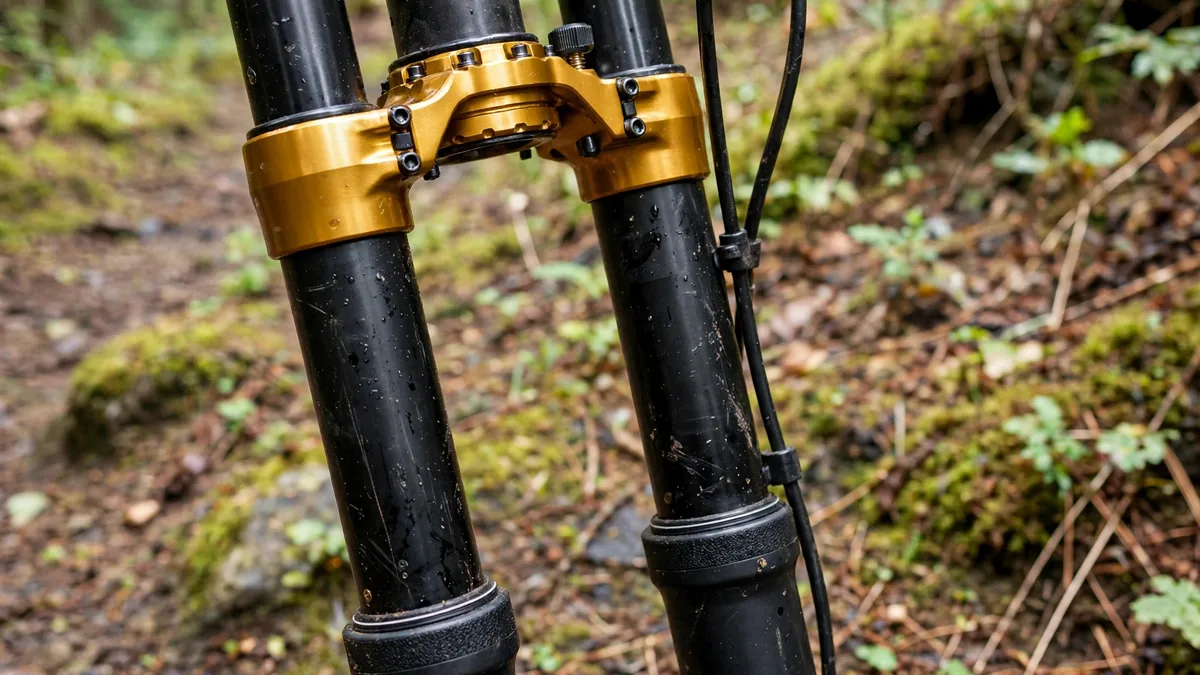
The shiny tubes at the top of the fork — the stanchions — slide in and out of the lowers thousands of times per ride, and they must do it without sticking, scratching or leaking. They are machined from aluminium, then hard-anodised and polished to a mirror finish, with tolerances measured in microns. A scratch or a flat spot means friction, and friction means a fork that feels harsh. The coating is a specialised process, and a stanchion that fails inspection is scrapped. The materials and the finish are chosen with the care described in e-bike suspension fork materials.
Reason 2: The damper is a miniature shock absorber
Inside one leg of the fork sits the damper: a tiny hydraulic shock absorber with pistons, shims and oil passages, doing the same job as a car damper in a space the size of a thumb. The shims are thin washers of spring steel, stacked in a precise order, that bend to let oil through at different rates — and the stack is tuned by hand for the weight and riding style the fork is built for. A damper with the wrong shim stack feels either dead or wild. Building and tuning it is skilled work, and it is the single most expensive part of the fork.
Reason 3: The air spring needs perfect seals
The other leg holds the air spring: a chamber of compressed air that supports the rider’s weight. Air springs are light and adjustable, but they need seals that hold pressure for months, slide smoothly under load, and survive mud, dust and freezing rain. The seals are made from specialised rubbers, fitted to exact tolerances, and tested until they leak less than a tiny amount over a season. A fork that loses air on a ride is useless, so the sealing system is engineered like a piece of aerospace equipment.
Reason 4: E-bikes are heavier, so everything is stronger
An e-bike weighs far more than a normal mountain bike — often 20 to 25 kilograms — and the motor adds torque the fork was never designed for on a pedal bike. The crown, the steerer tube and the lowers are all made thicker and stronger to carry that weight, using forged aluminium or carbon fibre, and the whole fork is tested for loads a normal fork never sees. The extra strength adds material, machining time and cost — the price of a bike that can climb with a motor and still be ridden hard downhill.
Reason 5: The chassis must be stiff and light at once
A fork that flexes sideways makes a bike feel vague in corners, but a fork that is heavy makes it feel dead. The best forks use a wide stance, a thick crown and tapered steerer tubes to get stiffness without weight, and each part is shaped by computer modelling before it is forged or machined. The balance is delicate: remove too much material and the fork twists, add too much and it is heavy. Getting it right takes prototypes, testing and redesign, and that cost is spread across a small number of forks. How the parts come together is shown in how an e-bike suspension fork is made.
Reason 6: Tuning is done by hand, fork by fork
Two riders of the same weight can want very different forks, so premium forks are built to be tuned: air pressure, volume spacers, rebound and compression dials, all adjustable by the rider or a mechanic. But the factory tuning — the shim stack, the oil weight, the spring curve — is set by technicians who test each design on real trails and adjust it until it feels right. That testing is slow, muddy work, and it is done by people whose judgement cannot be replaced by a machine. The fork that arrives in a box has already been ridden, in a sense, by the people who built it.
Reason 7: Small volumes, high standards
The final reason is scale. A premium e-bike fork is made in thousands, not millions, and every one is expected to survive years of hard riding with minimal service. There is no cheap mass-market version of a damper with hand-stacked shims and micron-tolerance stanchions, and the brands that make them invest heavily in testing and warranty support. A cheaper fork can look the same from the outside, as how an e-bike suspension fork works makes clear — but the difference is in the parts you cannot see, and how they feel after a thousand kilometres.

E-Bike Suspension Fork at a Glance
| Specification | Detail |
|---|---|
| Travel | 120 to 180 mm, depending on model (estimate) |
| Stanchion diameter | 34 to 38 mm (estimate) |
| Spring | Air spring, adjustable |
| Damper | Hydraulic, shim-stack tuned |
| Weight | About 2 to 2.5 kg (estimate) |
| Main materials | Aluminium, steel, rubber seals |
| Typical price | $800 to $2,000 (estimate) |
| Main benefit | Control and comfort on rough trails |

What Does It Cost?
A premium e-bike suspension fork typically costs between $800 and $2,000 (estimate), and the best downhill forks cost more (estimate). What the money buys is control: a wheel that stays on the ground over roots and rocks, braking that works because the tyre is in contact with the dirt, and a ride that leaves the rider fresh at the end of a long day. It also buys durability — seals that last a season, a damper that stays consistent, and a fork that can be serviced rather than thrown away. For a rider on a heavy, fast e-bike, that control is what makes the bike safe to ride hard.
A Rare Fact
The oil inside a suspension fork does more than damp bumps — it also lubricates the seals and carries away heat, and after a hard descent it can get hot enough to change how the fork feels. A fork that feels perfect at the top of a long downhill can feel different at the bottom, because the oil has warmed and thinned. The best forks are designed with this in mind, using oil volumes and passages that keep the temperature stable. It is a small detail, but it shows how much of a fork is really a tiny hydraulic machine, not just a spring.