The man stepped onto a single wheel in the middle of a city square, and the wheel did not fall over. He leaned forward, and it moved. He leaned back, and it stopped. He turned by shifting his weight, and the crowd that had gathered to watch him did not applaud, because they were too busy trying to understand what they were seeing. There was no handlebar, no seat, no second wheel and nothing to hold onto, only a man standing on a tyre, gliding across the paving stones as if the pavement were doing the work.
This article takes the price apart, reason by reason, so you can see exactly where the money goes. The battery is the biggest cost, the motor is the second, and the rest is in the shell, the electronics and the small production runs, because a luxury electric unicycle is built by a small company for a small market. The plain version of the same numbers is set out in the guide to luxury electric unicycle specs explained, where the figures are listed without the story behind them.

1. A battery that costs as much as a small motorcycle
The battery is the single most expensive part of a luxury electric unicycle, and it can cost a third of the whole machine. A top model carries a battery of two or three kilowatt-hours, built from hundreds of lithium cells, and those cells are the same high-grade cells used in electric cars, chosen for energy density and for safety. The cells are matched by hand, assembled into packs, and managed by a battery system that watches every cell for heat and voltage, because a fault in a battery this dense can be dangerous, and the maker cannot afford a failure.
2. A motor built to balance a person, not just move one
The motor in a luxury electric unicycle is a large hub motor, built into the wheel itself, and it does two jobs at once. It drives the wheel forward, and it keeps the rider upright, by pushing the wheel under the rider’s centre of gravity a thousand times a second. The motor must be powerful, because it has to accelerate a person from a standstill and hold them upright on a hill, and a top model makes three or four kilowatts of peak power, which is more than a small motorcycle engine. The motor is built to a tight tolerance, because any roughness in the power delivery is felt straight through the rider’s feet.
3. Electronics that never stop thinking
The electronics in a luxury electric unicycle are the reason it stays upright, and they are more sophisticated than the electronics in many cars. A gyroscope and an accelerometer measure the tilt of the wheel hundreds of times a second, and a controller works out how much power the motor needs to keep the rider balanced, adjusting it constantly as the rider leans, turns and brakes. The controller is a small computer, and it runs software that has been tuned over years, because a unicycle that is too eager will throw its rider off, and one that is too lazy will fall over.
4. A shell finished by hand
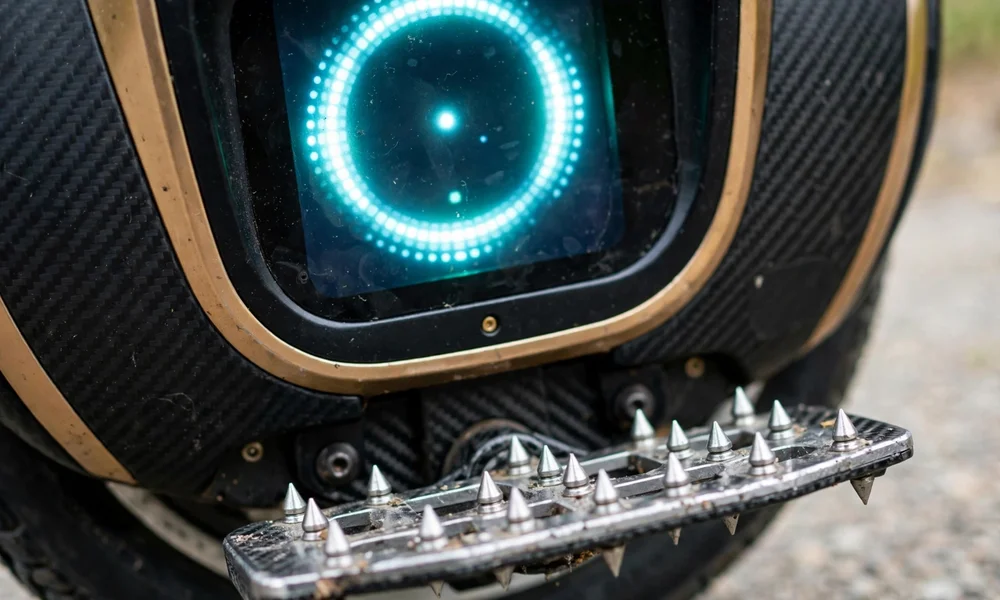
The finish matters because the machine is small and the owner sees all of it. A luxury unicycle is painted or anodised in a deep colour, with a clear coat that resists scratches, and the details are finished to the same standard as a good phone. The handle is machined from aluminium, the pedals are machined and spiked for grip, and the mudguard is shaped to keep the spray off the rider’s legs. None of these parts is expensive on its own, but together they add up, and they are the difference between a machine that feels like a tool and one that feels like a luxury object. The same hand-finished logic applies to the wider world of electric riding, as the guide to why a luxury electric bike is so expensive shows, where the battery and the motor set the price in the same way.
5. Small production runs, and a small market
The market is small as well, and that shapes the price in another way. The people who buy a luxury electric unicycle are enthusiasts, and they are willing to pay for the best, which means the maker can afford to build a better machine and charge for it, but it also means the maker cannot rely on volume to make money. The company is small, the support is personal, and the warranty is honoured by people who know the machine, which is a luxury in itself. The three-wheeled cousin of the unicycle is built the same way, in small numbers for enthusiasts, as the guide to how a luxury electric trike is made shows.
6. The cost of being the only wheel
The strangest reason a luxury electric unicycle costs so much is that it has only one wheel, and that one wheel has to do everything. A bicycle has two wheels to share the load, a motorcycle has two wheels and a frame to carry them, but a unicycle has one wheel, one tyre and one motor, and if any of them fails, the rider falls. That means every part is built to a higher standard than it would be on a two-wheeled machine, because there is no backup, and the maker tests each machine more thoroughly before it leaves the factory. The testing is done by people who ride the machines themselves, and the cost of that testing is in the price.
The spec sheet at a glance
| Figure | Typical luxury electric unicycle | What it tells you |
|---|---|---|
| Battery | 2,000 to 3,000 watt-hours | How much energy it stores |
| Range | 100 to 150 kilometres | How far it can go on a charge |
| Motor power | 3,000 to 4,000 watts peak | How much power the motor makes |
| Top speed | 60 to 80 kilometres per hour | How fast it can go |
| Weight | 30 to 40 kilograms | How heavy the machine is |
| Wheel size | 18 to 22 inches | How big the wheel is |
| Price | Roughly $3,000 to $6,000, as an estimate | What the machine costs |
What it costs
A luxury electric unicycle costs roughly $3,000 to $6,000, as an estimate, and the range is set by the battery and the motor. A smaller wheel with a smaller battery can be had at the lower end, while a big wheel with a long range and a powerful motor sits at the top, and the price is high for a machine with one wheel because the battery and the motor are the same parts that cost so much in an electric car, just smaller.
A rare fact
Some electric unicycle riders can ride backwards, turn on the spot and climb stairs, and the best of them compete in races where they ride a course of cones at speed, leaning so far that their knees nearly touch the ground. The world record for the fastest electric unicycle is over 100 kilometres per hour, set on a closed road by a rider who had practised for years, and the machine that did it was a standard production model with no modifications.