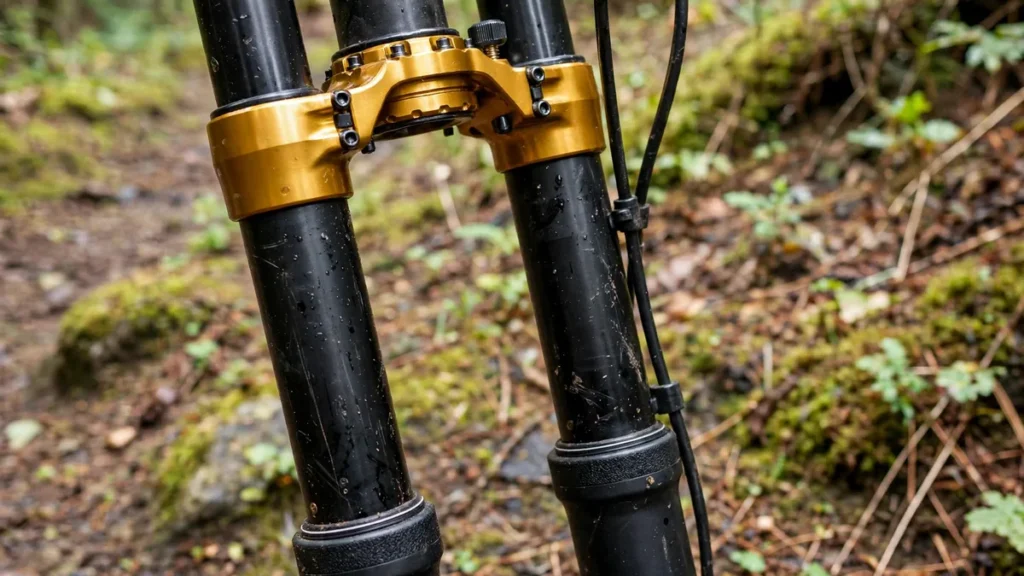
The trail drops away in front of you, a staircase of roots and rocks, and your front wheel hits the first one at speed. The fork swallows the hit, the wheel stays on the ground, and your hands stay on the bars. That is the suspension fork doing its job, and on an e-bike it has a harder job than on any ordinary bicycle.
An e-bike is heavier, faster and ridden further than a normal bike, and its fork has to cope with all three. The motor adds weight low down, the battery adds weight in the middle, and the assist means the rider arrives at every bump faster than their legs alone would manage. A fork built for a 12-kilogram road bike would not survive a season under a 25-kilogram e-bike, so e-bike forks are built thicker and stronger, from the stanchions at the top to the dropouts at the bottom.
What follows is the material story of that fork: the metals that slide, the springs that absorb, and the oil that turns a jolt into a controlled glide.
The Materials Behind It
1. Aluminium stanchions, the sliding tubes
The upper tubes, the stanchions, slide in and out of the lowers as the fork compresses, and they are almost always aluminium alloy, usually 6061-T6 or 7075-T6. The tubes are hard-anodised, a thick oxide layer that resists the scratches that would otherwise tear the seals and let dirt in. A scratched stanchion is a dying fork: grit drags past the seals and the oil leaks out.
2. Magnesium lowers, the casting that holds the wheel
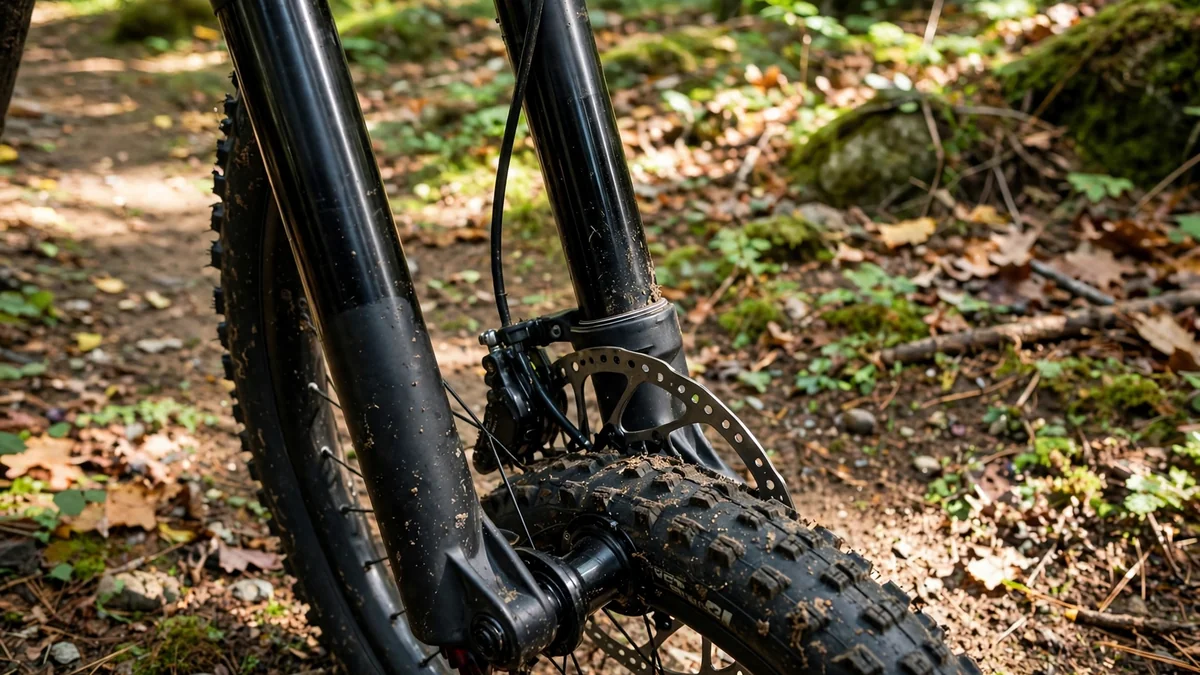
The lower legs, which hold the axle and the brake caliper, are cast from magnesium alloy, usually AZ91D. Magnesium is about a third lighter than aluminium, which matters because the lowers are unsprung weight, mass the wheel must move over every bump. Lighter lowers let the wheel follow the ground faster. The trade-off is corrosion: magnesium hates salt and road spray, so the castings are coated. The same weight obsession shapes the rest of the bike, as the guide to the e-bike lightweight frame shows.
3. Chromium steel steerer and axle, the parts that must not bend
The steerer tube, which runs through the head tube and clamps to the handlebars, and the thru-axle that holds the front wheel, are steel, usually a chromium-molybdenum alloy such as 4130. Steel is heavier than aluminium, but these parts take bending loads that would fatigue aluminium over time. E-bike forks often use a tapered steerer, wider at the bottom, which spreads the load into the frame, and a 15-millimetre thru-axle, thicker than the 9-millimetre quick releases of older bikes.
4. Steel coil and air springs, the push back
Inside one leg sits the spring, and there are two kinds. A coil spring is a steel wire wound into a helix, simple and reliable. An air spring is a sealed chamber of compressed air, lighter and adjustable with a pump, but with seals that wear and a feel that changes with temperature. Heavy e-bikes often need a firmer spring than the same fork on a normal bike. The spring does the easy half of the job; the damper does the hard half.
5. Damper oil and shims, the controlled slow-down
The damper is a piston moving through oil, and it stops the fork bouncing like a pogo stick after every bump. The oil is a low-viscosity suspension fluid, usually around 5 weight, chosen to flow the same in cold mornings and hot afternoons. Inside, thin steel shims flex to open ports as the piston moves, metering the oil and setting rebound and compression. The oil degrades with use, picking up metal wear and air, which is why a fork service is mostly an oil change, and a fork that has never been serviced feels harsh and dead.
6. Rubber seals and wipers, the guardians of the oil
At the top of each lower leg sits a wiper seal, a rubber ring that scrapes dirt off the stanchion on every stroke, with an oil seal beneath it keeping the lubricant inside. The seals are usually nitrile or polyurethane rubber, chosen to stay flexible in the cold. They are the most replaced part of any fork: a failed seal lets grit in and oil out. Foam rings above the seals hold a little oil against the stanchion, keeping it slick between services.
How a Suspension Fork Is Made
- Tube drawing. Aluminium billet is extruded into thin-walled stanchion tubes, then cut to length and hard-anodised.
- Casting the lowers. Magnesium alloy is die-cast into the lower leg shapes, then machined for the axle and brake mount.
- Crown and steerer. The crown, usually forged aluminium, is pressed onto the steel steerer and bonded to the stanchions.
- Spring and damper assembly. The coil or air spring goes into one leg and the damper cartridge into the other.
- Seals and assembly. Wiper seals, foam rings and bushings are fitted, the stanchions are slid into the lowers, and the fork is pressurised.
- Testing. The finished fork is cycled thousands of times on a test rig, checking for leaks and consistent damping, before it is boxed.

E-Bike Suspension Fork Materials
| Material | Where it is used | Why it is chosen |
|---|---|---|
| 7075-T6 aluminium | Stanchion tubes | Strong, light, hard-anodised against scratches |
| AZ91D magnesium | Lower legs | Very light unsprung weight, cast to shape |
| 4130 chromium steel | Steerer and thru-axle | Resists bending fatigue, strong in small sections |
| Steel coil or air | Spring leg | Stores impact energy and pushes the wheel back down |
| Damper oil, 5 weight | Damper cartridge | Controls rebound and compression smoothly |
| Nitrile rubber | Wiper and oil seals | Keeps dirt out and oil in, stays flexible |

What Does an E-Bike Suspension Fork Cost?
A basic e-bike suspension fork is estimated at roughly $150 to $300, a mid-range air-sprung fork at roughly $400 to $700, and a high-end fork with adjustable damping at roughly $800 to $1,200. A full service, with new seals and oil, is estimated at roughly $80 to $150 at a bike shop, recommended about once a year. The fork is often the most expensive single component after the motor and battery: a cheap fork on a heavy e-bike wears out fast, and a worn fork is a safety problem, not just a comfort one. The frame it bolts to is built to the same logic, and the guide to the e-bike carbon frame explains how frame and fork share the load.
A Rare Fact
The first suspension forks appeared on motorcycles, not bicycles, and early mountain bike forks were adapted from motorcycle parts. The idea was dismissed for years as unnecessary weight, until downhill racers in the 1990s proved that a fork let them ride terrain no rigid bike could touch. Within a decade, suspension forks went from a racing curiosity to standard equipment on almost every mountain bike sold.
An e-bike suspension fork is a small machine in itself: aluminium sliding on magnesium, steel pushing back, oil metering every movement, rubber keeping the dirt out. None of it is glamorous, and most riders never see it work, because the fork’s best day is the one where the rider notices nothing at all. That silence is the materials doing their job, a handful of alloys and a litre of oil working a hundred times a minute. The motor that makes the e-bike heavy is part of the same story, and the e-bike mid-drive motor shows what the fork is really carrying.