Electric boats are no longer a novelty. They are quieter than diesel boats, cheaper to run, and simpler to maintain, with far fewer moving parts. The challenge has always been range: a battery holds less energy than a tank of diesel, and water is harder to push through than air. The systems below solve that problem in different ways, and each one suits a different kind of boat.
This list ranks eight electric boat propulsion systems, from the small outboard that replaces a petrol engine on a tender to the ferry-scale battery system that carries hundreds of passengers. The ranking weighs efficiency, range, reliability and how mature the technology is. A system that works in the real world beats a clever idea that only works in a brochure.
Power figures are given in kilowatts and horsepower where the maker states them, and range figures are approximate because they depend on speed, load and sea conditions. A boat that goes twice as fast uses far more than twice the power, which is why speed matters so much at sea.

1. Electric outboard — the simplest swap
The electric outboard is the simplest electric propulsion system, and it tops this list because it is the one most boat owners can buy today. Torqeedo, the early leader, makes outboards up to 80 horsepower and inboard systems up to 200 horsepower, with complete systems that include the motor, battery and controls. An electric outboard is quiet, clean and easy to fit: it bolts on where a petrol outboard went, and it needs no fuel tank, no exhaust and almost no maintenance. Its limit is range, because a small boat carries a small battery, but for tenders, fishing boats and day boats, it is already the sensible choice. The propeller it turns is explained in our guide to how a ship propeller works, and the same principles apply at this smaller scale.
2. Inboard electric motor — the diesel replacement
The inboard electric motor replaces a diesel engine inside the hull, driving a conventional shaft and propeller. It is quieter than a diesel, produces no exhaust fumes, and has far fewer parts to service, which makes it popular for canal boats, sailing yachts and small ferries. Elco, one of the oldest names in electric boats, makes outboards and inboards from 5 to 50 horsepower equivalent, suitable for fishing and utility boats as well as tenders. Larger inboards reach 200 horsepower and beyond, and they pair well with a large battery bank under the floor.
3. Pod drive — the efficient newcomer
The pod drive puts the electric motor in a streamlined pod below the hull, with the propeller directly behind it. This removes the shaft, the gearbox and the drag they cause, and it lets the motor sit in the water where it stays cool. The Candela C-Pod is the best-known example: it has two electric motors and counter-rotating propellers, is rated at 50 kilowatts, weighs only 50 kilograms, and the maker says it gives 23 percent more range than a conventional electric motor in a boat. Pod drives are now used on yachts and ferries as well as small boats, and they are one of the reasons electric boats are becoming practical at larger sizes.
4. Hydrofoil electric — the range breakthrough
The hydrofoil electric system is the breakthrough that made fast electric boats possible. By lifting the hull out of the water on foils, it cuts drag by around 80 percent compared with a conventional planing boat, which means a small motor and battery can go fast and far. Candela’s C-8 is the best-known example: a 28-foot boat with retractable foils, a 50-kilowatt pod drive and a range of around 50 nautical miles at 20 knots. Its larger sibling, the P-12 ferry, carries 30 passengers on the same principle. The yacht-scale version of this idea is covered in our look at how a yacht propeller works.
5. Hybrid diesel-electric — the practical bridge
The hybrid diesel-electric system pairs a diesel generator with electric motors and a battery, and it is the practical bridge between diesel and full electric. The diesel runs at its most efficient speed to charge the battery, the electric motors drive the boat silently in harbour, and the battery smooths out peaks in demand. This system is already common on ferries, offshore vessels and large yachts, where full electric range is not yet possible. It cuts fuel use and emissions without asking the owner to give up range, and it lets a boat run silently where silence matters most. The comparison with pure diesel is explained in our guide to diesel versus hybrid ship propulsion compared.
6. Hydrogen fuel-cell electric — the long-range hope
The hydrogen fuel-cell electric system uses a fuel cell to turn hydrogen into electricity, which then powers electric motors. It offers the range of diesel with the silence and cleanliness of electric, and it refuels in minutes rather than hours. The Hynova 40, built in France, is a good example: it carries a 22.5-kilogram hydrogen tank, two 150-kilowatt electric motors, two 40-kilowatt-hour batteries and an 80-kilowatt fuel cell. The catch is infrastructure: hydrogen refuelling is rare, the tanks are bulky, and the system is expensive.
7. Solar-assisted electric — the slow and steady option
The solar-assisted electric system uses solar panels on the roof or deck to charge the battery while the boat is moored or moving slowly. On a sunny day, a large panel array can extend range significantly, and on some yachts it can run the boat alone for days at low speed. Solar power is free, silent and clean, but it is also weak: even a large array produces only a few kilowatts, which is enough for a slow canal boat but not for a fast motorboat. Solar works best as a supplement, keeping the battery topped up and running the lights, fridge and instruments without starting a generator.
8. Ferry-scale battery electric — the big test
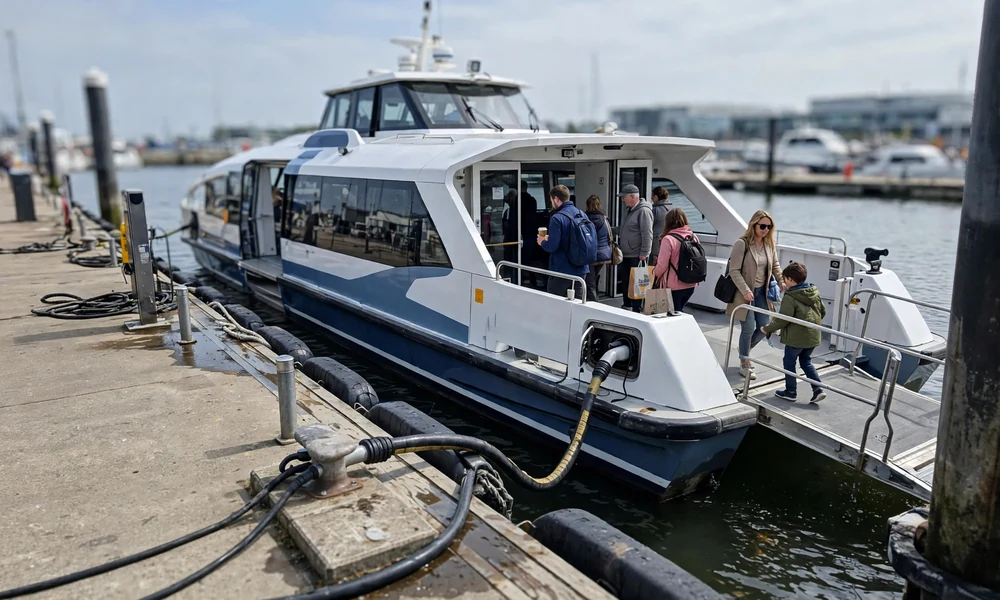
The ferry-scale battery electric system is the biggest test of electric propulsion, and it is already passing. Large ferries now carry batteries of hundreds of kilowatt-hours, charged at the dock between crossings, and they run silently with no exhaust. The X Shore Eelex 8000, a Swedish electric boat, carries a 126-kilowatt-hour battery and a 170-kilowatt motor, showing how far battery technology has come for larger craft. Ferries suit electric power because they run fixed routes, return to the same dock, and can charge while passengers board. The challenge is scale: a big ferry needs a huge battery and a powerful shore charger, but the running costs are far lower than diesel, and the air in the harbour is cleaner for it.
The Takeaway
The best electric boat propulsion system today is the electric outboard, because it is simple, proven and available now. The pod drive and the hydrofoil are the most exciting, because they solve the range problem with efficiency rather than bigger batteries. Hybrid diesel-electric is the practical choice for larger boats, and hydrogen fuel cells are the long-range hope for the future. Whichever system suits your boat, the direction is clear: the sea is going electric, quietly and faster than most people expected.


