It is seven in the morning on a flat calm lake, and a man is standing on what looks like a surfboard with no waves in sight. He leans forward, the board starts to move, and then the board rises out of the water and he is suddenly standing a metre above the surface, gliding in silence, with only a thin wing and a strut touching the lake. There is no boat pulling him, no sail, no wave. Under his feet is a battery, a motor, and a propeller. He is riding an electric hydrofoil board, and it costs more than the car he drove to the lake in.
The e-foil is the newest toy in the water-sports world, and one of the most expensive. A good one costs as much as a small car, and the top models as much as a luxury one. That seems absurd until you understand what is inside it. An e-foil has to do three very hard things at once: lift a person out of the water, keep them balanced on a wing they cannot see, and do it all with a battery that must be waterproof, silent, and safe. Every one of those problems is expensive to solve, and the market is still too small to solve them at scale.

Why It Costs So Much
The first cost driver is the foil itself, the wing under the water that does all the work. It is a precision shape, machined from aluminium or moulded from carbon fibre, and it has to be perfect: a flaw of a millimetre changes the lift and makes the board unstable. Carbon fibre is light and stiff, which matters when the wing is a metre below your feet, but it is expensive and fragile. Hit a rock or a sandbar and the foil can crack, and a replacement wing costs a thousand dollars or more. The foil is made like an aircraft part, not a surfboard.
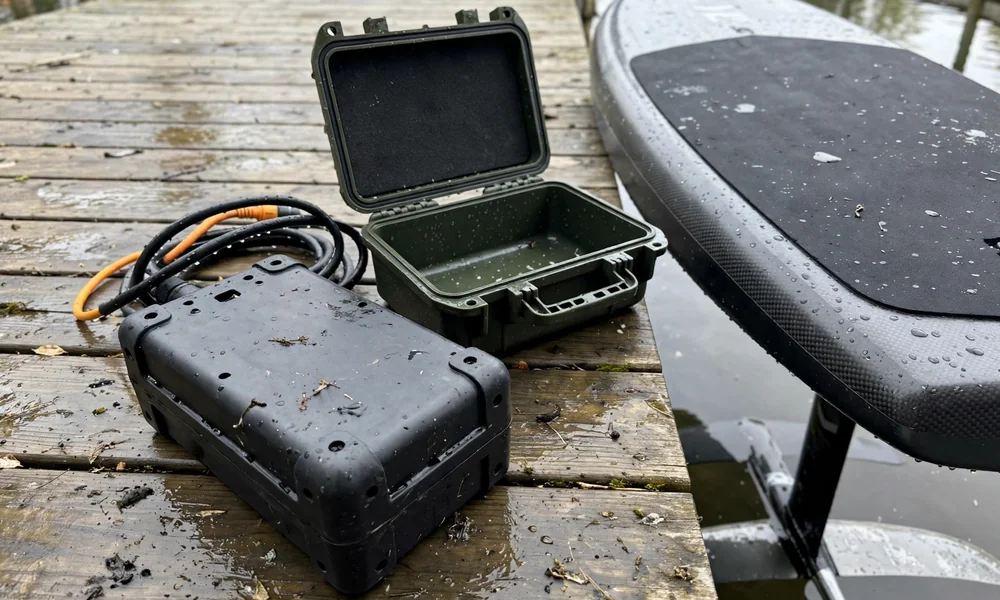
The second driver is the battery: a lithium pack of roughly 2 kilowatt-hours, sealed inside a waterproof case that must survive being dropped, submerged, and slammed by waves. It has to deliver a lot of power very quickly — the motor draws several kilowatts to get the board up on the foil — and it has to do it safely, because lithium and salt water are a bad combination. The battery management system watches every cell, and the pack is designed to be removed and charged on shore. It is the most expensive part of the board, and it wears out: after a few hundred charge cycles, the range starts to drop.
The third driver is the motor and the electronics. The motor sits at the bottom of the mast, underwater, spinning a propeller at several thousand revolutions per minute. It has to be sealed, cooled by the water around it, and powerful enough to lift a rider of 100 kilograms from a standing start. The controller reads the rider’s hand throttle, adjusts the power hundreds of times a second, and keeps the board from over-speeding. All of it is custom, and custom means expensive. The battery technology is the same kind that powers other electric rides, and the guide to e-bike battery specs shows how the same cells and the same trade-offs shape a very different machine.
The fourth driver is labour and rarity. An e-foil is assembled by hand, in small batches, by companies that employ dozens of people, not thousands. Every board is tested on the water before it ships, the mast and the foil are matched and tuned, and the customer gets a lesson included, because a twenty-thousand-dollar board that throws you in the water on your first try is a bad advertisement. The market is growing, but it is still tiny compared to surfing, so there are no economies of scale. The foil that lifts the board is the same idea that lifts whole ferries, and the guide to what a hydrofoil really is explains the physics behind it.
The Numbers That Matter
| Specification | Typical Value |
|---|---|
| Battery capacity | 1.8 to 2.5 kilowatt-hours |
| Motor power | 3 to 5 kilowatts |
| Ride time | 60 to 100 minutes |
| Top speed | 25 to 30 miles per hour |
| Foil material | Carbon fibre or aluminium |
| Board weight | 25 to 35 kilograms |
The numbers look modest next to a jet ski, which is faster, cheaper, and far easier to ride. But a jet ski is loud, it burns fuel, and it needs a trailer and a launch ramp. An e-foil fits in the back of a car, makes no noise, and lets you ride on a lake so flat that nothing else would move. The silence is the point: riders talk about the feeling of flying, not the speed. The guide to what a waterjet propulsion system is shows another way engineers move boats without a noisy propeller in open water.
What an Electric Hydrofoil Board Costs
A good electric hydrofoil board costs roughly 12,000 to 18,000 dollars as an estimate, while the top models with carbon fibre foils and bigger batteries cost 20,000 to 25,000 dollars. That is more than most people spend on a car, and it is the reason e-foils are still a rich person’s toy rather than a mainstream sport. The battery is the most expensive part, at 2,000 to 4,000 dollars to replace, and the foil is next, at 1,000 to 2,000 dollars if it cracks. A spare battery doubles the ride time, and many owners buy one.
The price is not only about the parts. It is about what the board lets you do: ride on flat water, in silence, with no boat and no wave. For the people who buy them, that is worth the money, and the second-hand market proves it — used e-foils hold their value well, because demand is still greater than supply. As more companies enter the market, the price will fall, but for now the e-foil is what happens when aircraft engineering meets a surfboard.
A Rare Fact Worth Knowing
Here is the detail that surprises everyone: the hardest part of riding an e-foil is not staying upright, it is taking off. The board has to reach eight to ten miles an hour before the foil generates enough lift, and until then you are standing on a heavy board ploughing through the water. Most beginners spend their first hour falling off at that exact moment, over and over, until their body learns the feeling of the lift. The trick is to look at the horizon, not at your feet, because the moment you look down, you fall. Trust the wing, not your eyes.
The electric hydrofoil board is a strange object: a surfboard with no surf, a boat with no hull in the water, a flying machine that never leaves the lake. It is expensive because it is hard to build, because it is built in small numbers, and because it does something nothing else can do. But it is also a sign of where water sports are going — quieter, cleaner, and powered by batteries rather than engines. The lake at seven in the morning is silent, the board is flying, and the only sound is water slipping past a wing.


