Press the accelerator of a modern electric car and the response is instant, silent and violent — hundreds of kilowatts flowing from battery to motor in a fraction of a second. What you never see is the equipment that makes that flow possible: a set of boxes, no bigger than a briefcase in total, that convert, switch and manage every watt of electricity in the car. This is the power electronics, and it is one of the most expensive and least understood parts of any EV. It has no moving parts you can admire, no sound and no badge, yet without it the battery and the motor are just expensive paperweights.
Power electronics is the inverter, the on-board charger, the DC-to-DC converter and the control units that sit between the battery and everything that uses electricity. It switches current thousands of times a second, at hundreds of volts, in a space that must survive heat, vibration and a decade of daily use. The price comes from the semiconductors inside — materials and manufacturing processes that are closer to a computer chip fab than to a car factory.

Why It Costs So Much
An electric car’s power electronics does three jobs at once: turn the battery’s direct current into the alternating current the motor needs, charge the battery from the grid, and step voltage down to run the lights, wipers and computers. Each job demands different hardware, and all of it must work perfectly, every time, for the life of the car.
Reason 1: Silicon carbide is the expensive heart of it
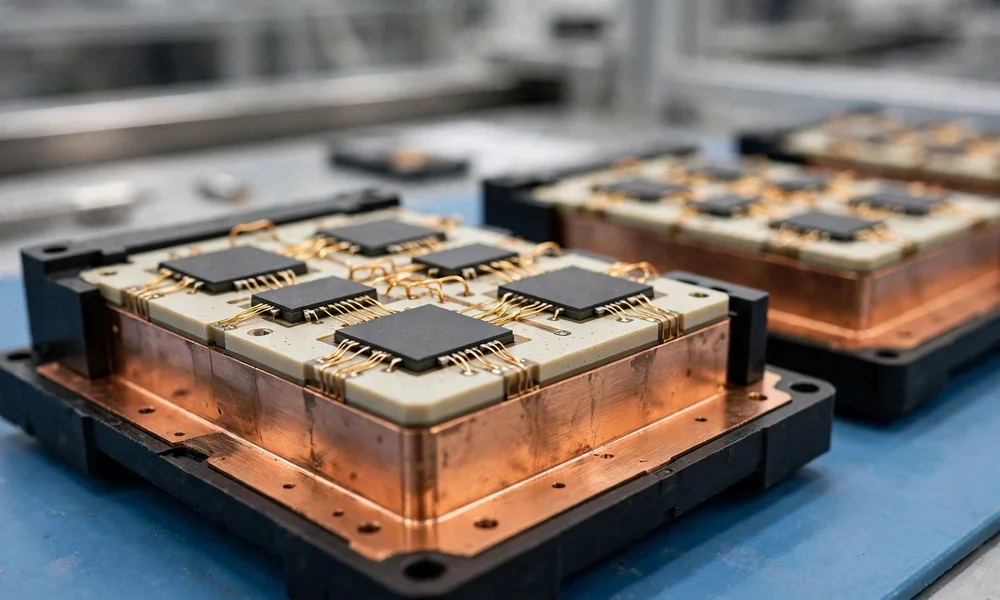
The switching devices at the core of a modern EV inverter are made from silicon carbide, a semiconductor that handles higher voltages, higher temperatures and faster switching than ordinary silicon. Silicon carbide wafers are far more expensive to grow and process than silicon ones, and the chips cut from them are still produced in relatively small numbers compared with the chips in phones and laptops. The inverter that uses these chips is a precision machine in its own right, as how the EV inverter works explains.
Reason 2: Switching hundreds of volts thousands of times a second
The inverter does not simply pass current through; it switches it on and off tens of thousands of times a second, shaping the waveform the motor needs at any given speed. Each switch must happen in nanoseconds, with no overshoot and no wasted energy, or the transistors overheat and fail. That demands carefully designed circuit boards, gate drivers, capacitors and busbars, all laid out to control electromagnetic interference that could otherwise disturb the car’s radios, sensors and computers.
Reason 3: Heat is the constant enemy
Even a very efficient inverter wastes a few percent of the power passing through it, and a few percent of three hundred kilowatts is several kilowatts of heat — enough to warm a small house. The power electronics therefore carries its own liquid cooling: cold plates, coolant channels and a connection to the car’s thermal system, all sealed against leaks that could short-circuit hundreds of volts. Keeping the battery cool is a related battle, as EV battery cooling shows.
Reason 4: The on-board charger is a second power station
When the car plugs into an alternating-current charger at home or at work, the on-board charger converts that grid power into the direct current the battery needs, at the right voltage and current, while talking to the charger about how much power is safe. Many cars now combine the charger, the DC-to-DC converter and the inverter into one integrated unit, which saves space and weight but makes the single unit more complex and more expensive to build and to replace.
Reason 5: Safety at 400 or 800 volts leaves no margin
An EV’s battery runs at 400 volts on most cars and 800 volts on the fastest-charging ones — voltages that are lethal and that demand serious protection. The power electronics contains contactors that disconnect the battery in a crash, insulation monitoring that watches for any leakage to the chassis, and fuses and sensors that react in milliseconds. Every high-voltage connection is sealed, shielded and tested, and the whole assembly must pass crash and fire testing before it is approved. Safety is not a feature added at the end; it is designed into every layer, and it costs money at every layer.
Reason 6: The software is as important as the silicon
The transistors switch, but software decides when. Control algorithms manage the motor’s torque, the regenerative braking that recovers energy when you lift off, the charging curve that protects the battery, and the thermal limits that keep everything alive. That software is developed and validated across deserts, winters and altitude, and it is updated over the life of the car. The battery cells it protects are themselves a feat of manufacturing, as EV battery cell specifications show.
Reason 7: Tiny volumes, huge validation
A power electronics module is built in the tens or hundreds of thousands per year, not the tens of millions of a phone chip, yet it must meet automotive standards for reliability, temperature range and lifetime that consumer electronics never face. The factories that build it use clean rooms, automated bonding and X-ray inspection, and every unit is tested under load before it ships.
Specifications
| Specification | Detail |
|---|---|
| System voltage | 400 volts on most EVs, 800 volts on fast-charging models |
| Key semiconductor | Silicon carbide MOSFETs, sometimes silicon IGBTs |
| Switching frequency | Tens of thousands of times per second |
| Power handled | Up to roughly 300 kW or more in performance EVs |
| Cooling | Liquid cold plates tied into the vehicle thermal system |
| Functions | Inverter, on-board charger, DC-to-DC converter, control units |
| Efficiency | Typically around 97 to 99 percent for the inverter stage |
| Safety | Contactors, insulation monitoring, fuses, crash disconnect |
Price
The power electronics in a modern electric car — inverter, on-board charger, DC-to-DC converter and controls — is estimated to cost roughly $1,000 to $2,500 per vehicle (estimate), depending on voltage, power and whether silicon carbide devices are used. That makes it one of the most expensive systems in the car after the battery itself, and its cost rises with every increase in charging speed and motor power. Carmakers pay it because the alternative is a car that wastes energy as heat, charges slowly and delivers less range from the same battery.

Rare Fact
Some electric cars can send power back out of the battery — to run a house, charge another car or feed the grid — and it is the power electronics that makes this possible, by running the inverter in reverse. The same box that drives the car can, in effect, become a small power station, and the car becomes a battery on wheels.
That is why EV power electronics costs so much: it is a computer-chip factory’s output, a power station’s hardware and a safety system, all packed into a briefcase-sized box that must work perfectly for a decade. The next time an electric car accelerates in silence, remember the silicon carbide chips switching thousands of times a second beneath the floor — they are the reason the silence is so fast.