On a desert highway at noon, a car rolls past that makes no sound at all. There is no engine note, no exhaust shimmer, no fuel gauge to watch. Its roof and bonnet are covered in dark glass panels that catch the sun, and the driver is not looking for a petrol station, because the car is filling its own tank from the sky as it drives. The other drivers stare, because the car looks like it is running on nothing, and in a sense, it is.
A luxury solar car is the most ambitious idea in the electric car world: a car that makes its own fuel while it moves. The panels on its body harvest sunlight, the battery stores it, and the motors turn it into motion, all in a machine shaped like a teardrop to slip through the air. Only a handful exist, built by specialist teams and wealthy enthusiasts, but they work. What follows is how one works, from the sunlight on the roof to the wheels on the road.

How a Luxury Solar Car Works
Step 1: Harvesting sunlight on the body
Everything starts with the solar panels, thin sheets of photovoltaic cells laminated into the roof, the bonnet, and sometimes the doors. Each cell is a sandwich of silicon that releases electrons when light hits it, and the cells are wired together into strings that feed a single charge controller. A luxury solar car carries five or six square metres of panels, far more than any ordinary car, and the cells are the most efficient kind made, converting more than a quarter of the sunlight that falls on them into electricity. On a bright day the array can produce one to two kilowatts, enough to add dozens of kilometres of range while the car simply sits in the sun.
Step 2: Storing the energy in the battery
The electricity from the panels flows into the battery, a lithium pack mounted low in the floor of the car, just like in any electric vehicle. The charge controller sits between the panels and the battery, matching the voltage of the array to the voltage of the pack and making sure the battery is never overcharged. A solar car’s battery is smaller than the battery in a conventional electric car, because the panels keep topping it up, and that saves weight, which saves energy, which means the panels go further. The battery also charges from a plug, like any electric car, so the car is never stranded on a cloudy day. Its management system watches every cell, balancing them as they charge.
Step 3: Turning electricity into motion
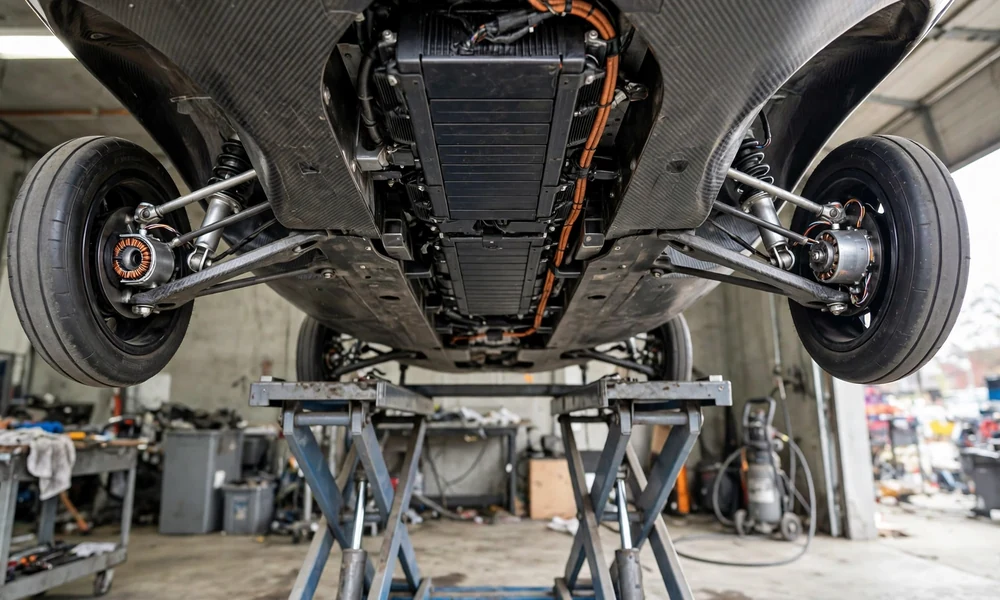
The motors in a solar car are usually mounted inside the wheels themselves, one in each rear wheel or one in each of all four. A wheel motor has no gearbox, no driveshaft, and no transmission losses at all: the electricity goes straight into the wheel. Each motor is small and light, but it makes enough torque to pull the car away from a standstill without any gearing, and it can also work in reverse, turning back into a generator when the car slows down and feeding energy back into the battery. Because there is no engine and no transmission tunnel, the cabin floor is flat and the car is eerily quiet, the only sound the soft rush of air over the body.
Step 4: Slipping through the air
A solar car lives or dies by aerodynamics, because the sun gives it so little power that every watt wasted on drag is a kilometre lost. The body is shaped like a teardrop, narrow at the back, with a completely smooth underside, covered wheel arches, and no mirrors sticking out into the wind. The drag coefficient is around 0.16, roughly half that of an ordinary car, which means the car needs half the energy to hold the same speed. Even the tyres are special, narrow and hard, with low rolling resistance, and the suspension is tuned for smoothness rather than sportiness. The result is a car that can cruise at highway speed on about as much power as a hair dryer uses, which is why the panels on the roof can keep up with it at all.
Step 5: The cabin and the computer that runs it all
Inside, a luxury solar car is spare but comfortable, with leather seats, a single wide screen, and almost no buttons. The screen shows the driver what matters: how much power the panels are making, how much the motors are using, and how far the battery will go. A central computer balances the three, deciding when to draw from the battery and when to let the panels carry the load, and it plans the route around the sun, suggesting when to stop and charge in the shade and when to keep driving. The cabin is cooled by a small heat pump rather than a conventional air conditioner, because every watt counts when the fuel comes from the sky.
Step 6: Driving on sunshine, day after day
On the road, a solar car behaves like a quiet, smooth electric car with one difference: the range gauge goes up as well as down. Park it in the sun while its owner has lunch, and it gains range. Drive it on a bright day, and the panels cover part of the energy the motors use, stretching the battery further than the gauge first promised. At night it is simply an electric car, plugged in like any other, and on a cloudy week it needs the plug more than the sun. But on a sunny day in summer, a luxury solar car can drive for hundreds of kilometres without ever visiting a charger, and that is the idea that keeps its builders going: a car that refuels itself, wherever the sun shines.

Specifications
| Feature | Typical luxury solar car |
|---|---|
| Solar array | 5 to 6 square metres, 1 to 2 kW peak |
| Battery capacity | 50 to 70 kWh |
| Range | 600 to 800 km, sun-assisted |
| Top speed | 160 to 180 km per hour |
| Drag coefficient | About 0.16 |
| Motors | Two or four in-wheel motors |
| Weight | 1,100 to 1,400 kg |
How Much Does a Luxury Solar Car Cost?
A luxury solar car typically costs an estimated $200,000 to $350,000, depending on the size of the solar array, the battery, and the level of finish. There is no mass-market price, because almost no solar cars are built in volume; each one is effectively a hand-built prototype, and the cost reflects the bespoke panels, the carbon fibre body, and the years of engineering behind it. The estimate covers the car itself, and running costs are almost nothing, since the sun is free and the drivetrain has almost no parts to wear out. For now it is a car for enthusiasts and collectors, but its builders believe the price will fall as the panels get cheaper.
A Rare Fact
The first solar car was built in 1955, and it was the size of a toy, a fifteen-inch model that ran on a tiny panel. The solar car of today is the same idea grown up, a full-size machine that crosses deserts on sunlight alone, and the World Solar Challenge in Australia has seen them drive 3,000 kilometres across the outback without a drop of fuel. A luxury electric car plugs in to charge, while the solar car charges itself, and the luxury autonomous car that shares its roads uses the same in-wheel motors and the same silent running, only it lets a computer do the driving too.


