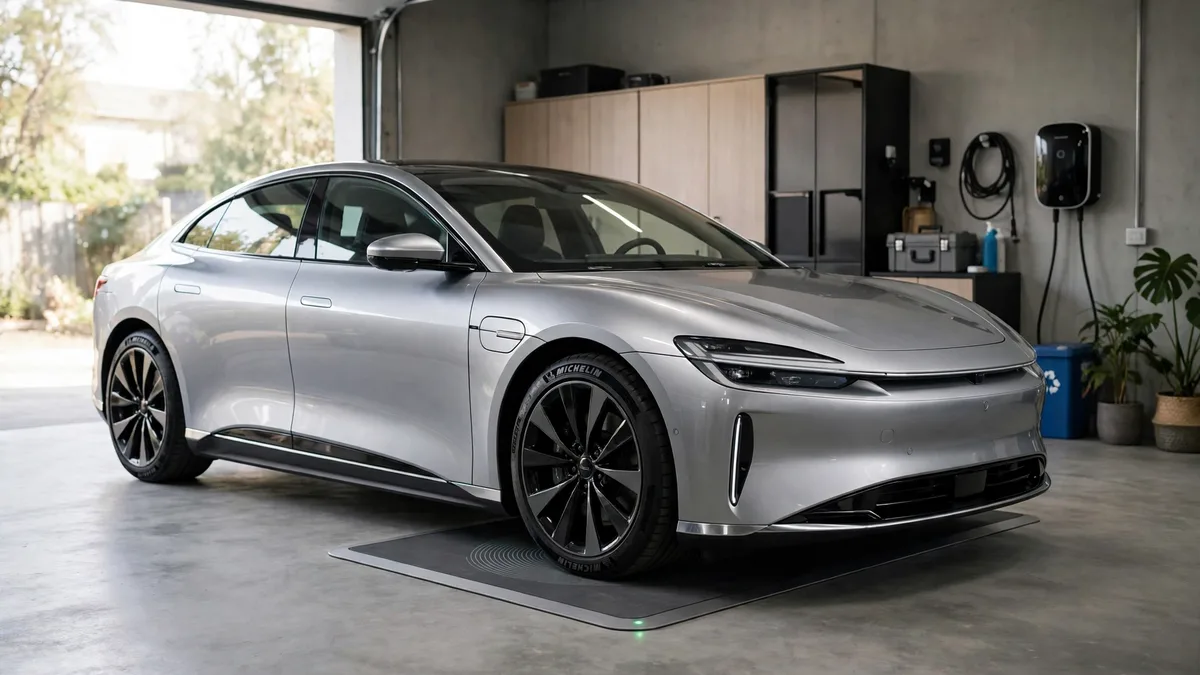
You pull into your garage, park over a flat pad on the floor, and walk away. Nothing plugs in, nothing clicks, nothing needs remembering. By morning, your car is charged. That is the promise of wireless EV charging: parking becomes charging, with no cable to handle in the rain and no connector to wear out. It sounds simple, and for a phone it is. For a car that needs tens of kilowatt-hours, it is one of the hardest and most expensive things in the electric vehicle world.
Wireless charging works by induction. A coil buried in the ground creates a magnetic field, and a coil under the car turns that field back into electricity. The physics is well understood, and it has been used in phones and toothbrushes for years. Scaling it up to a two-tonne car, across a gap of air, with enough power to charge a large battery in a reasonable time, is where the cost explodes. This is why wireless EV charging is so expensive, and why, for now, it remains a rarity.
Why It Costs So Much
1. Power on a completely different scale
A phone wireless charger delivers around 15 watts. A useful EV wireless charger must deliver 7 to 22 kilowatts, roughly a thousand times more, and the fastest systems aim higher still. Moving that much power through the air without a wire means large copper coils, heavy ferrite cores to shape the magnetic field, and power electronics that can switch thousands of watts cleanly. The components are bigger, hotter and more expensive than anything in a phone charger, and they must be built to automotive standards, which means surviving vibration, water, salt and a decade of daily use.
2. The air gap is the enemy
The coil in the ground and the coil under the car are separated by 10 to 20 centimetres of air, plus the thickness of the floor pad and the car’s underbody. Air is a poor conductor of magnetic fields, so much of the energy is lost unless the coils are precisely aligned and carefully tuned. Engineers use resonant circuits, ferrite shielding and active alignment systems to recover efficiency, and each of those adds cost. A car parked a few centimetres off-centre can lose a noticeable share of its charging power, so some systems add guidance cameras or sensors to help the driver park exactly right.
3. Heat, and getting rid of it
Even at 90 percent efficiency, a 22-kilowatt charger wastes more than 2 kilowatts as heat, enough to warm a small room. That heat builds up in the ground pad, which is sealed against weather, and in the receiver under the car, which sits close to the battery. Both need cooling, and cooling a sealed outdoor unit means heat pipes, aluminium spreaders or liquid loops, all of which add weight, complexity and cost. Without proper cooling, the electronics age quickly and efficiency falls further, so thermal design is not optional.
4. Digging up the ground to install it
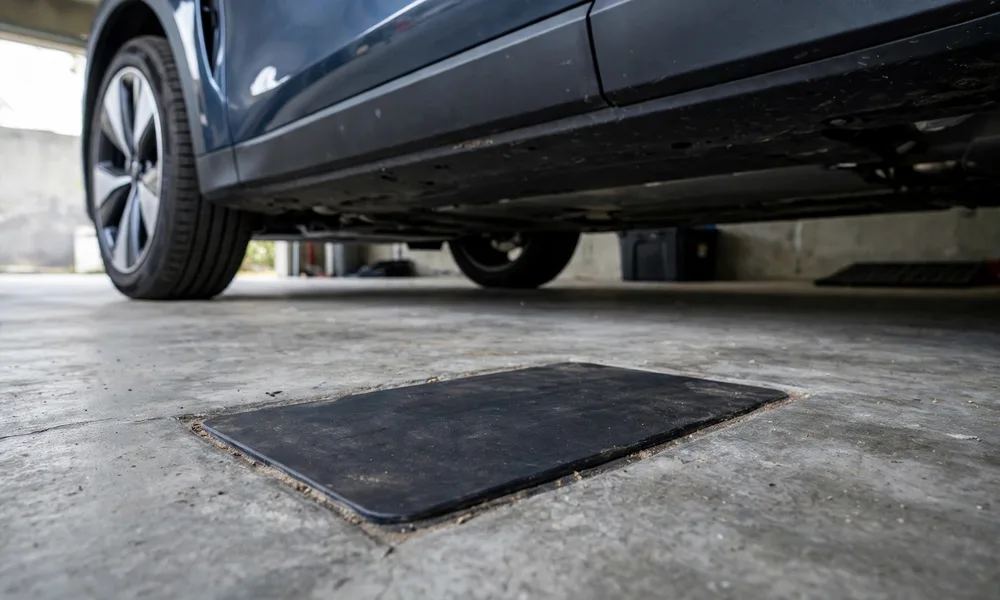
A wired charger is a box on a wall with a cable. A wireless charger is a civil engineering project. The ground pad must be set into a garage floor, a driveway or a road, levelled precisely, sealed against water, and wired to a high-power supply. In a public car park or a taxi rank, that means cutting concrete, laying ducts and resurfacing, work that can cost more than the charger itself. The receiver also has to be fitted to the car at the factory or by a specialist, because it sits under the floor and connects to the high-voltage battery. Installation, not the hardware alone, is often the largest single cost.
5. Safety, shielding and standards
A wireless charger creates a strong magnetic field in a place where people, pets and metal objects pass every day. It must detect foreign objects, a coin or a tool dropped on the pad, and shut down before they heat up. It must also shield the field so it does not interfere with pacemakers, phones or the car’s own electronics, and it must meet strict electromagnetic exposure limits. Meeting those rules means extra sensors, shielding and certification testing, and the standards themselves are still settling, so manufacturers must design for rules that may change. All of that testing and compliance is priced into every unit.
6. Almost nobody makes them at scale
Wireless EV charging is still a niche market, with only a few suppliers and small production runs. There are no economies of scale like those that have driven down the price of wired chargers and batteries. Each system is close to bespoke, with its own coil design, electronics and software, and buyers are often fleets, luxury car makers or pilot projects rather than ordinary drivers. Until volumes rise into the hundreds of thousands, prices will stay high, and until prices fall, volumes will stay low. It is the classic chicken-and-egg problem of a new technology.
Specifications
| Specification | Detail |
|---|---|
| Typical home power | 7 to 11 kilowatts |
| Typical public power | 11 to 22 kilowatts |
| Air gap | Approximately 10 to 20 centimetres |
| Efficiency | Typically 85 to 93 percent, below wired charging |
| Frequency | Around 85 kilohertz for automotive systems |
| Ground pad weight | Often 20 to 50 kilograms including housing |
| Foreign object detection | Required by safety standards |
| Alignment tolerance | A few centimetres before efficiency drops sharply |
Price
Wireless EV charging remains expensive, and prices vary widely because most systems are sold as pilot or fleet installations rather than retail products (estimate). A home wireless charging system, including the ground pad, the vehicle receiver and installation, has been quoted at several thousand dollars, often two to three times the cost of a comparable wired home charger. Public and fleet installations cost far more once ground works are included. Prices are expected to fall as volumes grow, but for now wireless charging is a premium option, chosen for convenience rather than value.

Rare Fact
The first wireless EV charging trials were not for cars at all in the modern sense but for buses, which follow fixed routes and park in the same place every night. A bus can charge a little at every stop if pads are buried in the road, a technique called opportunity charging, and it can run all day on a smaller battery. The idea is now being tested for taxis and delivery vans, where the vehicle returns to the same spot again and again.
Wireless charging is expensive today because it asks a simple idea, parking as charging, to work at a scale the physics makes difficult. The coils, the cooling, the ground works and the safety systems all add up, and small production runs keep the price high. But the convenience is real, and for fleets and drivers who charge every day, the day it becomes affordable may be the day the cable finally disappears.
The battery it charges is built as described in how an EV battery pack is made, the power it delivers passes through the device in how an EV inverter works, and the next generation of batteries it may one day serve is covered in how a solid-state battery is made.


