On the floor of a rocket factory, two aluminium panels the size of doors lie clamped to a steel table, edge to edge, with barely a paper-thin gap between them. A machine lowers a spinning steel tool onto the joint. There is no flash, no sparks, no shower of molten metal. There is only a low hum, a curl of fine shavings, and a smooth line forming behind the tool. When it lifts away, the two panels are one piece.
That is friction stir welding, a way of joining metal without ever melting it. The spinning tool rubs the metal so hard that it softens like warm clay, and the two sides are stirred together into a joint often stronger than the metal around it. It holds together rocket fuel tanks, aircraft wings, train bodies and ship hulls. But the machine costs a fortune, the tools wear out fast, and very few workshops can do it at all, which is why a weld you can barely see can cost more than the panels it joins.

Why Friction Stir Welding Costs So Much
The cost is not in the metal or the electricity. It is in the machine, the tool, the setup and the skill.
1. The machine is a giant built for force
Friction stir welding needs enormous downward pressure, several tonnes of it, to push the spinning tool into solid metal and keep it there. That means a machine built like a press, with a frame stiff enough not to bend, motors strong enough to spin the tool against solid aluminium, and controls precise enough to hold depth to a fraction of a millimetre. A full-size machine can cost well over a million dollars. The joint is solid-state, and the materials behind friction stir welding explain why the metal never needs to melt.
2. The tool wears out, and it is not cheap
The welding tool is a short steel pin with a flat shoulder, and it takes a brutal beating. It spins at hundreds of revolutions per minute while pressed into metal hot enough to soften, and it slowly wears down, losing the shape that makes the weld work. For steel and titanium they must be made from exotic materials like tungsten alloys, and a single one can cost thousands of dollars.
3. Setup takes longer than the weld
Before the machine starts, the two panels must be clamped perfectly flat and aligned, with no gap and no step between them. A gap of even a fraction of a millimetre can ruin the weld. The clamps, the backing plate and the fixtures are custom-made for each job, and setting them up can take hours for a weld that takes minutes.
4. Only a few people can run it well
Friction stir welding looks automatic, but the operator chooses the spin speed, the travel speed and the pressure, and those three numbers decide whether the joint is perfect or full of hidden flaws. Get them wrong and the weld has tunnels or voids inside that no eye can see. Aerospace work demands certified welders whose every weld is recorded and checked. Ordinary arc welding is far more forgiving, and the materials behind steel welding show how different that older craft is.
5. It only works on some metals, and only in some shapes
The process shines on aluminium, which softens neatly under friction, but it struggles with metals that are too hard, too brittle or too thin. It works best on straight lines and gentle curves, not on corners, pipes or complex shapes. That means every part must be designed around the weld from the start, and parts the machine cannot reach must be joined another way.
6. Inspection is slow and expensive
Because the weld looks smooth and clean on the surface, hidden defects can only be found with ultrasound, X-ray or by cutting test pieces apart. Aerospace customers demand full inspection of every weld, and a single failed test can mean starting again. Inspection often costs as much as the welding itself, and it is why a friction stir weld carries a price a normal weld never could.

How Friction Stir Welding Works
1: Clamp the panels
The two panels are clamped edge to edge on a steel backing plate, held flat and tight so they cannot move or lift.
2: Lower the spinning tool
The tool spins up to speed and plunges into the joint, its shoulder pressing the surface while the pin digs down between the panels.
3: Heat by friction
The spinning tool rubs the metal until it softens to a warm, clay-like state. The metal never melts, so the joint keeps its strength.
4: Stir the joint
The tool travels along the seam, stirring the softened metal from both sides into one solid mass behind it, like kneading dough.
5: Finish the run
At the end of the seam the tool lifts out, leaving a small exit hole where the pin was. The hole is filled later.
6: Inspect the weld
The finished joint is checked by ultrasound or X-ray for hidden voids, then trimmed and cleared for service.
Friction Stir Welding at a Glance
| Part | What it is | Why it matters |
|---|---|---|
| Welding machine | Heavy gantry built for force | Pushes the tool into solid metal |
| Welding tool | Steel pin with a flat shoulder | Stirs the softened metal together |
| Clamps and fixture | Custom holders for each job | Keep panels flat and gap-free |
| Backing plate | Steel plate under the joint | Supports the metal under pressure |
| Control system | Sets speed, depth and force | Holds the weld to a hair’s width |
| Inspection | Ultrasound and X-ray checks | Finds hidden flaws inside the weld |
What Does Friction Stir Welding Cost?
The price depends on the machine, the metal and how much inspection is required, and the figures below are estimates. A small friction stir welding job on aluminium panels is estimated at roughly $2,000 to $10,000, while a full-size machine for aerospace work is estimated at $1 million to $5 million or more. A single specialist welding tool is estimated at $500 to $5,000, and it may last only a few dozen welds. That is why a weld with no sparks can cost many times more than a conventional weld, and why the materials behind electron beam welding tell a similar story of rare machines and rare skill.
A Rare Fact
Friction stir welding was invented in 1991 at The Welding Institute in Britain, by a team trying to join aluminium without the flaws that melting causes. Within a few years it was welding the fuel tanks of the Space Shuttle, and today it joins the core stage of NASA’s Space Launch System rocket. The welds on that rocket are over sixty metres long, made by a machine the size of a building, and they must hold liquid hydrogen at two hundred and fifty degrees below zero. A single bad weld could end a mission.
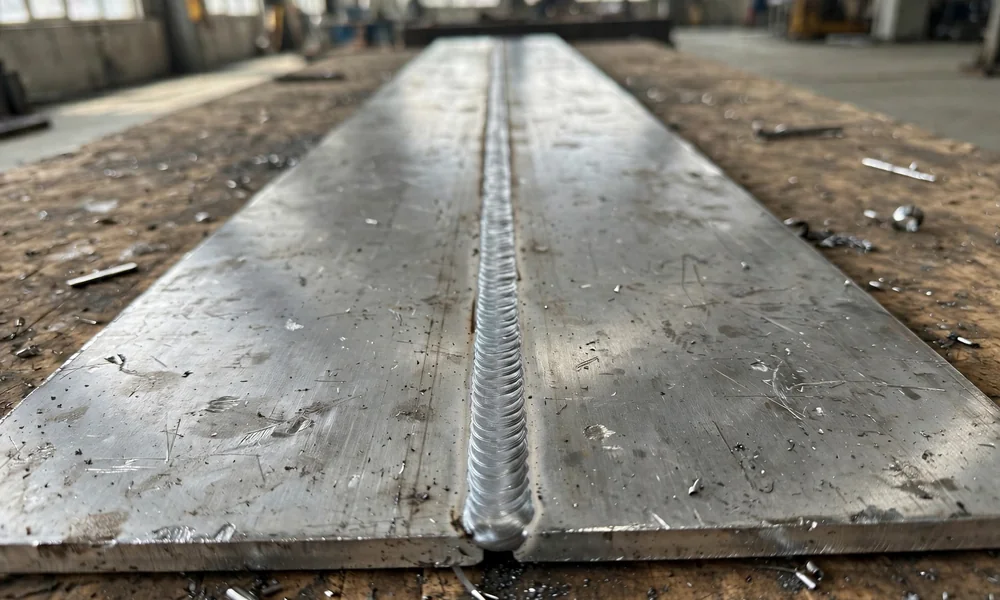
Friction stir welding looks like the simplest weld in the world: no flame, no sparks, no filler, just a spinning tool and a quiet hum. But behind that calm is a machine built to press with tonnes of force, a tool that wears out in dozens of welds, hours of setup for minutes of welding, and inspection that can condemn the result. That is why a joint you can barely see costs more than the metal it joins.