In a shipyard in northern Europe, a welder once watched two aluminium plates come together without a spark, a flame or a single drop of molten metal. A steel tool spun between them, the metal softened like warm clay, and when the tool moved on, the two plates had become one.
That is the quiet strangeness of friction stir welding. It joins metal without melting it, and the trick depends entirely on the materials involved: the plates being joined, the tool doing the stirring, and the backing plate underneath. Get those three right and the weld can be stronger than a conventional weld in the same metal. Get one wrong and the joint cracks, the tool snaps, or the plates simply refuse to stick.
Invented in 1991, the process spread first through aluminium — into aircraft wings, train carriages, ship panels and rocket fuel tanks. Its closest relatives here are the friction stir welding production line and electron beam welding, which joins metal in a vacuum where a deep, narrow weld is needed instead.

Aluminium: The Metal That Made the Process Famous
Aluminium is the metal friction stir welding was made for. It is light, strong for its weight, and it resists corrosion, which is why it fills aircraft, ships and trains. But aluminium is a difficult metal to weld in the ordinary way: melted with an arc, it soaks up hydrogen and leaves tiny pores in the weld, and it cracks as it cools, because it shrinks a great deal. The 2000 and 7000 series aircraft alloys were long considered unweldable by fusion methods at all.
Friction stir welding sidesteps all of that by never melting the metal. The tool heats aluminium to roughly 400 to 500 degrees Celsius, well below its melting point of about 660 degrees, and stirs it while it is soft. The most common alloys joined this way are 6061 and 6082, the workhorses of general engineering, and 7075, the high-strength alloy of aircraft wings. In 6061, a good friction stir weld reaches 70 to 95 per cent of the parent metal’s tensile strength.
The Tool: Steel That Must Not Soften
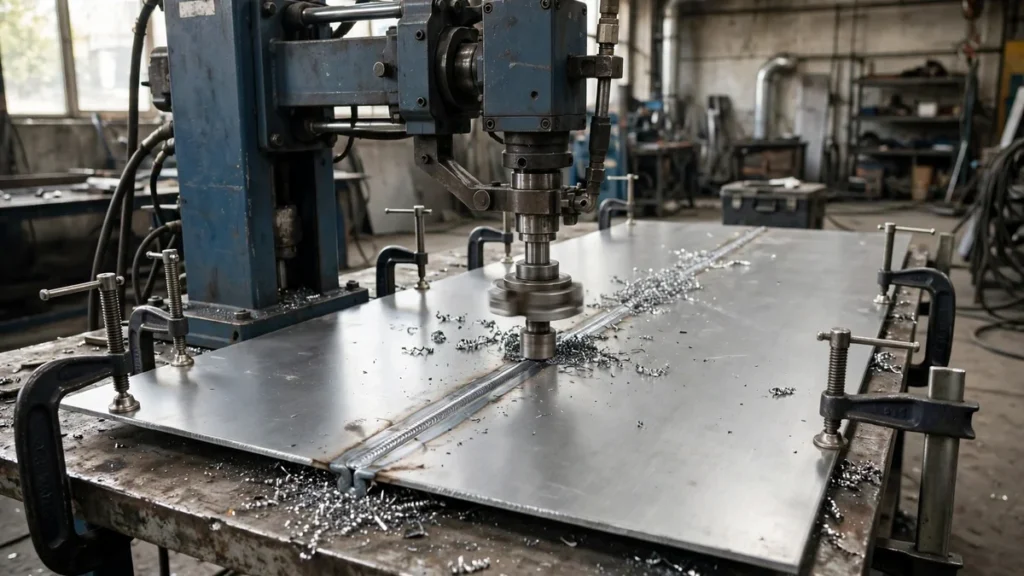
The tool is the most demanding piece of material in the whole process. It has a wide flat shoulder and a short pin, and it must stay hard and strong while spinning at up to 2,000 revolutions per minute inside metal heated to hundreds of degrees. For aluminium, the tool is usually made from hardened H13 tool steel, which is tough, cheap enough to replace, and holds its shape at the temperatures aluminium needs. The shoulder, typically 10 to 30 millimetres across, makes most of the heat, while the pin stirs the softened metal through the full depth of the joint.
Harder metals need harder tools. Joining steel or titanium pushes the weld temperature past 900 degrees, and ordinary tool steel would soften and wear away in minutes. For those jobs the tool is made from tungsten-based alloys, or from polycrystalline cubic boron nitride, a material second only to diamond in hardness. These tools cost many times more than a steel one and can be brittle, so a single careless plunge can shatter a tool worth thousands of dollars.

How a Friction Stir Weld Is Made
- The plates are cut, cleaned and clamped tight against a steel backing plate, which supports the joint and draws away excess heat.
- The rotating tool plunges into the seam, its pin sinking through almost the full thickness while the shoulder presses on the surface.
- Friction between the shoulder and the plates heats the metal to roughly 400 to 500 degrees Celsius for aluminium, softening it without melting.
- The tool travels along the joint at 100 to 500 millimetres per minute, and the pin stirs the softened metal from one side of the seam to the other.
- Behind the pin, the stirred metal cools and consolidates under the shoulder’s pressure, forming a solid weld with a fine, forged grain structure.
- The tool is lifted out or run off onto a scrap tab, the clamps are released, and the joint is inspected — usually by ultrasound — for voids.
When the Materials Fail
Failure in a friction stir weld usually starts with the wrong material in the wrong place. If the plates are different alloys, or one is much harder than the other, the softer metal can smear while the harder one barely stirs, leaving a weak, uneven seam. A worn tool is another quiet killer: as the pin shortens, it no longer stirs the full depth, and a thin unbonded line — engineers call it a kissing bond — hides inside the joint, ready to split under load. Contamination is just as dangerous: a film of oil or oxide on the plates gets stirred into the weld, so the metal must be cleaned first.
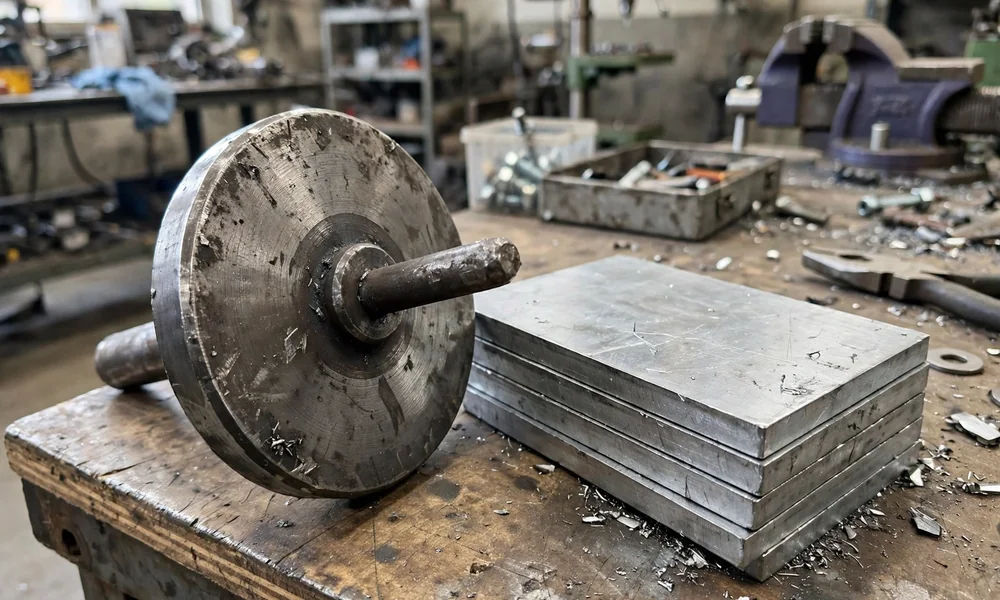
The backing anvil matters more than it looks. Too soft, and it lets the plates flex, so the weld thins and tears. Too good a heat sink, and it chills the weld before the metal has stirred properly. The worst failure is the simplest: the tool itself breaking. A pin snapped inside a plate leaves a steel fragment buried in the weld, and the whole part is usually scrapped.
Friction Stir Welding Materials
| Material | Where it is used | Why engineers chose it |
|---|---|---|
| Aluminium 6061 / 6082 | Ship panels, train bodies, fuel tanks | Light, weldable when stirred, 70 to 95 per cent joint efficiency |
| Aluminium 7075 | Aircraft wings and structures | Very high strength; fusion welding cracks it, stirring does not |
| Copper alloys | Electrical parts, heat exchangers | Stirring beats copper’s high heat conductivity |
| Magnesium alloys | Aerospace housings | Lightest structural metal; needs careful heat control |
| H13 tool steel | Welding tools for aluminium | Tough, holds its shape at 500 °C, cheap to replace |
| Tungsten alloy / boron nitride | Welding tools for steel and titanium | Stays hard past 900 °C; costly and brittle |
| Steel backing anvil | Support under the joint | Supports the plates and controls heat flow |
What Does Friction Stir Welding Cost?
The materials are not the expensive part — the machine is. A small friction stir welding machine is estimated to cost roughly $50,000 to $150,000, a production gantry system is estimated at $500,000 to $2 million, and the giant machines that weld rocket tanks cost several million dollars; all of these are estimates, and every installation is bespoke. Running costs are low: no filler wire, no shielding gas, and little grinding or rework. A steel tool for aluminium work costs relatively little, while a boron nitride tool for steel can cost thousands of dollars.
A Rare Fact
Friction stir welding was invented in 1991 by Wayne Thomas at The Welding Institute in Cambridge, England — and its first great success was in space. NASA adopted the process for the Space Shuttle’s external fuel tank, because friction stir welds were stronger and more reliable than the fusion welds they replaced. The tanks that carried rockets into orbit were held together by a weld that never melted the metal at all.
Friction stir welding looks like a small idea — a spinning tool, a seam, no flame — but it changed what engineers expect from a weld. The secret is not the machine. It is the match between the metal, the tool and the temperature: aluminium soft enough to stir, a tool hard enough to survive, and a joint that never has to melt. It is a very different bargain from steel welding, where the arc, the filler and the gas are all consumables.