Your phone buzzes once, a short soft tap against your palm, and you know a message has arrived without ever looking at the screen. Type on its keyboard and each key answers with a tiny click you can feel more than hear. That feeling is not an accident. It is made by a motor smaller than a coin, hidden deep inside the phone, spinning and stopping in a fraction of a second to fool your fingertips into feeling a button that is not there.
That tiny motor is one of the most expensive small parts in a phone, and the reason is not the metal in it. It is the precision. A haptic motor must start and stop in milliseconds, run silently, survive years of drops, and do it all in a space thinner than a pencil. Building something that small, that fast and that reliable takes rare materials, careful handwork and testing that never stops.
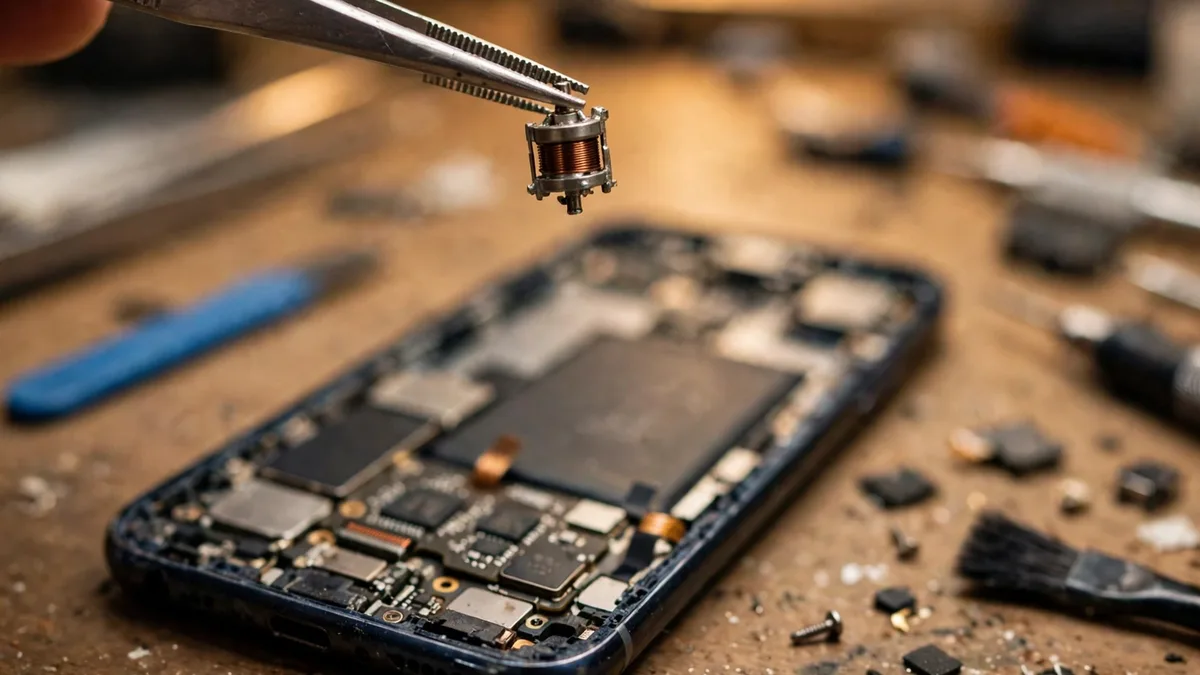
Why It Costs So Much
Reason 1: It is smaller than a coin and must be perfect
A modern haptic motor is a marvel of miniaturisation. The best ones are linear motors: a small mass suspended on springs inside a metal case, driven back and forth by a magnetic field instead of spinning around. The whole device is only a few millimetres thick, yet it must produce a sharp, clean tap that your skin can feel through glass and metal. Every part inside it is machined to tolerances measured in micrometres, because a spring a fraction too stiff or a magnet a fraction too weak changes the feeling completely.
Reason 2: The magnets are rare and costly
Inside the motor sits a magnet far stronger than its size suggests, and that strength comes from rare-earth metals such as neodymium. These metals are mined in only a few places in the world, refined through a long chemical process, and then shaped into magnets the size of a grain of rice. A haptic motor needs a magnet that is powerful, stable at high temperatures and consistent from one motor to the next, and only a handful of suppliers can make them to that standard. The copper coils are wound from wire thinner than a hair, and the springs are cut from special steel that can flex millions of times without weakening. The precision engineering behind tiny phone parts is laid out in the wireless earbuds driver specifications, where the same obsession with small, exact parts drives the price.
Reason 3: Handwork at a scale machines struggle with
Much of a haptic motor is assembled by hand, or by machines guided by people watching through microscopes. The coil must be wound evenly, the magnet glued in exactly the right place, and the springs fitted without bending them, because a bent spring makes the motor buzz instead of tap. Workers who do this job train for months, and even then a share of the motors fail their first test and are taken apart again. The labour is slow and skilled, and it cannot be rushed.

Reason 4: It must be silent, fast and tough
A haptic motor lives a hard life. It is shaken every time the phone is dropped, baked in a hot car, frozen on a winter morning, and run thousands of times a day. It must start in a few milliseconds and stop just as fast, because a tap that lingers feels mushy and a tap that arrives late feels broken. Engineers tune the motor the way a piano tuner tunes a string, adjusting the springs and the drive signal until the feeling is exactly right for that phone. Then the motor is tested for millions of cycles, far more than any owner will ever use. Small motors face the same testing burden across gadgets, as the drone motor specifications show for the motors that keep drones in the air.
Reason 5: It is tuned for one phone only
Unlike a screw or a battery, a haptic motor is rarely a standard part. Each phone maker designs the feeling it wants, then orders a motor built to match the weight, the shape and the frame of that one phone. The motor, the software that drives it and the metal frame it sits in are tuned together, like an instrument and its case. That means small production runs, custom tooling and a design process that starts over with every new model.
Reason 6: The feeling is the product
The last reason is about what the motor sells. A phone with a crisp, convincing tap feels expensive in the hand, and a phone with a rattly buzz feels cheap, even if the screens are identical. Phone makers know this, and they pay for the better motor because the feeling is one of the first things a buyer notices. It is the same logic that makes a good display worth paying for, and the display that shares the phone with this motor is covered in the OLED display panel specifications.

Haptic Motor at a Glance
| Specification | Detail |
|---|---|
| Motor type | Linear resonant actuator in premium phones |
| Size | Around 10 to 20 millimetres across, a few millimetres thick |
| Key materials | Neodymium magnet, copper coil, spring steel |
| Response time | A few milliseconds to start and stop |
| Durability | Tested for millions of vibration cycles |
| Assembly | Hand-finished under microscopes in cleanrooms |
| Main uses | Phones, watches, game controllers, wearables |
| Main advantage | Sharp, silent, precise touch feedback |
| Main drawback | Expensive, custom-tuned, hard to repair |
What Does It Cost?
| Cost item | Estimate |
|---|---|
| Premium linear haptic motor | Around $8 to $15 (estimate) |
| Basic spinning vibration motor | Around $1 to $2 (estimate) |
| Rare-earth magnet and coil | Around $2 to $4 (estimate) |
| Hand assembly and testing | Around $2 to $4 (estimate) |
| Custom tuning for one phone model | Around $1 to $3 (estimate) |
| Replacement motor repair | Around $40 to $90 (estimate) |
All figures above are estimates, not quotes, and the real number depends on the size, the supplier and the phone it goes into. A premium linear motor can cost five to ten times as much as the simple spinning motor in a budget phone, and the custom tuning adds more. The difference is one you can feel in a second: the cheap motor rattles, the expensive one taps.
A Rare Fact
The first mobile phones used a spinning motor with a lopsided weight, the same trick that makes a washing machine shake, and the buzz it made was loud enough to hear across a room. Engineers spent years replacing that crude shaker with a motor that moves in a straight line and stops dead, so the tap feels like a real button instead of a tremor. The best haptic motors today are so precise that they can mimic the click of a camera shutter, and your brain believes it completely.
A haptic motor is a tiny machine doing a delicate job: a magnet the size of a grain of rice, a coil of hair-thin wire and springs tuned like a piano string, all working to make glass feel like a button. It costs so much because it is built by hand at a microscopic scale, from rare materials, tuned for one phone alone, and tested for millions of taps.