There is a particular kind of photograph that dominates private aviation: a long, gleaming jet on a wide runway at a major airport, stairs down, crew waiting, the whole scene arranged to say that bigger is better. It is a persuasive image, and it is mostly wrong about what makes a private jet useful.
A private jet earns its keep not by being impressive on a runway but by getting a small group of people to the right place at the right time with the least fuss. It costs less to buy and to run, it can use far more airfields, it is quicker to turn around, and it asks less of the sky and the ground beneath it.
This is the case for smaller private jets: not a compromise for people who cannot afford a bigger one, but the better tool for most of the flying that private jets actually do.
More Airfields, Closer to Home
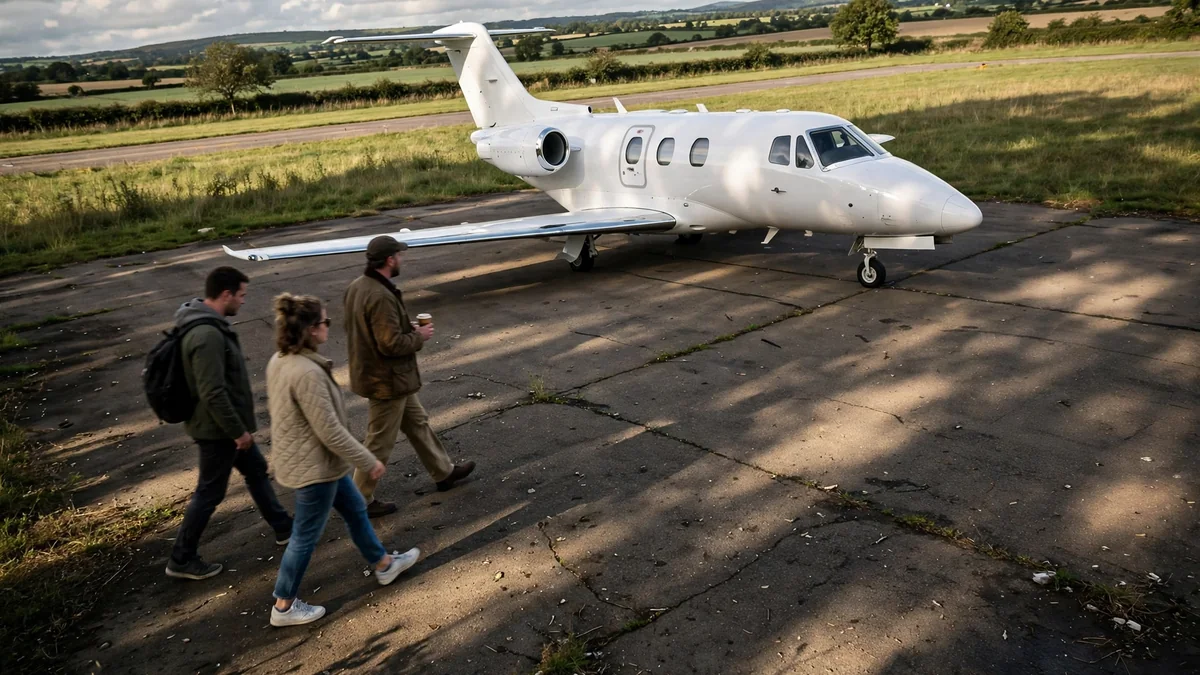
The first advantage is the simplest to picture. A large business jet needs a long runway, a wide apron, and a major airport with the services to match. That means it lands where the big airports are, and the traveller then drives the last stretch, sometimes for hours, to reach the town, the factory, the coast, or the hills where they actually need to be.
A smaller jet can use a shorter runway, which opens up far more airfields that a larger jet could never touch. Those airfields sit closer to the places people are travelling to: the regional town, the island strip, the airfield beside the industrial estate.
A team visiting a supplier, a family heading to a remote house, a doctor flying to a rural clinic: all of them gain more from landing near their destination than from flying in a bigger cabin to a bigger airport further away.
A Smaller Bill Every Time You Fly
The second argument is money, and it is the one the big-jet photograph never mentions. A smaller jet burns less fuel on a trip, needs a smaller crew, and costs less to park, to insure, and to maintain. A lighter aircraft with smaller engines simply asks for less of everything, and the saving repeats on every single flight, not just on the day it is bought.
That matters because most private flights are short, with only a few people aboard. Flying a large jet with a dozen empty seats on a one-hour hop is like hiring a coach to take three people to the next town: the seats are comfortable, but the waste is obvious. A smaller jet matches the aeroplane to the trip, and the trip is usually small.
Aircraft costs are driven by what is built into them, and the forces that push the price of a new aircraft up are the same forces that keep a smaller, simpler jet within reach — a point made clear by looking at why electric aircraft are so expensive.
The Cabin Is the Point, Not the Size
The usual objection to a smaller jet is the cabin: less room to stand, fewer seats, less space to spread out. It is a fair objection, and it is also less important than it sounds. A private jet cabin is not an office or a living room. It is a place to sit for an hour or two, work a little, talk, and look out of the window.
What matters in a cabin is not how many seats it holds but how well the ones it has are made: the shape of the seat, the light from the windows, the quiet, the feeling that the space was built for people rather than for a brochure. The craft that goes into a small cabin is the same craft that goes into a large one, and the details that make a cabin comfortable are matters of care, not of size, as a look inside how a private jet cabin is made shows.

Simpler Machines, Fewer Surprises
A smaller jet is also, in general, a simpler machine. Fewer systems, fewer parts under strain, and a design that has less to go wrong. That simplicity shows up in the day-to-day life of the aircraft: quicker pre-flight checks, shorter maintenance visits, and fewer occasions when a small fault grounds the aeroplane for days while a part is found.
Simplicity is not the same as crudeness. A small jet still carries sophisticated engines, careful aerodynamics, and the same safety thinking as any other aircraft. The point is that the engineering is concentrated on what the aeroplane must do — fly safely, efficiently, and reliably — rather than on the extras that a larger aircraft carries to justify its size. The care that goes into building a jet engine is the same whether the engine is large or small, and a smaller engine built to the same standard is no less an achievement, as how a private jet engine is made shows.
A Lighter Footprint
There is also the question of what the aeroplane leaves behind. A smaller jet burns less fuel, makes less noise on departure, and needs less concrete beneath it. None of that makes private flying harmless — it remains a demanding way to travel — but the difference between a small jet and a large one is real, and it is the difference between using as much as the trip needs and using far more.
If private aviation is to keep its place in a world that is watching every tonne of fuel, it will have to show that it can be proportionate. The small jet is the honest version of that argument: a machine sized to its job, flown when it is the right tool, and no bigger than it needs to be.
The Counter-Case, Honestly
The case against smaller jets is real, and it should be stated plainly. A small jet cannot fly as far without stopping, cannot carry as many people, and cannot offer the standing room and the beds that a large cabin provides on a long overnight flight. In rough weather it can feel the bumps more, and on a long journey the smaller cabin can feel, well, smaller.
For a handful of trips — a long ocean crossing with a full party, a journey that genuinely needs a bedroom in the sky — the larger jet is the right answer, and pretending otherwise would be dishonest. But most private flights are not those trips. They are short hops with a few people, and for those flights the large jet’s advantages are mostly unused while its costs are paid in full.

The Verdict
The private jet industry has spent years selling size as the measure of success, as if the best aeroplane were simply the biggest one a buyer could afford. That is the logic of a showroom, not of a journey. The best private jet for most flying is the one that lands closest to where you need to be, costs least to run, and wastes least on the way.
That jet is usually the smaller one. It is not a lesser choice or a stepping stone to something bigger. It is the right-sized answer to the question private aviation exists to answer: how do a few people get to a particular place, quickly and with the least fuss? For most trips, the small jet already has the answer — and the industry should stop apologising for it.


