A hypercar crosses the start line at full throttle, its engine screaming past 8,000 rpm, its turbos glowing orange in the dark. In less than a minute it has turned enough fuel into heat to warm a house, and almost all of that heat has to go somewhere, right now, or the engine destroys itself. The car does not slow down. It does not stop. It keeps accelerating, lap after lap, while a cooling system the size of a small wardrobe works invisibly to keep it alive. That system is one of the most expensive parts of the car, and most owners will never see it.
Cooling a hypercar is not a bigger version of cooling a family car. A family car makes perhaps 150 horsepower and spends most of its life cruising. A hypercar makes more than 1,000 horsepower and is expected to use all of it, repeatedly, on a track, in summer heat, without losing power. The radiators, pumps, pipes and ducts that make that possible are engineered like aircraft parts, built from exotic materials, and tested until they survive conditions no road car will ever meet.

Why It Costs So Much
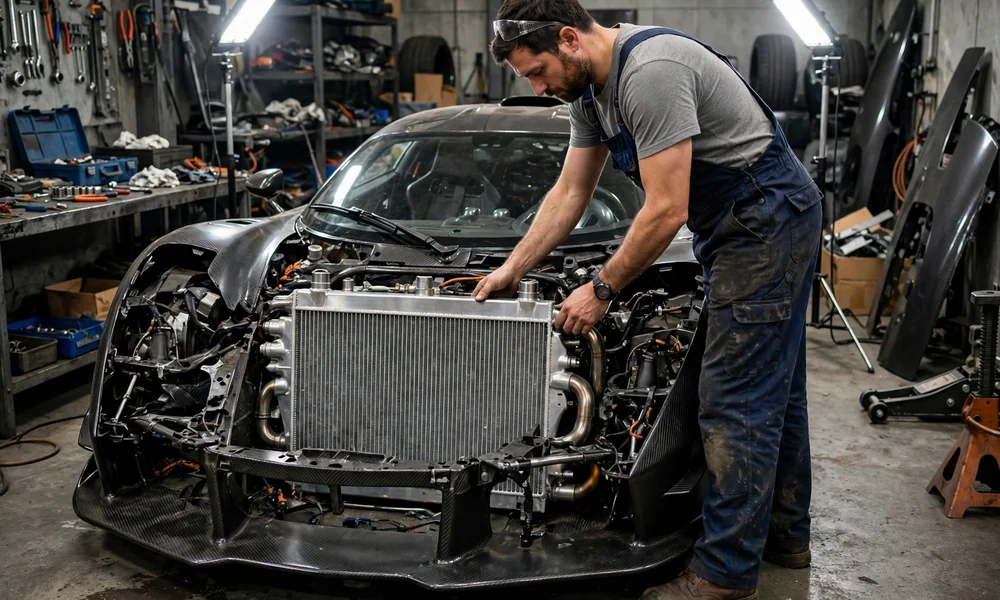
A hypercar cooling system looks like plumbing: radiators, hoses, pumps and fans. In reality it is a thermal management system that has to cool an engine, two turbochargers, a hybrid battery, electric motors, an oil system and a gearbox, all at different temperatures, all at the same time. The cost comes from the sheer amount of heat, the lack of space, and the materials needed to move that heat without adding weight.
Reason 1: The heat is enormous
A 1,000-horsepower engine turns roughly two-thirds of its fuel energy into heat, which means the cooling system must shed heat at a rate of more than a megawatt at full throttle. That is the heat output of a small power station, and it has to be removed through radiators that fit inside a car barely a metre tall. The radiators are therefore large, numerous and densely packed, often three or four of them, each one fed by its own duct.
Reason 2: Every part is made from exotic materials
Weight is the enemy, so steel pipes and brass radiators are out. Hypercar cooling systems use aluminium radiators with cores brazed in vacuum furnaces, titanium and carbon fibre pipes, and pumps machined from billet aluminium. The hoses are often silicone or PTFE, rated for temperatures and pressures that would destroy rubber. The same obsession with light, strong materials shapes the engine itself, where a hypercar V12 engine is built from alloys chosen gram by gram.
Reason 3: The air has to be managed like a wind tunnel
A radiator only works if air flows through it, and at 200 miles per hour the air around a hypercar is doing violent things. Engineers shape the whole body around the cooling system, carving ducts through the nose, the sills and the roof, and designing exits that pull hot air out without ruining the aerodynamics. Designing those ducts takes hundreds of hours in a wind tunnel and in computer simulation, and a duct that works at 100 miles per hour but stalls at 200 can cook an engine in seconds.
Reason 4: The hybrid battery needs its own cooling
Modern hypercars are hybrids, and their batteries hate heat even more than engines do. A battery that gets too hot loses power, ages quickly and, in the worst case, becomes a fire risk. So the cooling system must keep the battery in a narrow temperature band, often with its own liquid circuit, its own radiator and its own pump, completely separate from the engine’s circuit. Keeping a battery cool under track loads is a problem electric cars face too, where EV battery cooling decides how long a car can hold full power.
Reason 5: Everything must survive vibration, heat and crashes
A hypercar’s cooling system lives in the harshest place on the car: bolted to a shaking engine, baked by exhaust heat, and exposed to stones, kerbs and the occasional off-track excursion. Pipes are routed to survive a crash without spilling coolant onto hot turbos, radiators are mounted on flexible brackets that absorb vibration, and every joint is tested to pressures far beyond what it will ever see.
Reason 6: It is tested like an aircraft part
Before a hypercar is signed off, its cooling system is tested in climate chambers at desert temperatures, on dynamometers that simulate full-throttle laps, and on tracks in the hottest places the engineers can find. Prototypes run for thousands of kilometres with sensors in every pipe, and the data is used to redesign ducts, resize radiators and re-route hoses. The same testing culture governs the most powerful engines, where the Bugatti W16 engine needed a cooling system almost as complex as the engine itself.
Reason 7: It is built by hand, in tiny numbers
Hypercar production runs are measured in hundreds of cars, not hundreds of thousands, so there are no economies of scale. Radiators are brazed by hand, pipes are bent and welded one at a time, and the whole system is assembled by technicians who fit each car individually. A cooling system that takes a day to build on a hypercar takes minutes on a production line, and the labour cost alone is enormous. With so few cars to spread the development cost across, each one carries a large share of the wind tunnel time, the testing and the tooling.
Specifications
| Specification | Detail |
|---|---|
| Power to cool | Over 1,000 horsepower, shedding heat at more than a megawatt |
| Radiators | Typically 3 to 4, aluminium, vacuum-brazed cores |
| Circuits | Separate loops for engine, battery, motors, oil and gearbox |
| Pipe materials | Aluminium, titanium, carbon fibre, silicone and PTFE hoses |
| Air management | Ducted inlets, active flaps, aerodynamic exits |
| Battery cooling | Dedicated liquid circuit, narrow temperature band |
| Testing | Climate chambers, dynamometers and hot-weather track testing |
| Production | Hand-built, a few hundred cars per model |
Price
A hypercar cooling system is one of the most expensive assemblies on the car. A replacement radiator for a flagship hypercar can cost several thousand dollars (estimate), and a complete cooling system rebuild, including radiators, pumps, pipes and labour, can run into the tens of thousands of dollars (estimate). The aluminium itself is cheap; the price is in the vacuum brazing, the titanium pipework, the wind tunnel hours, the testing programme and the hand assembly, spread across only a few hundred cars.

Rare Fact
Some hypercars carry so much cooling hardware that their radiators hold more coolant than a family car’s entire cooling system, and the cars are designed so that the cooling ducts double as aerodynamic devices, shaping the airflow that keeps the car glued to the road.
That is the quiet extravagance hiding under a hypercar’s skin: a thermal management system that moves the heat of a small power station through a car barely a metre tall, built from titanium and carbon, tested in deserts, assembled by hand. It costs so much because there is no cheap way to keep a thousand horsepower cool when there is nowhere for the heat to go.


