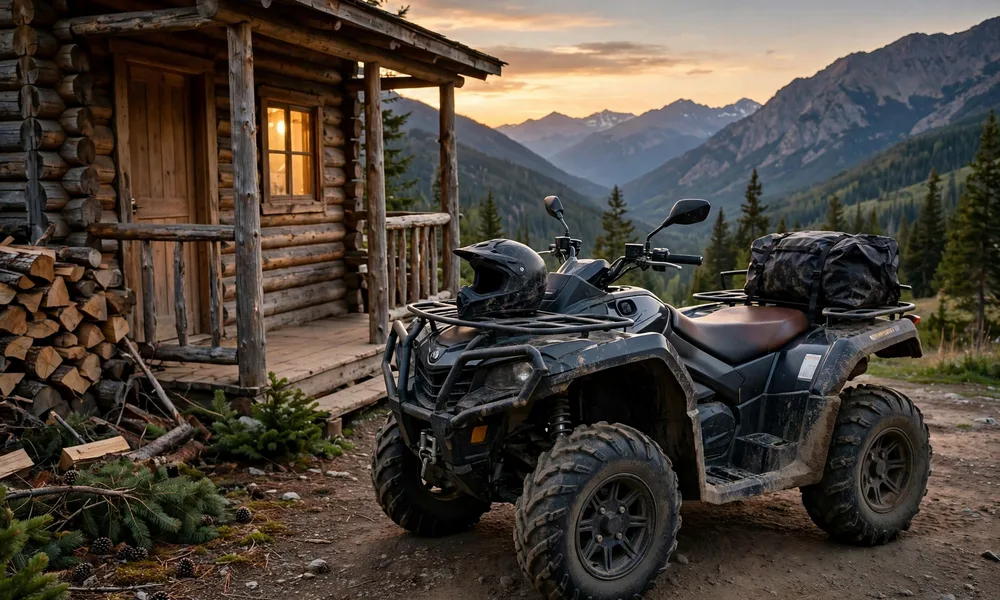
The trail is mud up to the axles, the hill ahead is steep enough to make a car turn back, and the machine at the bottom of it does not look expensive at all. It is caked in earth, its tyres are wide and knobbly, and there is a winch on the front and a rack on the back with a chainsaw strapped to it. Yet this muddy four-wheeler costs more than many new cars, and the reason is not the mud. A luxury ATV, an all-terrain vehicle built for people who want the toughest machine money can buy, is expensive because every part of it is built to survive a life that would destroy an ordinary vehicle, and then to do it again the next day, in comfort. The price is in the engineering, not the paint.

1. The engine: torque, not speed, and built to last
The first cost is the engine. A luxury ATV usually has a large single-cylinder or twin-cylinder four-stroke engine of 700 to 1,000 cubic centimetres, tuned for torque rather than top speed, because an ATV pulls hard from low revs up a steep hill, rather than racing down a road. The guide to how a luxury ATV works follows the same power from the throttle to the tyres. The engine is liquid-cooled, sealed against dust and water, and built with stronger internals than a normal small engine, because it spends its life at full throttle in heat, mud and dust.
2. Four-wheel drive and the drivetrain: power to every wheel
An ordinary vehicle drives two wheels. A luxury ATV drives all four, and it does so through a system that costs a fortune to build well. A continuously variable transmission changes gear ratio smoothly without the rider shifting, a transfer case splits the power between the front and rear axles, and locking differentials force both wheels on an axle to turn at the same speed, so the machine keeps moving even if one wheel is spinning in the air. The drive shafts run through constant-velocity joints that let the wheels steer and bounce while still receiving power, and every seal in the system must keep water and mud out. It is a small, tough, expensive piece of engineering, and it is what lets an ATV go where nothing else can.
3. The suspension: long travel, and it has to work
A luxury ATV rides on long-travel independent suspension at both ends, with coil springs and shock absorbers at each wheel that can move up and down by 20 centimetres or more. That travel is what lets the machine roll over rocks, roots and ruts without throwing the rider off, and it is far more sophisticated than the simple solid axles of a cheap ATV. The best models have adjustable suspension, and some have electronic damping that firms up when you brake and softens when you hit a bump. Building suspension that works in mud, snow and sand, and keeps working after a thousand hours of it, is not cheap, and the difference between a luxury ATV and a cheap one is felt in the first hundred metres of rough ground.
4. The chassis and bodywork: strong, light and sealed
Under the plastic bodywork sits a welded steel tube frame, built in a jig that holds every tube in exactly the right place while it is joined. Steel is chosen because it can take the knocks of off-road riding and be repaired in the field, and because it gives the chassis the stiffness that keeps the steering precise when the ground gets rough. The guide to how a luxury ATV is made follows the same frame from the welding jig to the finished machine. The bodywork itself is tough, flexible plastic that bends rather than cracks, and it is sealed against water, because an ATV spends its life crossing streams and dusty tracks.
5. The electronics: a small computer in the mud
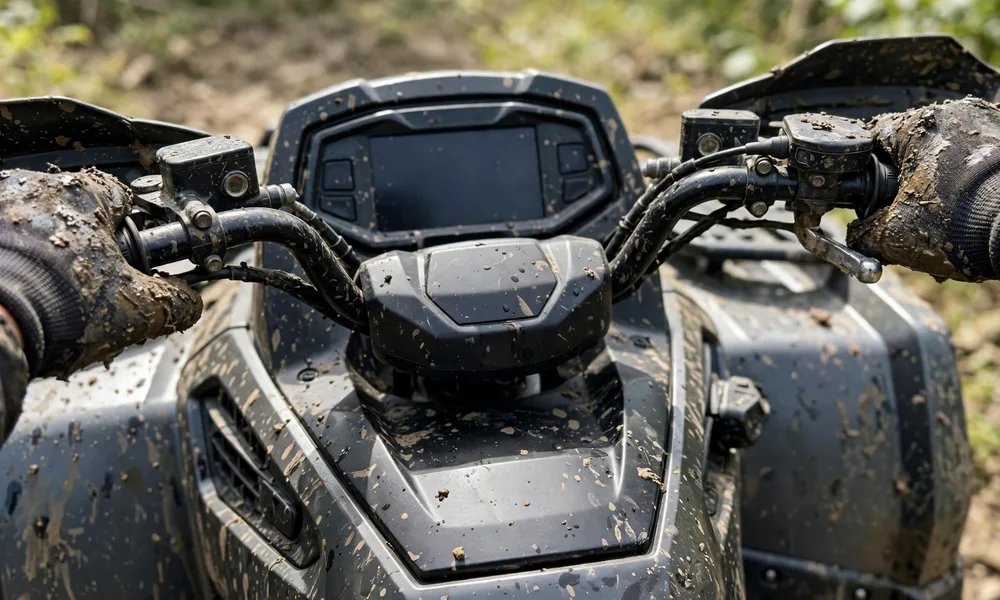
A modern luxury ATV carries more electronics than many cars did twenty years ago. There is a digital dashboard, ride modes for mud, sand and rock, traction control, power steering, and sometimes a winch, heated grips and a GPS unit built in. The power steering alone is a marvel: an electric motor that helps the rider turn wide, heavy tyres in deep mud, and that must keep working when it is soaked, frozen or caked in earth. Every electronic part must be waterproof, dustproof and vibration-proof, which means sealed connectors, potted circuit boards and testing that a road car never faces. Electronics built to survive the trail cost far more than electronics built to survive a dashboard.
6. The low volume and hand assembly: a handful a year
Luxury ATVs are built in small numbers compared with ordinary ones, and each one is assembled largely by hand, with its engine bench-tested before it ever meets the frame, its suspension set up by a technician, and its drivetrain checked twice. There is no production line churning out thousands of identical machines to spread the cost across, and the parts are often shared with no other vehicle, so there is no bulk discount to be had. Hand assembly by people who have done it for years is slow, and slow is expensive. The guide to luxury ATV specs tells the same story in numbers, where every figure is a little bigger than the ordinary version.
7. The accessories and the finish: everything is an option
The base price of a luxury ATV is only the beginning. A winch, a plough, a gun rack, a cargo box, a windshield, heated grips, upgraded tyres, a snorkel kit for deep water and a trailer to carry it all home are mostly options, and together they can add thousands of dollars to the price. The finish is an option too: premium paint, sculpted bodywork, LED lighting and a seat that stays comfortable after eight hours on the trail. The machine is sold as a starting point, and the owner finishes it, at a price, to suit the ground they ride on.
What it costs
The estimated price of a luxury ATV is around 15,000 to 40,000 dollars, and that figure is an estimate only, because the cost depends on the engine, the drivetrain and the accessories. A well-equipped single-cylinder model sits at the lower end, while a large twin-cylinder model with power steering, a winch, upgraded suspension and a full set of accessories sits at the top. Add a trailer, riding gear and the first service, and the real cost of getting on the trail is higher still, but so is the ground the machine will take you across.
A rare fact
Few people know that the ATV was invented not for fun but for farming, when a Japanese maker in the 1970s built a three-wheeled machine to carry farmers across rice paddies too soft for a tractor. The fourth wheel came later, when riders discovered that three wheels tipped over far too easily, and the luxury version came later still, when owners realised that a machine built to work all day in mud deserved to be comfortable too.