He was halfway through a lane change on a wet motorway when the little amber light in his mirror came on. He had checked the mirror a second earlier and seen nothing, but the light was firm, and he held his line. A moment later a grey motorcycle slid past in the rain, exactly where he had been about to move. He never saw it in the glass. The car did.
That amber light is the visible end of a blind spot monitor, a system that watches the space beside and just behind the car where mirrors cannot reach. It looks like a tiny lamp, and it costs a surprising amount of money, because behind it sits radar, wiring, software, crash testing and a calibration routine that must be repeated whenever a bumper is touched. The price is not in the light. It is in everything that makes the light trustworthy.

Why a Blind Spot Monitor Costs So Much
1: The radar sensors are small, precise and expensive to make
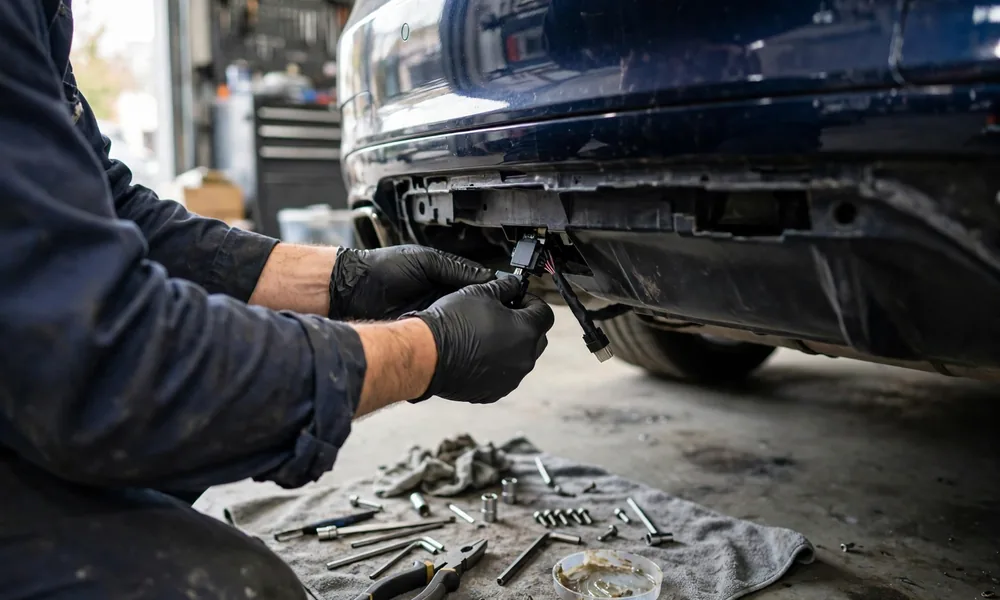
A blind spot monitor usually uses two small radar sensors hidden inside the rear bumper, one on each side, watching the lanes beside the car. Each sensor sends out radio waves and listens for the reflection, measuring the distance and speed of anything nearby many times a second. The sensors must be small enough to hide, tough enough to survive heat, cold and vibration, and precise enough to tell a motorcycle from a crash barrier. Making a radar unit that small and that reliable is costly, and a luxury car needs two of them, plus spares in the supply chain for repairs.
2: The bumper becomes part of the sensor
Radar waves pass through plastic, which is why the sensors can hide inside a bumper at all, but the bumper’s paint and thickness change how the waves behave. Makers must test the exact bumper, with its exact paint, and tune the sensor to suit it. A thick coat of filler after a repair, or a bumper from a different model, can weaken or distort the signal. That is why a blind spot monitor often needs recalibration after even a small rear-end bump, and why a cheap bumper repair can quietly break a safety system the driver still believes is working.
3: The software must decide what counts as a threat
The hardest part of a blind spot monitor is not seeing things, it is deciding which things matter. A guardrail, a parked car, a lamppost and a fast motorcycle all reflect radar, but only the motorcycle is a reason to warn the driver. The software filters out the stationary objects, tracks the moving ones, and predicts whether they will still be beside the car in the next few seconds. It also has to stay silent when the driver is parked or crawling in traffic, or the warning light would glow all day and the driver would learn to ignore it. Writing and testing that judgement takes years of road data, and the testing is a large part of the price.
4: The warning has to reach the driver without distracting them
A blind spot warning must be noticed instantly but never startle the driver, which is a fine line. Luxury makers put a small light in the mirror glass, where the driver’s eyes already go, and add a soft chime or a gentle steering nudge only when the driver signals toward an occupied lane. The light looks simple. The research behind its brightness, size and timing is not.

5: Calibration and repair are built into the lifetime cost
When a radar sensor is replaced, it cannot simply be bolted in and trusted. A technician must aim it with specialist equipment, drive the car through a set course, and confirm that it sees the test targets at the right distances. That session can take an hour or more, and it needs software that only franchised workshops hold. The same applies after a bumper replacement or a suspension repair that changes the car’s ride height. Owners pay for this precision over the life of the car, not just on the day they buy it, and the bill surprises people who expected a mirror light to cost as little as a bulb.
6: It is tied into steering, braking and the rest of the car
A modern blind spot monitor does not stand alone. It shares its radar picture with the lane-keeping system, the rear cross-traffic alert and sometimes the automatic braking, so one sensor serves several safety features. That integration makes the car safer, but it also means the system must be tested as part of the whole car, not as a separate gadget. A fault in one corner can trigger warnings from another system, and diagnosing it needs a technician who understands the network, not just the sensor. The integration is why the option is priced as a safety package rather than as a single light, and it is the same kind of teamwork that shapes the car’s other systems, as our ranking of the best hypercar steering systems ranked shows.
Blind Spot Monitor Costs at a Glance
| Cost driver | Typical figure | Why it costs |
|---|---|---|
| Radar sensors | 2 per car | Small, precise, built to survive heat and vibration |
| Option price | Estimated $1,000 to $2,500 | Sensors, wiring, software and testing together |
| Single sensor replacement | Estimated $500 to $1,200 | Part plus aiming and calibration time |
| Calibration session | Estimated $200 to $500 | Specialist rig, software and a test drive |
| Bumper tuning | Model-specific | Paint and thickness must suit the radar |
| Linked systems | Lane keeping, cross-traffic alert | One sensor picture serves several safety features |
What the Price Buys, in Plain Terms
All prices above are estimates, not quoted prices, and they vary with the brand and the model. What the money buys is not the light in the mirror but the confidence behind it: radar that can tell a motorcycle from a barrier, software that stays quiet until it matters, and a system that still works after a bumper has been repaired and recalibrated. A cheap system that cries wolf is worse than none, because drivers learn to ignore it, and a system that misses a motorcycle is worse still. The luxury price is, in large part, the cost of being right almost every time.
A Rare Fact About Blind Spot Monitors
The blind spot is not a fixed patch of road. It moves with the car’s speed, with the size of the vehicle beside it, and even with how the driver has set their seat and mirrors. A tall driver sitting upright has a different blind spot from a shorter driver sitting lower, which is why the best systems watch a wide zone and let the software, not the mirror setting, decide what counts. Some early systems warned about everything and were switched off within a week. The ones that survive are the quiet ones, and quiet costs money.
The amber light in the mirror is easy to take for granted, and that is the compliment it deserves. It asks for nothing, it glows only when it must, and it has already done the hard work before the driver ever looks at it. Behind that small light sits a radar, a bumper tuned like an instrument, and years of testing on wet motorways. Building that kind of trust into a car takes the same care as building the car itself, as our guide to how a luxury autonomous car is made explains, and the same protective thinking that shapes an armoured car, as our guide to how a luxury bulletproof car works shows.