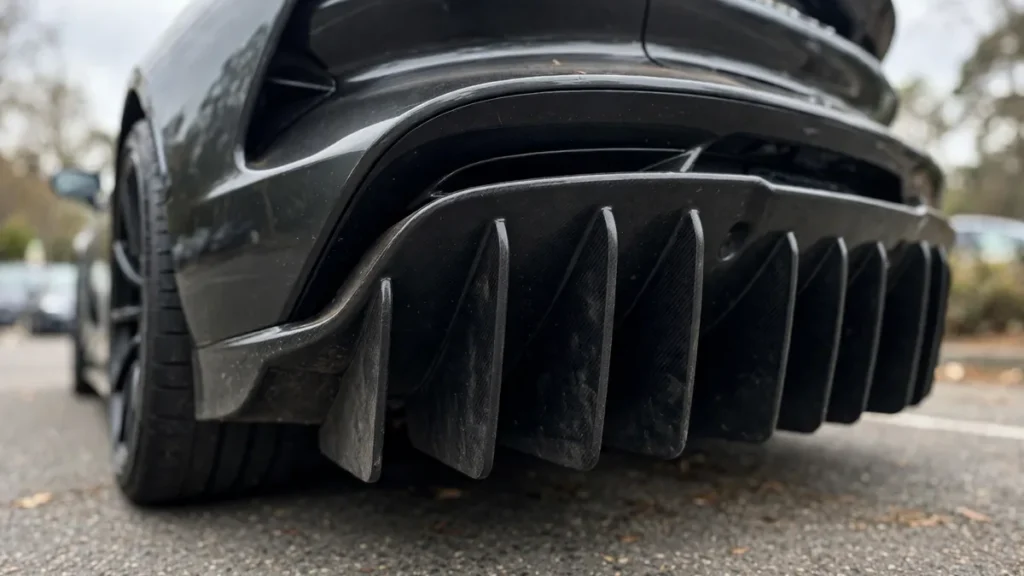
Crouch down behind a luxury sports car and look underneath the rear bumper, and you will see something that looks like a piece of sculpture: a set of vertical fins, made from dark woven carbon fibre, framing the exhaust pipes. A replacement diffuser for a large luxury sports car is estimated to cost between eight thousand and forty thousand dollars, and on the rarest models it can cost more than a good used car.
That price is strange, because a diffuser does not move, has no electronics, and contains no precious metal. It is a shaped piece of bodywork, and its job is invisible: it manages the air flowing underneath the car, speeding it up as it leaves, which pulls the car down onto the road. The reasons for the cost are hidden in the shape, the material, and the testing that proves the shape works.

Carbon Fibre, Laid by Hand
The first cost driver is the material. A luxury car diffuser is almost always made from carbon fibre, and not the kind that comes off a roll in a factory. The fins are thin, curved, and different from each other, and each one is laid up by hand: sheets of carbon cloth cut to a pattern, placed into a mould one layer at a time, brushed with resin, and then cured in an autoclave, a pressurised oven, at high temperature. A single diffuser can take a skilled worker a full day to lay up, and a mistake in one layer means starting again.
The moulds are expensive too. Each fin shape needs its own mould, machined from aluminium or steel to a tolerance of fractions of a millimetre, and the moulds are used for only a few hundred parts before they wear. Spread across a production run of a few hundred cars, the mould cost alone adds thousands of dollars to each diffuser. The craft of building light, strong parts by hand runs through the whole car, and how a luxury hypercar is made shows how many of its parts are built the same slow way.
Wind Tunnel Hours and the Shape That Works
The second cost driver is the shape, and the testing that proves it. A diffuser works by giving the fast air under the car room to expand as it exits, which speeds it up and drops its pressure, pulling the car down. Finding the right shape takes hundreds of hours in a wind tunnel, with a full-size car or a scale model, measuring the air with sensors and smoke.
A diffuser programme can consume weeks of tunnel time, plus the computer simulation that runs before the car ever reaches the tunnel, plus the track testing that follows, with engineers changing one fin at a time and measuring lap times. All of that engineering is spread across a small number of cars, which is why the diffuser on a car built in the hundreds costs far more than a similar-looking part on a car built in the hundreds of thousands. The fins are also made from materials chosen to survive heat from the exhausts beside them, and why a Kevlar panel costs so much explains what happens when a heat-resistant composite has to be both light and tough.
Small Runs, Heat and Hand Finishing
The third cost driver is scale, or the lack of it. A diffuser for a mass-market car is injection moulded in plastic, thousands a day, for a few dollars each. A diffuser for a luxury sports car is made in the hundreds, sometimes the dozens, and every part is finished by hand. The edges are trimmed, sanded, and polished, the weave of the carbon is checked to make sure it lines up across the fins, and the clear coat is applied in several layers and polished until the finish is flawless, because the diffuser is on show every time someone walks behind the car.
The part also has to survive a harsh life. The resin, the clear coat, and the fixings are all specified for heat and impact, and the mounting points are designed so the diffuser can flex slightly without cracking. The fitting itself is a skilled job: the diffuser must sit perfectly flush with the bumper, with even gaps all round, and on many cars it is fitted and adjusted by hand on the production line, not by a robot.

The Price, in Plain Terms
Put the pieces together and the numbers look like this. The carbon fibre material, moulds, and hand lay-up are estimated at three thousand to fifteen thousand dollars. The wind tunnel testing, simulation, and track development are estimated at two thousand to ten thousand dollars per car, spread across a small production run. The hand finishing, heat-resistant coatings, and fitting are estimated at one thousand to five thousand dollars. The total for a large luxury sports car diffuser lands, by most estimates, between eight thousand and forty thousand dollars, and on the rarest limited models it can go higher still.
Those are estimated figures, and they move with the car, the maker, and the production run, but the shape of the bill is stable. Roughly half goes into the material and the making, roughly a third into proving the shape works, and the rest into finishing a part that has to look perfect and survive the road. The exhausts that sit in the middle of the diffuser are a story of their own, and how a titanium exhaust is made shows why the metal beside the fins is expensive too.
A Rare Fact About the Diffuser
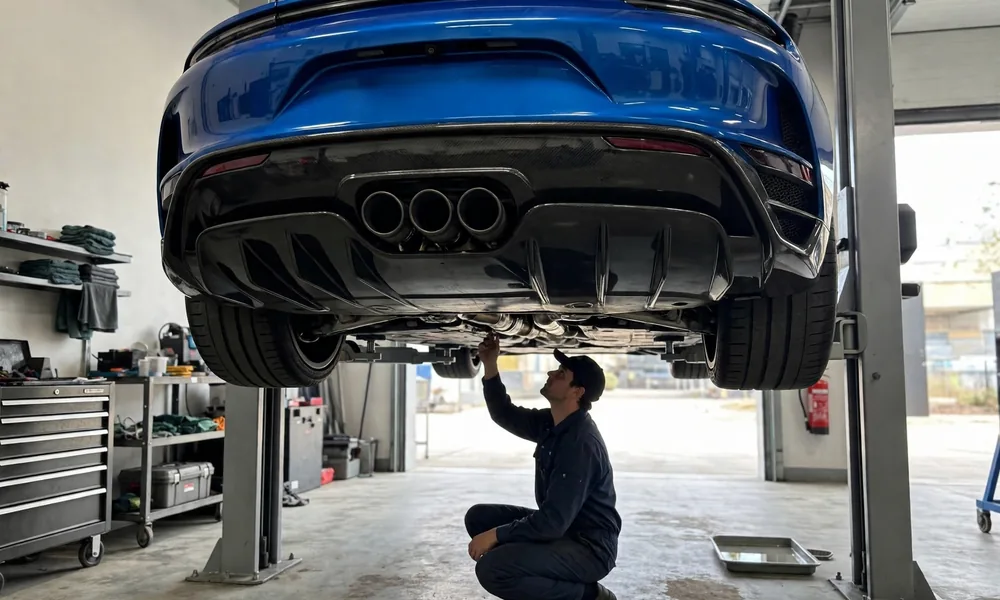
Here is a detail that surprises even people who own these cars. On some luxury sports cars, the diffuser is not fixed at all. It can extend backwards as the car gathers speed, lengthening the tunnels underneath and making more downforce, then retract when the car slows down, so it does not scrape on speed bumps and driveways. The movement is only a few centimetres, driven by a small motor hidden in the bumper, and it is one more reason the part costs what it does. The sculpture under the bumper is, in effect, a moving wing, and it is still moving after the car has parked.
What the Price Means for You
For an owner, the price of the diffuser is paid back in grip and in looks. A diffuser that works means a rear end that stays planted in fast corners, and a rear view that tells everyone behind you that the car is serious. A diffuser that is built well also means a part that survives stones, heat, and car washes without fading or cracking, which matters when the replacement costs as much as a holiday.
The next time you walk behind a luxury sports car, crouch down and look at the fins under the bumper. They are not decoration. They are a wind tunnel, a carbon fibre workshop, and a small production run, all fitted into a space the size of a shoebox. They cost thousands, and now you know why.