Hold a Kevlar panel in your hands and it feels wrong for its price. It is light, almost soft, a golden woven sheet that bends like cloth, and it looks like something you could buy by the metre in a fabric shop. Then you learn what a finished panel costs, fitted to a car or a boat, and it is enough to buy a used car of its own, for a piece of material that weighs less than a bag of shopping.
The reason is not the size of the panel. It is everything that went into it before it became a panel: a fibre that is spun from chemicals under conditions no ordinary factory can manage, a weave that must be perfect, a resin that must cure without a flaw, and hands that lay each layer by eye. A Kevlar panel is cheap to look at and dear to make, and every step in its making adds to a price that surprises everyone who meets it for the first time.

The Fibre Itself Is Dear Before It Is Woven
Kevlar is not a natural fibre, and it is not spun like cotton or wool. It is made by dissolving a polymer in concentrated acid, spinning the solution through tiny holes, and drawing the fibres out under heat, a process that needs specialist plants, careful handling and constant quality checks. The fibre that comes out is five times stronger than steel for its weight, and that strength is what buyers pay for, but the plant that makes it costs a fortune to build and run.
The fibre is also fussy to handle. It frays easily, it does not like to be bent sharply, and it absorbs moisture from the air, which weakens it if it is not stored properly. The luxury Kevlar panel specs show how the fibre’s strength depends on keeping it dry and undamaged before it is ever woven, and a roll of Kevlar that has been stored badly is worth far less than one that has been kept sealed and cool.
Supply is the other half of the price. Only a handful of plants in the world make aramid fibre at the quality a luxury panel needs, and the fibre is also bought by armies, police forces and aerospace firms, who pay whatever it takes. A yacht or car maker ordering a small batch is a small customer in a market dominated by governments, and it pays the price that market sets, not the price it would like.
Weaving, Laying and the Hands That Make It
Once the fibre exists, it must be woven, and the weave is where the luxury begins. Kevlar is woven into cloth on looms that must be set up for its stiffness and its tendency to fray, and the weave must be even, with no loose threads and no thin spots, because a thin spot in the cloth becomes a weak spot in the panel. The cloth is then cut by hand, because the fibre blunts ordinary blades, and the cutting tools alone are a cost most workshops notice.
Laying the panel is slower still. Each layer of cloth is placed in a mould, brushed with resin, rolled flat to push out air, and then covered with the next layer, and the direction of each layer is chosen so the finished panel is strong in every direction. The composite layup materials engineering story shows how that layering works, and the panel in a luxury car may have a dozen layers, each one laid by a person who has done the job for years.
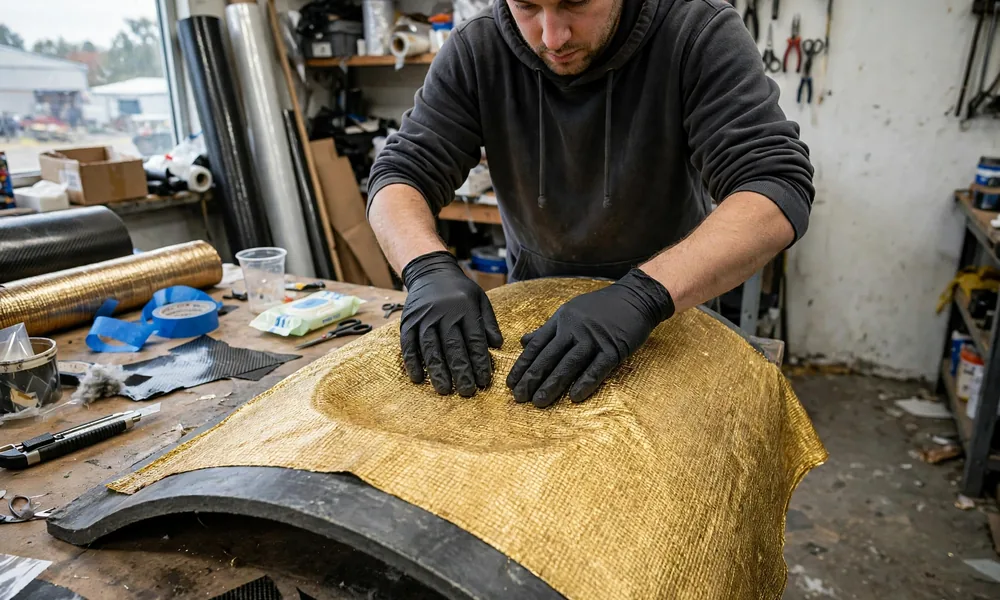
Curing is the step that cannot be rushed. The laid-up panel is sealed in a bag, the air is drawn out, and it is baked under heat and pressure so the resin sets hard and even. A panel cured too fast cracks, a panel cured too slowly wastes a day, and a panel with a bubble trapped inside must be thrown away, because no one can fix a bubble in a finished laminate. The waste rate is part of the price, and the buyer pays for the panels that were scrapped as well as the one that survived.
Finishing, Testing and Rarity
A raw Kevlar panel is rough, yellow and ugly, and turning it into a luxury part takes more work. The panel is trimmed, sanded, sealed against moisture and often painted or covered in a clear coat, because Kevlar fades and weakens in sunlight, and a panel left bare would not last a season outdoors. The finishing must be perfect, because the panel sits where guests can see it, and a flaw in the clear coat is a flaw the owner will notice every day.
Testing is quieter but just as strict. Each panel is checked for voids, for delamination and for thickness, and the best makers log every reading. The best materials for a hypercar chassis story shows how Kevlar sits alongside carbon fibre and titanium in the materials a maker chooses from, and Kevlar is chosen where toughness matters most, in panels that must absorb a knock without shattering, which is exactly the job where failure would be most expensive.
As an estimate, a luxury Kevlar panel costs about $5,000 to $40,000, the Kevlar fibre and resin about $2,000 to $12,000 of that, the weaving, laying and curing about $2,000 to $15,000 more, and the finishing, testing and fitting about $1,000 to $8,000 on top. These are estimated ranges, not quotes, and the final figure depends on the size of the panel, the number of layers and the maker. What never changes is that the panel is made by hand, one at a time, and a handmade part can never be cheap.
A Rare Fact From the World of Kevlar Panels
Here is a detail few buyers ever learn: a Kevlar panel is almost impossible to repair invisibly. Steel can be welded and filled, carbon fibre can be patched and sanded, but Kevlar fibres fuzz and fray when they are cut, and a repair leaves a rough patch that shows through paint. Most makers do not repair a damaged Kevlar panel at all, they replace it, and that is why a small knock on a Kevlar-bodied car can lead to a bill that looks like a crash repair, even when the damage looks minor.
What the Price Means for You
If you are wondering why a luxury Kevlar panel costs so much, look at four things: the fibre, the weave, the curing and the rarity. A fibre made in a handful of plants, a weave that must be flawless, a cure that cannot be rushed and a panel made by hand for a single car or boat are the marks of a panel worth its price. The weight matters less than the brochures suggest, and the toughness matters more than anyone admits, because a panel that absorbs a knock without shattering is the one that protects everything behind it. The best Kevlar panel is the one you never notice, light, tough, and quietly doing a job no cheaper material could do. Ask who laid it and how it was cured, because those two answers tell you more about the panel than any brochure ever will.


