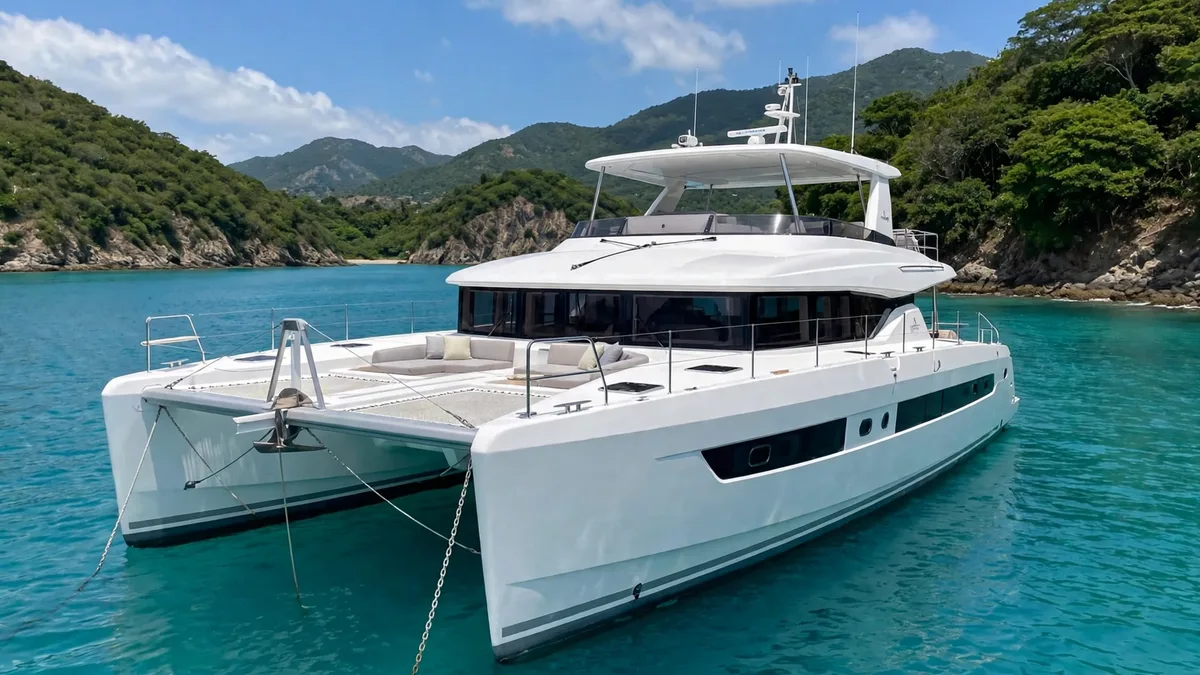
The boat sits at anchor in a turquoise bay, two white hulls spread wide across the water, a deck so broad you could hold a dinner party on it without anyone feeling crowded. From the beach it looks simple, almost peaceful, like a floating holiday home. It is not. A luxury catamaran yacht, a power catamaran built for comfort rather than sails, is one of the most expensive boats a person can buy that has no mast at all, and its price is the cost of building a floating apartment that must also cross oceans, stay level in a swell, and carry two engines, two hulls and a houseful of guests. This is not a sailing catamaran: there is no rig to buy and no sail to trim. The money goes somewhere else entirely.
1. Two hulls: building a boat twice
The first cost is the shape itself. A catamaran yacht has two hulls instead of one, and each hull is a complete boat in its own right, with its own bow, its own cabins, its own tanks and its own engine. Building two hulls means building the boat twice, then joining them with a bridgedeck, the wide platform between them that carries the saloon and the cockpit. That platform must be strong enough to hold the two hulls together in a storm, when waves try to twist them in opposite directions, and it is one of the most heavily engineered parts of the vessel. The guide to how a luxury catamaran works describes the same twin-hull logic, but the making is only half the story: the cost is in doing it twice, and then joining the two halves so they never come apart.
2. The beam: a deck wider than a house
A luxury catamaran yacht is wide, often 8 to 11 metres across, and that width is both its greatest luxury and its greatest cost. The wide beam gives the boat a saloon with windows on three sides, a cockpit big enough for a dozen guests, and cabins in each hull that feel like hotel rooms. The structure that spans the gap, the bridgedeck and its crossbeams, must be enormously strong, because it carries the weight of the whole living space while the hulls move independently in a swell.
3. The materials: carbon, foam and resin, laid by hand
A luxury catamaran yacht is not built from ordinary fibreglass. The hulls are usually a sandwich of carbon fibre and foam core, wetted with epoxy resin and laid up by hand, layer by layer, in the mould. Carbon fibre is light and enormously stiff, which is why the boat can be both wide and fast, but it is expensive, it must be kept clean and dry while it is worked, and every layer must cure before the next goes on. The racing version of the same construction is even more extreme, as the guide to racing catamaran specs shows, where weight is cut until there is almost nothing left to cut.
4. Two engines, two of everything
A power catamaran yacht has two engines, one in each hull, and that doubling runs through the whole boat. Two engines, two fuel systems, two cooling systems, two propellers and two sets of controls, all of which must work together and each of which must be able to drive the boat alone if the other fails. The engines themselves are large marine diesels, often 600 to 1,000 horsepower each, and they are expensive, heavy and thirsty.
5. The interior: a floating apartment, built to survive the sea
Inside, a luxury catamaran yacht is an apartment: a saloon with a dining table for eight, a galley with a full cooker and fridge, and three or four cabins, each with its own bathroom. The difference from an apartment is that every panel, every cupboard and every fitting must survive being thrown around by waves, soaked in salt air, and baked in tropical sun, all while staying quiet and dry. Building a beautiful room is one thing; building a beautiful room that floats is another, and the second costs far more.

6. The systems: power, water and comfort, off the grid
A catamaran yacht at anchor is a long way from a power socket, so it must make its own electricity and water. Solar panels cover the roof, a generator sits in one hull, and a large lithium battery bank stores the power for the air conditioning, the watermaker, the fridge and the navigation electronics. The watermaker turns seawater into drinking water, the air conditioning keeps four cabins cool in the tropics, and the electronics include radar, satellite communications and a chart plotter that costs more than a car. All of these systems must work together, and they must be serviceable in a remote anchorage, because a broken watermaker a thousand miles from land is a serious problem. The electric end of the same market is growing fast, as the guide to the best electric catamaran brands shows, but a luxury power catamaran still carries a full set of conventional systems as well.
7. The low volume: a handful a year, each one different
Luxury catamaran yachts are built in tiny numbers. A yard may launch only a handful of large power catamarans in a year, and each one is customised: a different layout, a different interior, a different set of equipment. The yard keeps a team of naval architects, laminators, engineers and joiners for a handful of boats, and it keeps moulds and tooling that are used only a few times. There is no production line to spread the cost across, no bulk discount on parts, and no economies of scale. Every boat carries the full cost of the yard that built it, and that is the final reason the price is so high. A catamaran yacht is not mass-produced. It is made, one at a time, by people who have done it for years.
What it costs
The estimated price of a luxury catamaran yacht is around 2 million to 12 million dollars, and that figure is an estimate only, because the cost depends on the length, the engines and the interior. A 15-metre power catamaran with a modest fit-out sits at the lower end, while a 25-metre yacht with twin high-power diesels, a full-width saloon and a custom interior sits at the top. Running costs add roughly a tenth of the purchase price every year, in berthing, fuel, crew and maintenance, and a wide beam means a wide berth, which marinas charge handsomely for.
A rare fact
Few people know that the catamaran is one of the oldest boat designs in the world, used for thousands of years by Pacific islanders who lashed two canoes together to cross open ocean, long before anyone built a single-hulled yacht. The modern luxury version uses carbon fibre and diesel engines instead of logs and paddles, but the idea is unchanged: two hulls are steadier than one, and steadiness is what lets people live comfortably on the water. The ancient design took two thousand years to become a luxury, and the price, in the end, is the price of building it twice, beautifully, and joining the two halves so they never come apart.