The bus pulls away from the hotel at dawn, and nobody inside notices the road at all. Twenty-four people are asleep in reclining leather seats, or watching films on their own screens, or making coffee in the little kitchen at the back, while the mountains slide past windows the size of shop fronts. From the outside it is a long, dark coach like any other. Inside, it is a hotel that moves. A luxury coach bus can cost more than a small house, and the reason is not the engine or the wheels, which are the same as any coach. The reason is everything that has been built on top of them, by hand, for a handful of passengers who expect a hotel room, a cinema and an office, all at seventy miles an hour.

1. The body: a shell built for comfort, not capacity
A normal coach is built to carry fifty or more people as cheaply as possible, with thin seats, hard floors and windows that rattle. A luxury coach starts with the same kind of shell, a long steel and aluminium body roughly twelve to fourteen metres long, and then throws away the capacity. Instead of fifty seats, it carries twenty or twenty-four, and the space saved becomes legroom, wider seats, a lounge and a kitchen.
2. The seats: first-class chairs, twenty-four of them
Each seat in a luxury coach is closer to a first-class airline seat than to a bus seat. It is wide, it reclines deeply, it has a leg rest, a heater, and sometimes a massage function, and it is trimmed in leather that is cut and stitched by hand. There is a personal screen, a reading light, a power socket and a small table, and the seats are spaced far enough apart that a tall passenger can stand up without disturbing anyone. The spacing is the real luxury: on a normal coach, the seat pitch is roughly 75 centimetres, while on a luxury coach it is often more than a metre, and that extra space is bought by removing seats, which is the most expensive way to buy comfort there is.
3. The interior: a hotel, fitted by hand
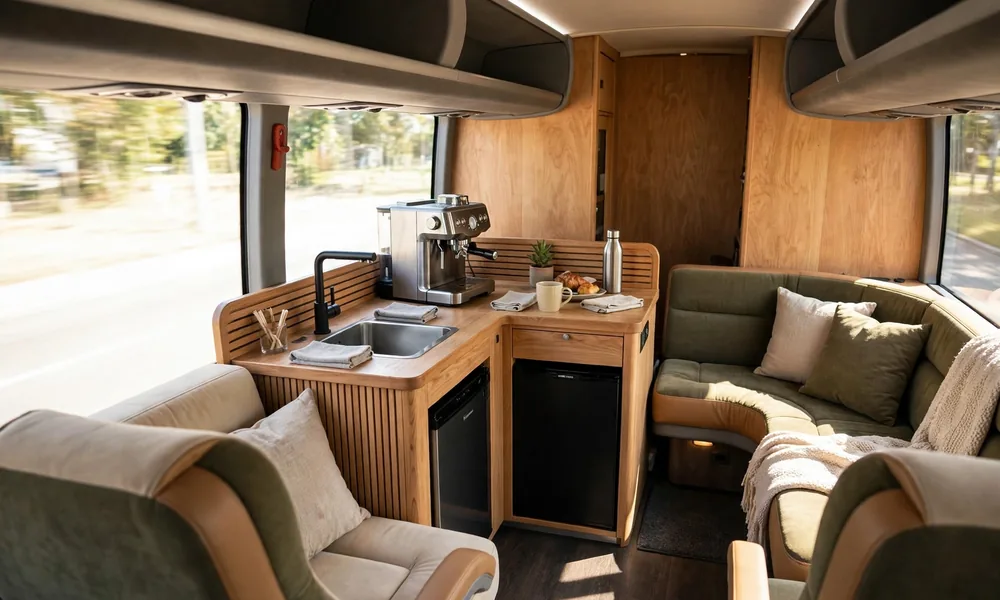
Past the seats, the coach becomes a small hotel. There is a kitchenette with a coffee machine, a fridge and a microwave, a toilet with a proper washbasin, and at the rear, on the best coaches, a lounge with a sofa and a table, or even a small bedroom. All of this is built by hand, panel by panel, because no two coaches are fitted out quite the same way, and the work takes months. It is the same hand-built logic that shapes a luxury motorhome’s build, where a vehicle becomes a living space one panel at a time.
4. The ride: silence and smoothness at speed
A coach at motorway speed is a noisy, shaking place unless a great deal of work has gone into stopping it being one. A luxury coach gets extra sound insulation in the floor and walls, laminated glass, and an air suspension system that reads the road and adjusts each corner of the bus to keep the body level. The suspension is the same kind of system a luxury car uses, scaled up to a vehicle that weighs more than fifteen tonnes, and it is what lets passengers sleep while the bus crosses a mountain pass. The test is simple: if you can hold a normal conversation in the back row at full speed, the money was well spent.
5. The systems: power, air and water for a day on the road
Twenty-four people, each charging a phone and a laptop, with screens, lights, a kitchen and air conditioning running, need far more power than a standard coach provides. A luxury coach carries a generator or a large battery bank, an inverter that turns it into ordinary socket power, and a water system with a tank, a pump and a heater for the kitchen and toilet. These systems are the least visible part of the coach and the most likely to fail if they are done cheaply, so they are built with commercial-grade parts and serviced by specialists.

6. The low volume: every coach is a one-off
Almost no luxury coaches are built alike. A tour company, a sports team or a band orders one coach, specifies the layout, the colours and the equipment, and waits months while it is built. There is no production line and no discount for buying ten, because almost nobody buys ten. That is why the price does not fall the way car prices do: a luxury coach is closer to a small building project than to a vehicle purchase. A full-size luxury RV’s spec sheet shows the same economics at a smaller scale, where a hand-built living space costs more than the vehicle underneath it.
7. The running costs: a hotel that needs a garage
Buying the coach is only the start. A luxury coach needs a driver with a special licence, insurance that covers twenty-four passengers and a vehicle worth more than a house, and servicing by a workshop that understands its generator, its air conditioning and its hand-built interior. Fuel consumption is high, tyres are large and expensive, and the interior needs the kind of cleaning and repair a hotel would budget for. Over ten years, the running costs can approach the purchase price, and that is part of why the coaches are bought by companies that earn money from them, not by private owners who want a toy.
The spec sheet at a glance
| Figure | Typical range | What it tells you |
|---|---|---|
| Length overall | Roughly 12 to 14 metres | How long the coach is, and where it can park |
| Seats | Usually 20 to 28 | How many travel in luxury, not how many fit |
| Seat pitch | Roughly 1.0 to 1.2 metres | How much legroom each passenger gets |
| Engine | Diesel, roughly 450 to 530 hp | What moves fifteen tonnes smoothly |
| Price | Roughly $600,000 to $1,500,000 | What a luxury coach bus costs, as an estimate |
What it costs
A luxury coach bus usually costs roughly $600,000 to $1,500,000 as an estimate, starting with the base coach and adding the interior, the seats and the systems on top. A straightforward executive layout with twenty-four seats sits near the bottom of that range; a top-end build with a lounge, a bedroom, a full kitchen and a bespoke finish reaches the top. The same trade-off appears in a luxury minivan’s spec sheet, where space and comfort are bought by removing seats, just on a much smaller scale.
A rare fact
Here is a detail most passengers never notice: the windows on a luxury coach are often slightly tinted from the outside but clear from the inside, and the glass is laminated in two layers with a plastic sheet between them. That sheet does more than stop the glass shattering: it blocks most of the sun’s heat, which is why the cabin stays cool even when the bus sits in full sun.


