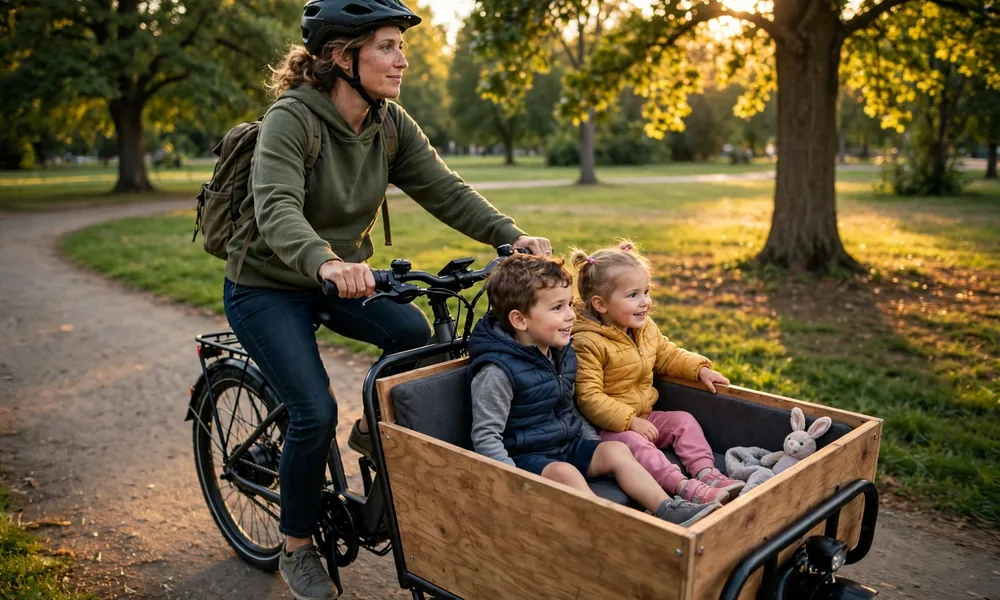
On a rainy Tuesday morning, a father rode past a queue of cars stuck at the school gates. In the wooden box at the front of his bike sat two children in rain capes, giggling, and behind them a bag of groceries and a schoolbag. He parked at the school door, dropped the children off, and rode on to work, arriving dry, on time and smiling. The cars behind him were still queuing. His vehicle cost more than many second-hand cars, and it was a bicycle. But by the end of the year, he had sold the family’s second car, and the bicycle had paid for itself.
That is the quiet revolution of the luxury electric cargo bike. It is not a toy and not a niche curiosity; it is a genuine replacement for a second car, built to carry children, shopping, dogs and deliveries through a city, in all weathers, day after day. The price shocks people at first, until they add up what it replaces. And then they look closer at the machine itself, and the price starts to make sense.

Where the Money Goes
The frame is a load-bearing structure, not a bicycle frame. A cargo bike must carry up to 200 kilograms of people and goods, plus its own weight, plus the force of a powerful motor, and it must do it without flexing or cracking. The frame is longer, thicker and far more heavily reinforced than a normal bicycle frame, with a long wheelbase that keeps the bike stable when fully loaded.
The box is furniture, not a basket. The front box on a luxury cargo bike is often made from varnished marine plywood or moulded composite, with bench seats, seat belts for children, a rain cover and storage underneath. It is built to survive rain, sun and daily knocks, and it is finished to a standard that would not look out of place in a living room. The box alone can cost as much as a whole budget bicycle.
The motor and brakes are sized for a heavy load. A cargo bike’s motor must pull a fully loaded bike up a hill from a standing start, which takes far more torque than a normal e-bike needs. Luxury models use high-torque mid-drive motors, often making 85 newton-metres or more, paired with large batteries of 500 watt-hours or bigger. And because a heavy bike needs to stop reliably, the brakes are hydraulic disc brakes with oversized rotors, the kind of stopping power you would expect on a motorcycle.
Weather protection and accessories add up. A luxury cargo bike is sold as a complete system: rain canopy, child seats, footboards, lights, locks, kickstand and storage, all designed to work together. Each accessory is made to the same standard as the bike itself, and together they can add a large sum to the price.
It is built in small numbers by specialists. Cargo bikes are not mass-produced in the millions like ordinary bicycles. The best makers build in small batches, often by hand, with each bike assembled and tested by a single mechanic. That craftsmanship costs money, but it also means the bike arrives perfectly set up, and the maker stands behind it for years. A luxury cargo bike is expected to last a decade or more of daily use, and it is built like it.
How It Works
Step 1: The load sits low and central
The secret of a cargo bike is where the weight goes. The box sits low, between the front wheel and the rider, so the centre of gravity stays close to the ground. That makes the bike stable even when fully loaded, and it means the rider can see the children at all times. The long wheelbase adds stability at speed, and the steering is linked to the front wheel by a rod or cable system that keeps the handling predictable despite the unusual layout.
Step 2: The motor does the heavy lifting
When the rider pedals, a torque sensor measures the effort and the mid-drive motor adds its own power at the cranks. With a full load, the motor does most of the work on hills, and the rider simply keeps the pedals turning. The assistance is smooth and strong, and because the motor drives through the gears, it can use a low gear to climb steep slopes with a heavy load, just as a car uses first gear on a hill.

Step 3: The brakes stop a heavy machine safely
Stopping a bike carrying 200 kilograms needs serious brakes, and cargo bikes use large hydraulic disc brakes with four pistons and big rotors. The brakes are designed to work in all weathers, with pads that grip even when wet, and the levers are sized so a rider can brake hard with one finger. Some models add a parking brake, so the bike cannot roll away while children climb in and out.
Step 4: The battery lasts the whole day
A large battery, usually 500 to 750 watt-hours, gives an estimated 50 to 100 kilometres of range even with a full load, depending on the hills and the assistance level. That is enough for the school run, the shopping and the commute, with charge to spare. The battery is usually removable, so it can be charged indoors, and a full charge takes around four to five hours.
Step 5: The stand holds it steady
Loading children into a bike that tips over would be a disaster, so cargo bikes have a heavy-duty double kickstand that holds the bike rock-steady while it is loaded. The stand is wide and strong, and on some models it locks in place. It is a small detail, but it is the one that parents notice first, because it is the difference between a stressful loading routine and an easy one.
The cargo format has its own numbers, covered in the luxury electric cargo bike specs, and the non-electric version shows where the design came from in the luxury cargo bike specs. The motor and battery technology is explained in the luxury electric bike specs.
What It Costs
A luxury electric cargo bike costs an estimated $5,000 to $12,000, depending on the box, the motor and the accessories. That sounds like a lot for a bicycle, until it is compared with the cost of running a second car: fuel, insurance, tax, servicing and parking easily add up to several thousand dollars a year, while a cargo bike costs a few hundred a year in electricity, tyres and servicing. Many families find the bike pays for itself within two years, and after that it saves money every single day.
A Rare Fact
Here is the fact that surprises almost everyone: in some European cities, cargo bikes now carry more goods than delivery vans in the city centre. In Copenhagen, where the cargo bike was born as a family vehicle, parents have used them for generations, and the city has built its streets around them. A single cargo bike can carry a weekly shop for a family of four, two children and a dog, all at once, and it does it with no fuel, no emissions and no parking ticket. The luxury cargo bike is not a new idea at all. It is an old idea, rebuilt with a motor, a battery and modern brakes, and it turns out the old idea was right all along.