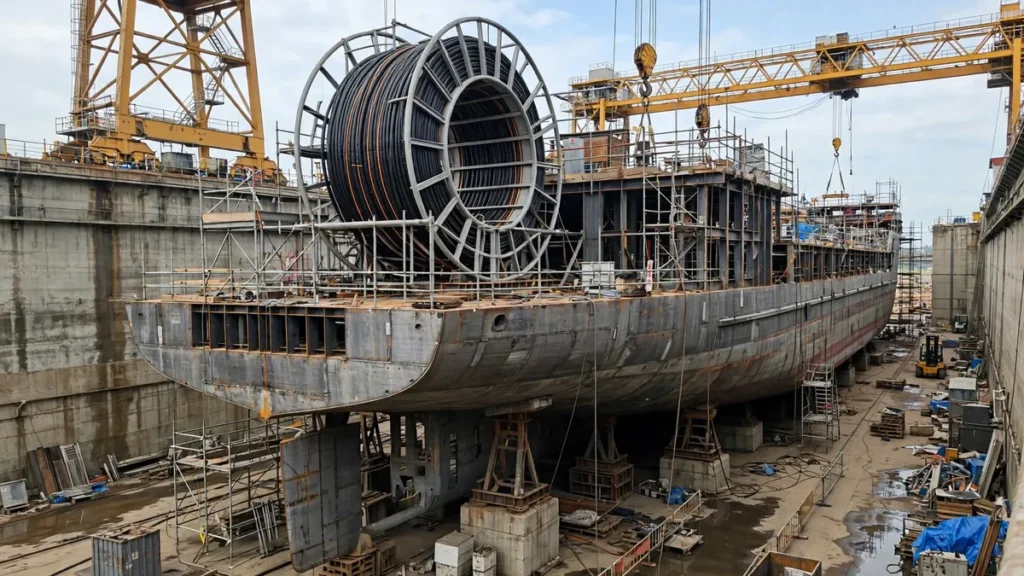
Sixty miles off the coast, the platform never stops. It burns through food, fuel, drilling mud and spare parts every day, and the only way any of it arrives is by sea. On the horizon a grey workhorse of a ship is coming in, its wide flat deck stacked with containers, its cranes folded, its bow pushing through a swell that would send a yacht home. This is a luxury offshore supply vessel, usually called a platform supply vessel, and it is the delivery truck of the offshore world. The luxury versions serve superyachts and remote offshore operations, carrying everything from fresh water to drilling chemicals in weather that keeps most ships in port, and they do it with a level of comfort and capability that ordinary workboats never reach.
The spec sheet for such a ship mixes the language of cargo with the language of seamanship. Deadweight sits next to deck area, tank capacity next to cruising speed, and a figure that matters enormously to a charterer means almost nothing to a casual reader. This guide explains the numbers one by one, so you can tell a genuine luxury supply vessel from an ordinary workboat with a fresh coat of paint.

The spec sheet at a glance
| Figure | Typical luxury supply vessel | What it tells you |
|---|---|---|
| Length | 70 to 95 metres | How much ship and deck there is |
| Deadweight | 3,000 to 5,500 tonnes | How much cargo it can carry |
| Deck area | 700 to 1,000 square metres | How much cargo fits on deck |
| Top speed | 14 to 17 knots | How fast it reaches the platform |
| Range | 8,000 to 12,000 nautical miles | How far it can work from port |
| Dynamic positioning | DP2 | How steadily it holds station |
| Crew and guests | 20 to 30 people | How many it can carry in comfort |
Deadweight and deck area
Deadweight is the first number to look for, because it decides how useful the vessel is. It is the total weight of everything the ship can carry: cargo, fuel, fresh water, drilling mud and stores. A luxury supply vessel typically carries three thousand to five thousand five hundred tonnes, and that capacity is what makes it valuable. A smaller vessel might make the trip faster, but it would have to make the trip twice, and in offshore work every extra trip costs fuel, crew time and weather risk.
Deck area matters just as much, because much of the cargo travels on deck rather than below it. Seven hundred to a thousand square metres of flat, open deck can hold containers, pipes, spare parts and even small vehicles, all lashed down against the motion of the sea. The deck is fitted with tie-down points and container sockets, and the best vessels have a deck strong enough to carry loads of ten tonnes per square metre. When you compare two supply vessels, the one with the bigger usable deck is usually the one that earns its keep.

Tanks, power and positioning
Below deck, the tanks tell their own story. A supply vessel carries fuel for the platform, fresh water for its crew, and drilling mud in dedicated tanks, each with its own pumps and piping. Fuel capacity of a thousand cubic metres or more is common, and the ability to transfer it safely to a platform in a swell is one of the skills that separates a good supply vessel from an ordinary one. The tanks are arranged low in the hull for stability, because a vessel that carries heavy loads high on deck must never become top-heavy.
Power comes from two or four main engines, usually diesels, driving propellers through gearboxes or through diesel-electric systems that let the vessel run quietly and efficiently at low speed. The number that matters most here is not top speed but dynamic positioning. A DP2 system uses satellite positioning, thrusters and computers to hold the vessel within a metre of a fixed point, even in wind and current, so it can work safely alongside a platform for hours. Without it, a supply vessel is just a fast cargo boat. With it, it is a precision tool, and it is what the luxury research vessel relies on too, to hold station over a study site while instruments are lowered to the seabed.
Speed, range and comfort
Top speed on a supply vessel is modest, fourteen to seventeen knots, because the hull is shaped for a heavy load and a rough sea rather than for speed. The bow is flared to throw spray clear, and the stern is designed to work close to a platform without damage. What matters more than speed is range: eight thousand to twelve thousand nautical miles lets the vessel work far from port for weeks at a time, and that endurance is what offshore operators pay for.
Comfort is where the luxury versions earn their name. Cabins are quiet and well finished, the galley serves proper meals, and there is a lounge, a gym and sometimes a small cinema for the crew. A crew that sleeps well works better, and a vessel that can stay at sea for weeks without returning to port gathers more work than one that must keep coming home. The luxury support vessel follows the same logic, carrying tenders and toys for a superyacht, while the support yacht shows how the same deck-and-crane thinking is measured when the cargo is leisure rather than industry.
What a luxury offshore supply vessel costs
A new luxury offshore supply vessel costs roughly forty to eighty million dollars, depending on its size, its dynamic positioning system and the finish of its accommodation. The most capable vessels, with DP2 positioning, large deck cranes and ice-class hulls, can exceed one hundred million dollars. These are estimates, not fixed prices, because the final figure depends on the shipyard, the equipment fitted and the state of the offshore market at the time of ordering. Chartering one costs roughly twenty to forty thousand dollars a day, which sounds enormous until you consider what it replaces: a platform that stops work for a day can lose far more than that.
A rare fact

Some supply vessels are built to work in ice, with reinforced hulls and heated decks, and a few have carried cargo to research stations in the Antarctic, where the nearest port is a thousand miles away and the weather can close in within an hour. The crews of those vessels train for conditions most sailors will never see, and the ships themselves are fitted with extra fuel, extra food and extra spare parts, because out there a supply vessel is not just a delivery truck. It is the only link between the people it serves and the rest of the world.
When you read a supply vessel spec sheet, start with deadweight and deck area, because those two numbers decide how much work the ship can do. Then look at the dynamic positioning and the tank capacities, because those decide whether it can do that work safely and for how long. The speed, the range and the comfort fill in the rest of the picture. Get those numbers right and you can see the vessel for what it is: not a glamorous ship, but an indispensable one.