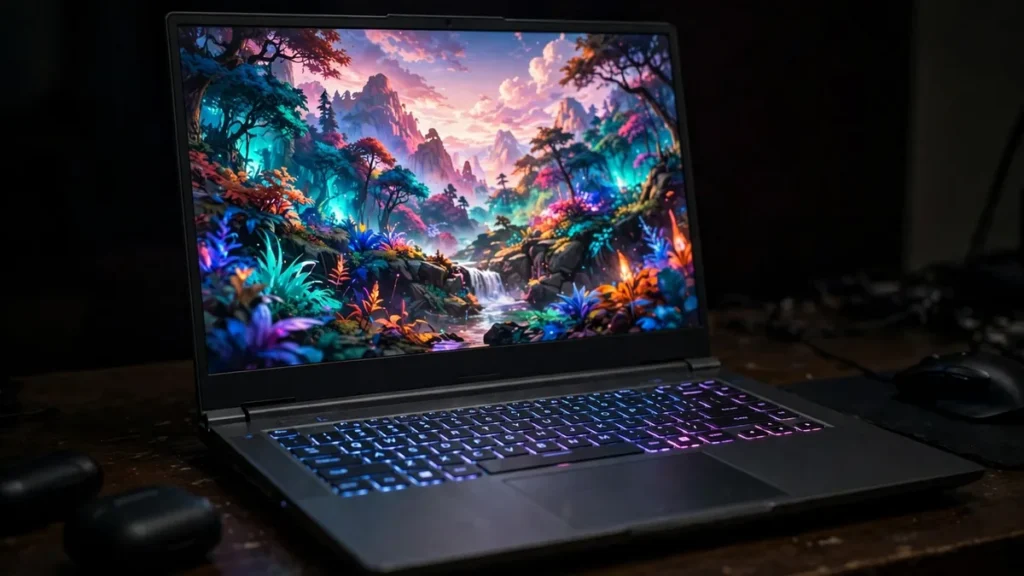
The box is heavier than you expect. You lift the lid of a luxury gaming laptop and the first thing you feel is the cold of the metal, then the weight of it in both hands, then the screen lighting up with a game running at a smoothness your old machine never managed. It looks like a laptop, it opens like a laptop, and then the price tag tells you it costs as much as a good used car. The gap between what it looks like and what it costs is the whole story, and it is written in parts you mostly never see.

The graphics chip is the biggest bill
The single most expensive part of a luxury gaming laptop is the graphics processor, the GPU, and it is expensive for reasons that start far away from the laptop factory. A top-tier mobile GPU is a silicon chip with tens of billions of transistors, made on the newest and most costly manufacturing process, and only a fraction of the chips cut from each silicon wafer are good enough to sell.
The chip is also binned, which is the industry’s quiet way of saying that not all chips are equal. Each chip is tested, and the ones that run fastest while using the least power are sorted into the top grade and sold at the top price. The guide to gaming GPU specs explained breaks down what the numbers on those chips mean, and the transistor count and the power rating on that page are the two figures that drive the price hardest.
Cooling a desktop in a slab of metal
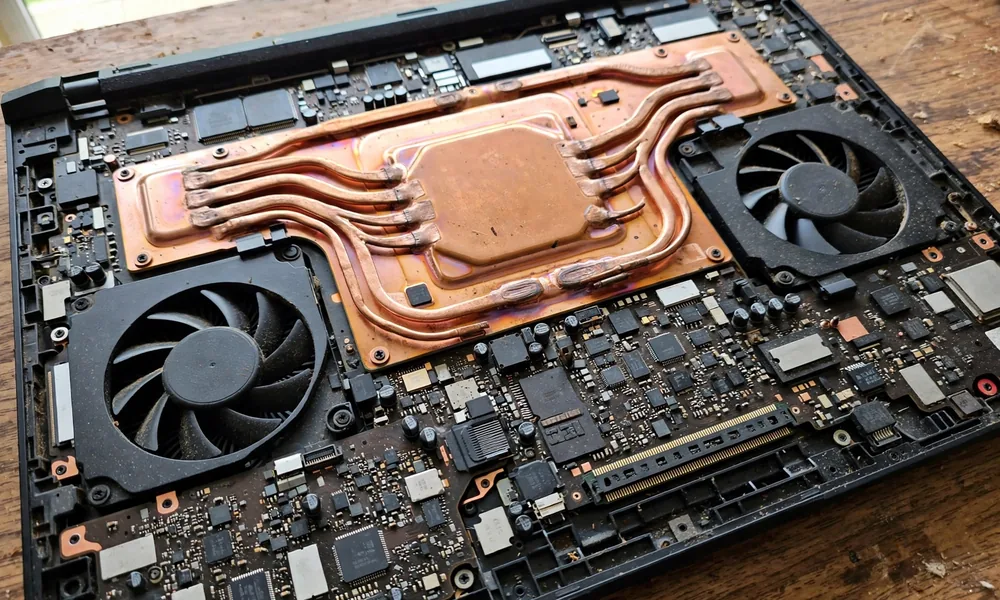
The second great cost is cooling, and it is where the laptop stops being a computer and becomes a piece of thermal engineering. A powerful GPU and processor together can produce as much heat as a small room heater, and all of it has to leave through a machine barely two centimetres thick. The answer is a vapour chamber, a flat sealed plate with liquid inside that boils at the hot spots and condenses at the cool edges, moving heat far faster than solid metal ever could.
Around the vapour chamber sit two or three fans with blades thinner than a sheet of paper, spinning at thousands of revolutions per minute, and a chassis machined from a solid block of aluminium with vents cut into it. The guide to how a luxury gaming laptop works follows the heat from the chip to the vents, and the vapour chamber described there is the part that lets the whole machine run at full speed without throttling itself to a crawl.
The screen, the keyboard and the chassis
The display is the third big cost, because a gaming screen is not an ordinary laptop screen. It refreshes two or three times faster than a normal display, which means the panel, the driver electronics and the cable to the GPU all have to work harder.
Below the screen, the keyboard is a small mechanical system of its own, with switches that travel further and feel more precise than the membrane keys in a cheap laptop, and a trackpad machined from glass. The chassis is milled from aluminium or magnesium alloy, anodised and polished, and the whole machine is assembled and tested by hand in far smaller numbers than a mass-market laptop. The guide to how a luxury laptop is made follows that hand assembly, and the slow, careful fitting described there is the opposite of the fast automated lines that build ordinary machines.
Memory, storage and the power brick
Memory and storage add their own quiet costs. A luxury gaming laptop carries far more fast memory than an ordinary machine, and the memory chips have to be the fastest grade available, because a slow memory chip would starve the GPU of data. The storage is a large, fast solid-state drive, sometimes two of them, and fast storage is priced by the gigabyte at a premium.
Then there is the power supply, which is easy to forget and hard to make cheap. A gaming laptop needs a charger the size of a paperback book, delivering hundreds of watts, because the battery alone cannot feed the GPU for long. The charger, the battery and the power circuitry that juggles them are all engineered for a machine that can draw more power than most household appliances.
Low volume, long testing and the badge
The last cost driver is the one buyers never see on a spec sheet: volume. A mass-market laptop sells in the millions, and its factory can spread the cost of design, tooling and testing across all of them. A luxury gaming laptop sells in the tens of thousands, so each machine carries a far larger share of the design bill. The tooling for a machined aluminium chassis, the testing of a new vapour chamber, the tuning of the fans and the calibration of the screen all have to be paid for by a small number of buyers.
Each machine is also tested longer before it leaves the factory, because a machine that runs this hot cannot be allowed to fail in a customer’s hands. That testing time, the warranty that covers a machine pushed to its limits every day, and the support staff who understand it, are all priced into the box. The real reason the price is high is that almost nothing inside this machine is shared with anything cheaper.
The spec sheet at a glance
| Part | What a luxury build uses | Why it costs more |
|---|---|---|
| Graphics processor | Top-tier mobile GPU, top-binned chips | Newest silicon, low yields, no bulk discount |
| Cooling | Copper vapour chamber, two or three fans | Hand-fitted, vacuum sealed, thin blades |
| Display | High refresh, bright, colour-accurate panel | Fast panels made in small batches |
| Chassis | Machined aluminium or magnesium alloy | Hours of machining, most material cut away |
| Memory | Large, fastest-grade memory | Top-grade chips, priced at a premium |
| Storage | Large fast solid-state drive, sometimes two | Fast storage priced by the gigabyte |
| Battery and charger | Large dense battery, high-wattage charger | Best cells, power circuitry for heavy loads |
| Assembly | Hand assembly, long testing | Small volumes, each machine carries more cost |

What it costs
A luxury gaming laptop typically costs an estimated $3,000 to $7,000, depending on the graphics chip, the screen, the memory and the storage. The estimate covers the machine alone, not the games, the accessories or the extended warranty. The most expensive configurations, with the top-binned graphics chip and the fastest screen, sit at the top of that range, and a machine with a lesser chip but the same chassis can cost far less.
A rare fact
One detail few owners ever learn is that the most expensive part of a gaming laptop is not always the chip you can see in the spec sheet. On some machines the vapour chamber and the fans cost more to design and build than the difference between the top graphics chip and the one below it, because the cooling system is custom to that one chassis and cannot be reused in any other machine.