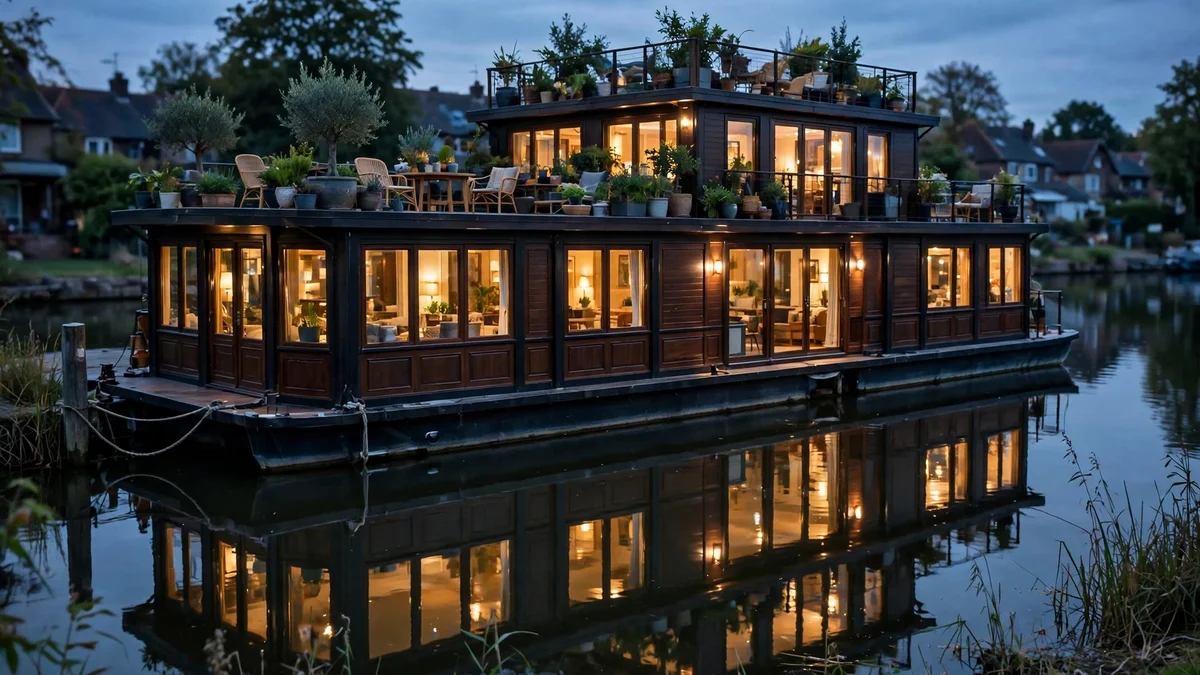
The houseboat sat on a still canal at dusk, lights glowing in every window, a rooftop terrace above and a hot tub steaming on the deck. From the towpath it looked like a handsome floating home, the kind of place where weekends stretch out and mornings start with coffee over the water. Then the owner mentioned the price. The boat cost more than the houses on the street beside it, and the mooring fees alone would cover a family car every year. A luxury houseboat is a home, a boat, and a hotel all at once, and its price is the sum of all three.
A luxury houseboat is a large, fully fitted floating home built for comfortable long-term living on rivers, lakes, and canals, with real bedrooms, bathrooms, a kitchen, and outdoor living space. Unlike a narrowboat or a simple cabin cruiser, it is built to the standard of a high-end apartment, with underfloor heating, stone worktops, air conditioning, and smart-home systems, all packed into a steel or aluminium hull that must float level, stay dry, and pass a boat safety inspection.
Why a Luxury Houseboat Is So Expensive
The price of a luxury houseboat is not one big cost. It is a dozen medium costs stacked on top of each other, each one made worse by the fact that the home also has to float. The hull, the fit-out, the systems, and the mooring all charge a premium, and none of them can be skipped.
The hull: a home built on a boat budget
Every luxury houseboat starts with a hull, usually steel, built and welded by a specialist yard. A widebeam hull of fifteen to twenty-five metres costs an estimated $100,000 to $300,000 before a single room is fitted, because the steel must be thick enough to last decades in the water, the welding must be watertight, and the hull must be painted and blacked with coatings that resist corrosion. A hull built wrong means a home that lists, leaks, or cannot be insured, so buyers pay for yards with a reputation, and those yards charge for it.
The fit-out: a penthouse squeezed into a tube
Fitting out a houseboat is harder than fitting out a flat of the same size, because every centimetre counts and nothing is square. The hull curves, the ceiling is low, and the kitchen, bathroom, and bedrooms must fit around the engine bay, the water tanks, and the fuel tanks. Joiners build bespoke cabinets, beds fold or lift to reach storage, and the galley is a working kitchen in a space smaller than a hallway. The luxury yacht galley faces the same problem at a higher budget, and the houseboat borrows its tricks: induction hobs, compressor fridges, and stone or solid-surface worktops that survive damp air. The finish is where the money shows: oak floors, brass fittings, full-height glazing, and a bathroom with a walk-in shower and underfloor heating, all installed by craftsmen working in a space they can barely turn around in.
The systems: a house that makes its own power and water
A luxury houseboat is off-grid in a way a flat never is. It makes its own electricity from solar panels, a generator, and a large battery bank, heats its own water, treats its own waste, and pumps its own fresh water from tanks that must be filled regularly. The systems are marine-grade, which means they cost two or three times what domestic equivalents cost, and they must be installed by specialists who understand both plumbing and boats. A lithium battery bank alone can cost an estimated $10,000 to $30,000, and a full solar and inverter setup adds more. When something fails, the owner cannot call a normal plumber or electrician; they need a marine engineer, and marine engineers charge marine rates.

The mooring: the most expensive car park on the water
The boat is only half the purchase. A luxury houseboat needs a mooring, and a good residential mooring in a city like London or Amsterdam can cost an estimated $10,000 to $40,000 a year, with waiting lists that run for years. The mooring fee buys water, electricity, waste disposal, and security, but it also buys scarcity: there are far fewer residential moorings than there are buyers, and the best ones change hands for large premiums of their own. Some owners buy the mooring outright, which can cost as much as the boat. How a luxury cruise ship suite is made shows the same logic at sea: the room is only part of the price, and the place it sits is the rest.
Rarity and craft: built one at a time
Luxury houseboats are built one at a time, by small yards, to the buyer’s specification. There is no production line, no volume discount, and no standard model to copy. Each boat takes six to eighteen months to build, and the yard’s skilled labour, welders, joiners, and marine electricians, is the most expensive part of the bill. That rarity also protects the price: a well-built houseboat holds its value because there are so few of them, and a good mooring makes it worth more every year. Why a vintage yacht is so expensive follows the same rule, that a scarce, well-made floating home does not depreciate the way a mass-produced boat does.
Luxury Houseboat Specifications
| Specification | Typical figure |
|---|---|
| Length | 15 to 25 metres, widebeam |
| Hull | Steel, 10 to 12 millimetre plating |
| Living space | 60 to 120 square metres |
| Bedrooms | 2 to 3, plus saloon and galley |
| Power | Solar, lithium batteries, diesel generator |
| Water | 1,000 to 2,000 litre tanks, onboard treatment |
| Mooring | Residential, water and power included |
What a Luxury Houseboat Costs
A luxury houseboat costs an estimated $400,000 to $1.5 million new, depending on size, fit-out, and location, and running costs run an estimated $20,000 to $60,000 a year, covering the mooring, insurance, maintenance, fuel, and blacking the hull every few years. The mooring is the largest running cost, and hull maintenance is the most easily forgotten: the steel below the waterline must be inspected and repainted regularly, or corrosion will eat the boat from beneath. Owners accept the bill because the boat is both a home and an asset, and because no flat offers a garden that changes with the seasons and a view that moves.
A Rare Fact About the Luxury Houseboat
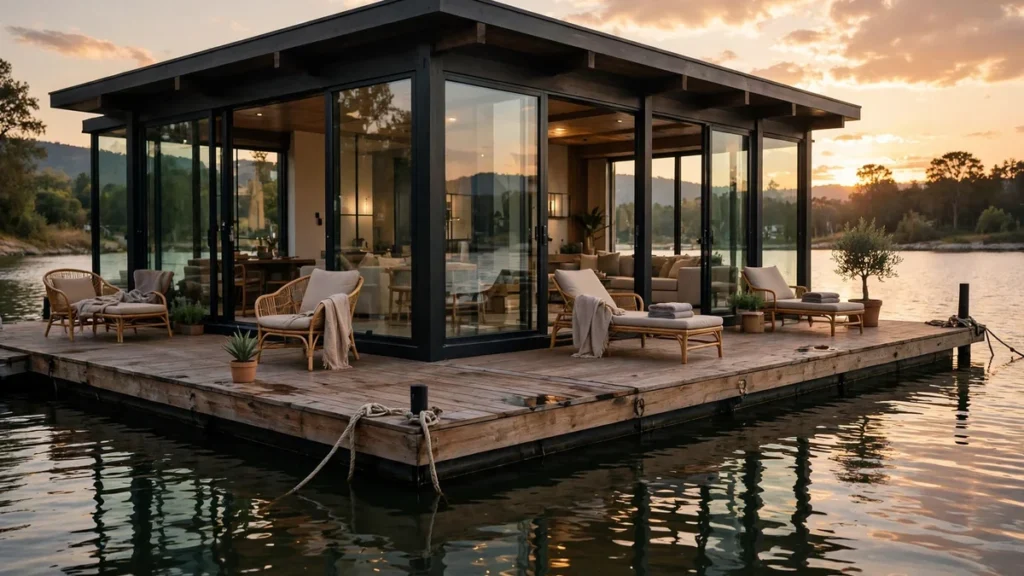
The most expensive houseboats are not on canals at all. On lakes in the Netherlands, Germany, and the United States, floating homes built on concrete pontoons sell for several million dollars, with glass walls, rooftop pools, and no engine at all. They are houses that happen to float, and they are priced as houses in the most expensive neighbourhoods, because that is what they are. The canal houseboat, by comparison, is the affordable end of the market, which says everything about how far the idea has travelled from a steel tube with a bed in it.

A luxury houseboat is expensive because it asks one structure to be two things at once, and to do both to a high standard. It is a boat that must not leak and a home that must feel like one, and the price is what it costs to build both, by hand, in a space no bigger than a bus.