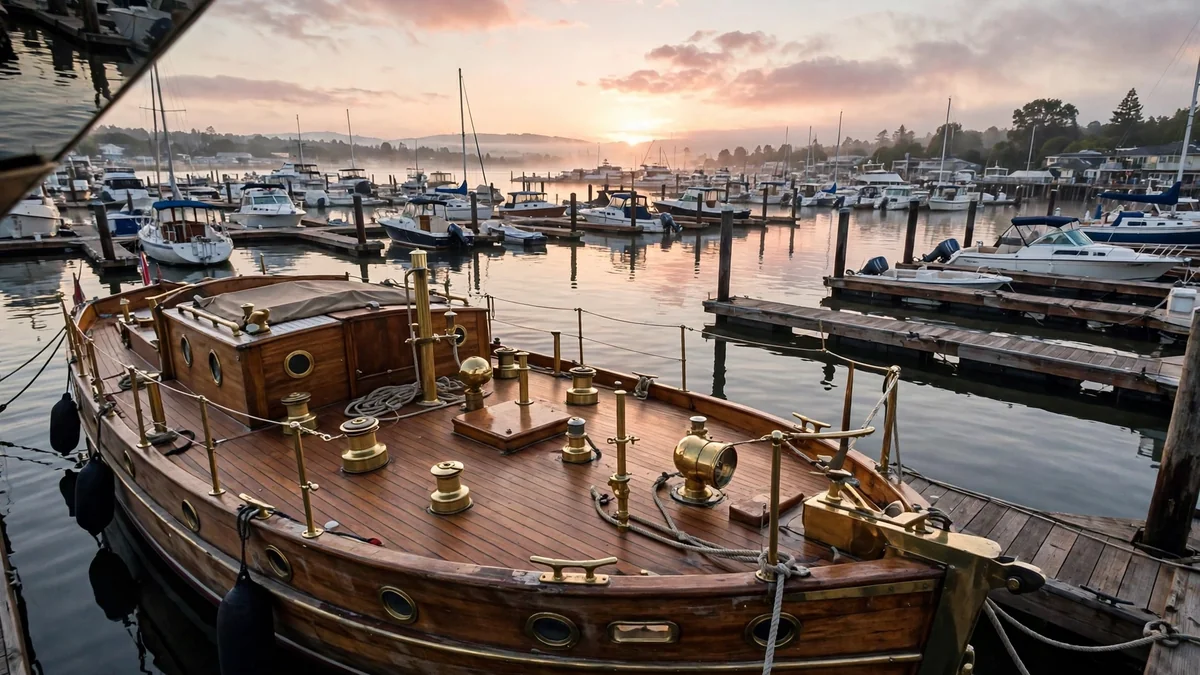
An old yacht sits in a marina in the south of France, its wooden hull gleaming in the morning light, its brass fittings polished to a shine. A broker walks a potential buyer along the dock and names a price that makes the buyer stop: several million dollars, more than a brand-new yacht of the same size would cost.
The buyer looks at the yacht again. The paint is fresh, the teak deck is immaculate, the varnish is deep enough to see a reflection in, and yet the yacht is nearly ninety years old. So why does it cost so much?
The answer is not the yacht itself. It is what the yacht is made of, who made it, how few of them are left, and what it takes to keep one alive.
Why a Vintage Yacht Costs So Much
The craft: built by hand, not by machine
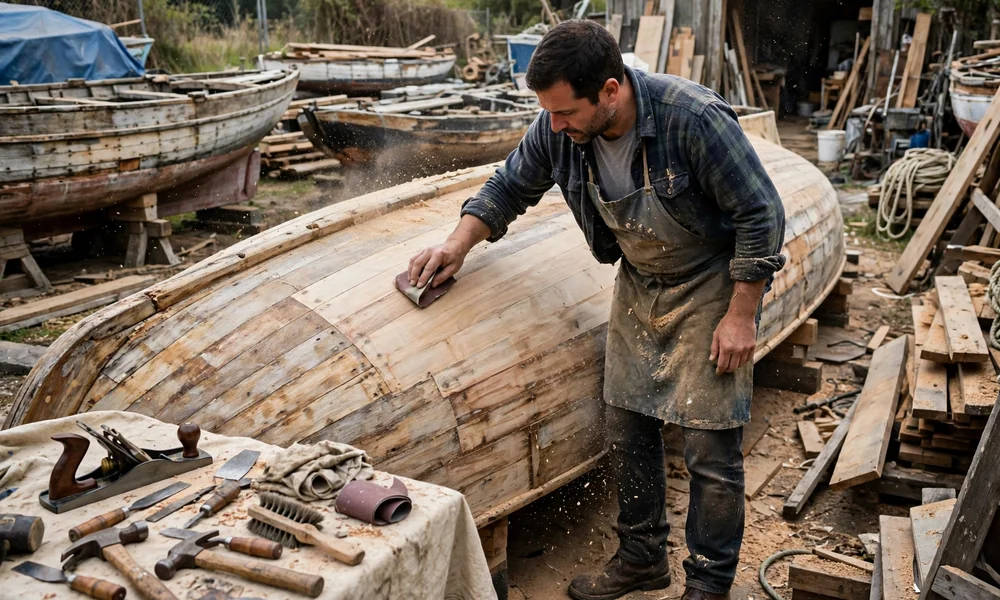
A vintage yacht was built the slow way. Its hull was made from planks of mahogany or teak, steamed and bent over wooden frames, fastened with thousands of bronze screws, and caulked by hand with cotton and pitch. A team of shipwrights might spend two years on a single yacht, and every plank was shaped to fit one place on one hull, never repeated, never mass-produced. When a vintage yacht needs repair, it needs a craftsman who learned a trade that almost nobody learns any more, and that craftsman charges accordingly. The deck alone is a work of art: the way a teak deck is laid, plank by plank, is described in how a yacht teak deck is made, and it is a job that takes weeks of patient work.
The materials: wood that no longer exists
The timber in a vintage yacht is part of the price. The mahogany, teak, and oak used in the 1930s came from old-growth forests, and trees of that size and quality are now rare, protected, or simply gone. A single plank of clear, quarter-sawn teak can cost hundreds of dollars, and a yacht needs hundreds of planks. The bronze fittings, the brass, the lead keel, and the linen sails were all made from materials that are now expensive, restricted, or replaced by cheaper substitutes that do not look or feel the same. That insistence on authenticity is what drives the price up, and it is also what makes the yacht worth owning.
The rarity: few were built, fewer survived
Only a small number of fine yachts were ever built, and most of them are gone. Wooden yachts rot, burn, sink, and get broken up, and the ones that survive are usually the ones that were loved by owners who could afford to keep them. A 1930s yacht that is still sailing is one of perhaps a few dozen of its kind left in the world, and that scarcity is the same force that drives the price of a painting or a rare car. Collectors want what cannot be replaced, and a vintage yacht cannot be replaced, because the yard that built it is gone, the plans may be lost, and the wood it was made from no longer grows.
The labour: maintenance never stops
Owning a vintage yacht is a commitment, not a purchase. The varnish has to be stripped and reapplied every year, the caulking has to be checked and replaced, the rigging has to be inspected, and the hull has to be hauled out of the water and repainted. The annual maintenance bill for a vintage yacht is often estimated at ten to fifteen per cent of the yacht’s value, which means a five-million-dollar yacht can cost half a million dollars a year simply to keep afloat. The full scale of that burden is set out in why vintage superyacht restoration is so expensive, and it is the reason many vintage yachts are sold not because their owners are tired of them, but because they are tired of paying for them.
The interior: joinery that takes years
Step below deck on a vintage yacht and the reason for the price becomes obvious. The cabins are lined in polished mahogany, the drawers are dovetailed by hand, the tables are inlaid with contrasting woods, and the light fittings are brass. That joinery was made by craftsmen who spent their whole lives on one skill, and it takes years to build and months to restore. The art of fitting that woodwork into the curve of a hull is the same art that built the great yachts of the past, and inside superyacht interior joinery production shows how that work is still done today, one piece at a time, by hand.
The story: a yacht with a past
A vintage yacht is worth more when it has a story. A yacht that raced in a famous regatta, that belonged to a film star, that crossed an ocean, or that survived a war carries a history that a new yacht can never have, and buyers pay for that history. The paperwork matters too: the original plans, the logbooks, the photographs, and the record of every owner are part of the yacht’s value, because they prove that the yacht is what the seller says it is. A yacht with a documented past is a known quantity, and a yacht without one is a gamble.
Vintage Yacht Specs
| Specification | Typical range |
|---|---|
| Era | Mostly 1920s to 1950s |
| Hull material | Mahogany, teak or oak planking |
| Length | About 15 to 40 metres |
| Build time when new | About 1 to 2 years by hand |
| Annual maintenance | About 10 to 15 per cent of value |
| Varnish cycle | Stripped and reapplied yearly |
| Surviving examples | Often fewer than 50 of a kind |
| Crew needed | Two to six, depending on size |
What Does a Vintage Yacht Cost?
A vintage yacht is estimated to cost roughly $2 million to $15 million, depending on its size, its history, and its condition. A smaller yacht from the 1950s in good order is estimated at the lower end, while a large, famous racing yacht from the 1930s, with a documented history and a recent restoration, is estimated at the top end or beyond. The purchase price is only the beginning: a full restoration can be estimated at $1 million to $5 million, and the yearly running costs are estimated at ten to fifteen per cent of the yacht’s value.
A Rare Fact
Some vintage yachts were built with a lead keel that weighs more than the rest of the yacht put together, and the lead was poured in a single piece, in a mould dug into the ground of the boatyard. The mould was destroyed to get the keel out, which means the keel can never be exactly reproduced, and if it is ever damaged, the repair is a major piece of engineering.

A vintage yacht costs so much because it is the last of its kind, built by hands that are mostly gone, from wood that mostly no longer grows, and kept alive by craftsmen who charge what their rare skill is worth. It is the one that cannot be made again, and that is what makes it priceless to the people who buy it.