In a large house, the video call in the study never freezes, the film in the living room never buffers, and the doorbell camera at the far end of the garden still answers instantly. Nobody thinks about the small white boxes tucked on shelves in three different rooms, yet they are doing a job that a single ordinary router could never manage. They talk to each other constantly, passing the connection from room to room like a relay team.
A luxury mesh router system is expensive because it is not really one router but a small team of them, each one a powerful computer in its own right. Every node carries fast radios, a strong processor and careful antennas, and the software that binds them together has been tuned for years. The price is the cost of building three or four premium devices, then making them behave as one.

How It’s Made
Step 1: Designing a system, not a single box
A mesh system starts with a map of a home, not with a single device. Engineers decide how many nodes a large house needs, where each one should sit, and how they will talk to each other without getting in each other’s way. One radio band is often kept aside purely for the nodes to speak to each other, so the traffic between them never competes with the family’s phones and laptops for airtime.
That dedicated backhaul is one of the main reasons a luxury system costs more. It means extra radios and extra antennas in every node, and it means the system can move a huge amount of data between rooms without slowing down. The same idea of building separate devices to work as one team appears elsewhere in a smart home, and the way a luxury mesh router is made shows how the nodes are designed together from the start rather than added one by one.
Step 2: Fast radios and careful antennas
Each node carries several radios that work on different bands at the same time, and each radio can talk to many devices at once. The antennas inside are not simple wires but carefully shaped arrays, placed and angled so the signal spreads evenly through a room instead of beaming in one direction. In a luxury system the antennas are tuned by hand in a test chamber, with engineers measuring the signal in every direction and adjusting the layout until the coverage is smooth.
The radios also use the newest wireless standards, which squeeze more data into the same airwaves and waste less time waiting for a clear moment to speak. A cheap router can skip much of this and still work in a small flat; a luxury mesh system is built for a house where a dozen people and a hundred devices all want the network at once.
Step 3: A processor in every node
Inside each node sits a processor closer to a small computer than to a simple router chip. It has to encrypt traffic, manage dozens of connections, decide which node should serve each device, and keep all of that running without a hiccup. In a luxury system the processor is paired with generous memory, so the node can remember every device in the house and make decisions instantly rather than looking them up slowly.
That computing power is also what lets the system move a device from one node to another without dropping a call or a game. The handover is decided in a fraction of a second, based on signal strength and how busy each node is. The specification of the system as a whole is what matters, and the luxury mesh router specifications explained show how the radios, the processor and the memory are balanced against each other rather than chosen alone.

Step 4: Software that manages itself
The most expensive part of a mesh system is often invisible: the software. It has to build the network on its own when the nodes are switched on, heal itself when a node is unplugged, and update itself safely without ever leaving the house offline.
The software also runs the security that keeps the network safe, from automatic updates to a firewall that watches for unusual traffic. A luxury system is supported for years, with new features arriving in updates long after the box is bought, and that long support is part of what the price pays for. It is a service as much as a device, and it is why the same boxes can keep improving instead of going stale.
Step 5: Building, testing and tuning every node
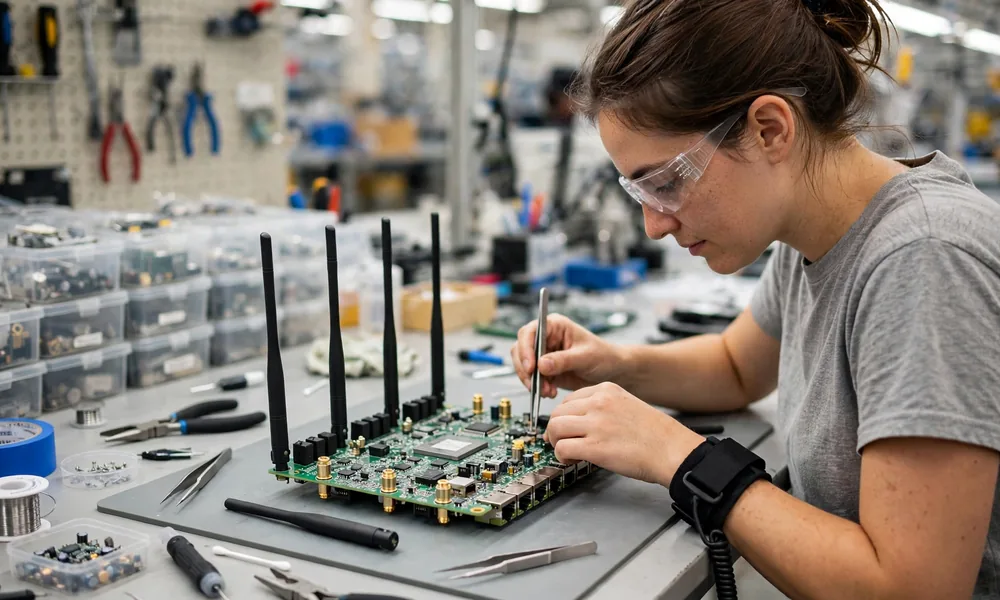
Each node is assembled from a circuit board, radios, antennas, a power supply and a case that must hide all of it while letting the signal out and the heat escape. The case is designed to look at home on a shelf, with no visible antennas and no fan, so the heat has to be managed with careful vents and metal parts that spread warmth away from the chips. Every board is tested before it is put in a case, and every finished node is run for hours to catch any part that would fail early.
The finished system is then tested as a whole in a mock house, with engineers walking from room to room carrying a phone and measuring the speed at every step. Only when the handover is smooth and the speed stays high in the furthest room is the system packed. The same care with a connected device that must simply work appears in other premium smart home gear, and the way a luxury smart doorbell is specified shows how a small device is built to be reliable rather than merely clever.
| Specification | Typical luxury mesh router system |
|---|---|
| Nodes in the box | Two or three, covering a large house together |
| Wireless bands | Two or three bands, one often kept for node-to-node traffic |
| Backhaul | Dedicated radio link between nodes, not shared with devices |
| Processor | Fast multi-core chip with generous memory in every node |
| Coverage | Hundreds of square metres from a multi-node system |
| Device capacity | A hundred or more devices connected at once |
| Security | Automatic updates, firewall and encrypted traffic |
| Design | Fanless, no visible antennas, built to sit on a shelf |
A luxury mesh router system is an estimate of $500 to $1,500 for a set of two or three nodes, depending on the wireless standard, the number of radios in each node and the size of the home it must cover. The price covers several premium devices at once, the software that binds them together and years of updates, and it is a small part of the cost of a connected home that already depends on the network for work, films and security.
Here is a rare fact worth knowing. The nodes in a luxury mesh system spend much of their time talking to each other rather than to your devices, and they do it on a radio channel your phone never sees. When you walk from the kitchen to the bedroom on a video call, the system has already agreed which node will take over before you reach the doorway, and the handover is so fast that the call never notices. The network you use is only half the system; the invisible half is the one that makes it feel like magic.


