The invoice arrived in a plain envelope, and the operations manager opened it the way you open a letter you already know is bad news. What he had not expected was the second number, the one for fuel, and the third number, the one for the crew, and the fourth, for the insurance, and the fifth, for the dry dock. He looked up at the accountant and asked the question every operator asks sooner or later: where does it all go?
A luxury offshore supply vessel is not expensive for one reason. It is expensive for a hundred reasons, stacked on top of each other. The steel is expensive, the engines are expensive, the crane is expensive, the crew is expensive, and the simple fact of keeping a working ship at sea, far from any workshop, in weather that closes ports, makes everything cost three times what it would cost on land.
This is exactly where the money goes, from the first plate of steel to the last polished rail.
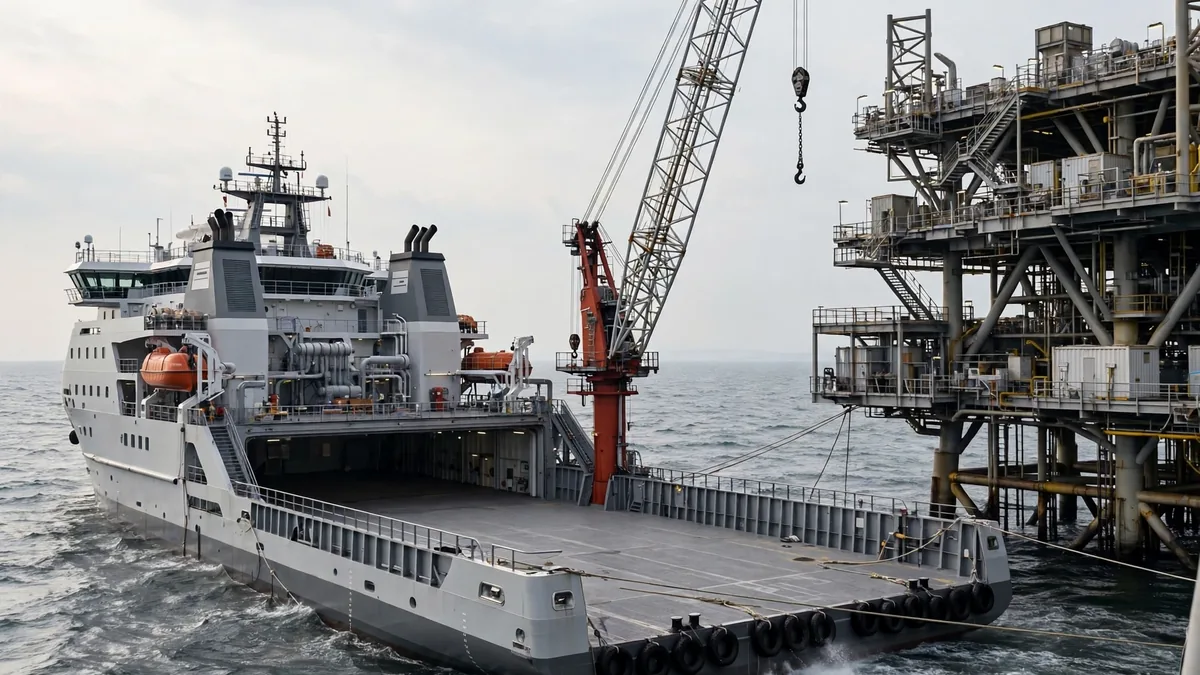
Where the Money Goes on a Luxury Offshore Supply Vessel
The hull and structure: steel, time and certification
The hull is where the money starts, and it starts big. An offshore supply vessel hull is built from marine-grade steel, welded plate by plate in a dry dock, and the welding alone takes thousands of hours, because every seam must be inspected by ultrasound and certified by a classification society. A vessel of about 70 to 90 metres is estimated at 15 to 30 million dollars before a single cabin is fitted, and the certification process, with its surveys, sea trials and paperwork, adds an estimated 1 to 2 million dollars more. How the hull and its systems work together is a story of its own, as our guide to how a luxury offshore supply vessel works explains.
The deck and crane: a floating warehouse that lifts
The open rear deck is the reason the vessel exists, and it is one of the most expensive parts of the ship. The deck is usually about 600 to 1,000 square metres of clear, reinforced steel, built to carry about 1,000 to 3,000 tonnes of cargo, from containers and pipes to drilling equipment and wind turbine parts. The crane, mounted on the deck or the bridge, can usually lift about 50 to 150 tonnes, and a large crane alone is estimated at 2 to 5 million dollars. The deck must be strong enough for a forklift to drive across it in a rolling sea, and flat enough for cargo to be lashed down in minutes, because time alongside a platform is charged by the hour.
Engines, thrusters and systems: a power station below deck
Below the working deck sits a power station. Two or four main diesel engines, each producing thousands of horsepower, plus two or three generators, plus bow thrusters, dynamic positioning systems, water makers, air conditioning plants and fire systems, together are estimated at 10 to 20 million dollars. Every system is duplicated, because at sea there is no repair shop and no second chance: if one engine fails, another must already be running. The dynamic positioning system, which holds the vessel still beside a platform using satellite signals and thrusters, is estimated at 1 to 3 million dollars on its own. How the vessel is built from the keel up is a craft of its own, as our guide to how an offshore supply vessel is made explains.
The crew: the largest bill, every single year
The crew is the largest running cost, and it never stops. A luxury offshore supply vessel needs about 15 to 25 crew: a captain, officers, engineers, deckhands, a cook and often a medic, working in rotations of four to six weeks at sea followed by time ashore. Their wages together are estimated at 2 to 4 million dollars a year, and that is before food, training, flights, medical checks and insurance. The captain alone is estimated at 150,000 to 250,000 dollars a year, because the job carries the legal responsibility for everyone aboard and for a ship worth tens of millions.
Customisation and waiting: one of one, built to order
The last cost is the one buyers forget: the vessel is built to order, and building to order is slow and expensive. A custom offshore supply vessel takes two to four years from contract to delivery, and the owner pays in stages while a team of naval architects, engineers and project managers works only on that one ship. The design fees alone are estimated at 5 to 10 percent of the build cost, and the vessel is fitted for the exact work it will do, whether that is supplying oil platforms, servicing wind farms or carrying subsea equipment. That is why an expedition yacht built the same way carries a similar premium, as our guide to how a luxury expedition yacht works explains.
Luxury Offshore Supply Vessel Costs
| Specification | Typical range |
|---|---|
| Purchase price | Estimated 30 to 60 million dollars |
| Hull and structure | Estimated 15 to 30 million dollars |
| Engines and systems | Estimated 10 to 20 million dollars |
| Deck area | About 600 to 1,000 square metres |
| Cargo capacity | About 1,000 to 3,000 tonnes |
| Crane lift | About 50 to 150 tonnes |
| Crew wages per year | Estimated 2 to 4 million dollars |
| Fuel, one month at sea | Estimated 300,000 to 600,000 dollars |
| Dry dock | Estimated 1 to 3 million dollars |
| Build time | About 2 to 4 years |

What Does a Luxury Offshore Supply Vessel Cost in Total?
A luxury offshore supply vessel typically costs an estimated 30 to 60 million dollars to buy, and an estimated 5 to 10 million dollars a year to keep, which means the running costs pass the purchase price in about six years. The largest vessels, over 100 metres, are estimated at 80 million dollars or more to build, with annual running costs estimated at 10 to 15 million dollars. The purchase price is the ticket in the door; the running cost is the real price of the work, and it is the number that separates operators who keep their vessels earning from operators who quietly sell them after two seasons.

A Rare Fact
The dynamic positioning system on an offshore supply vessel is so precise that it can hold the ship within a metre of a platform in a rolling sea, using satellite signals, wind sensors and thrusters that adjust many times a second. From the dock it looks like a workboat. Up close, it is a computer, a power station and a crane, holding still in the middle of the sea.
A luxury offshore supply vessel is expensive because it is a warehouse, a crane, a power station and a small company, all floating in salt water and all built exactly once. The hull is certified steel, the deck is a reinforced warehouse, the engines are duplicated, the crew is a payroll, and the fuel bill never stops. None of those things is cheap on its own, and together they add up to a number that shocks even the people who can afford it.


