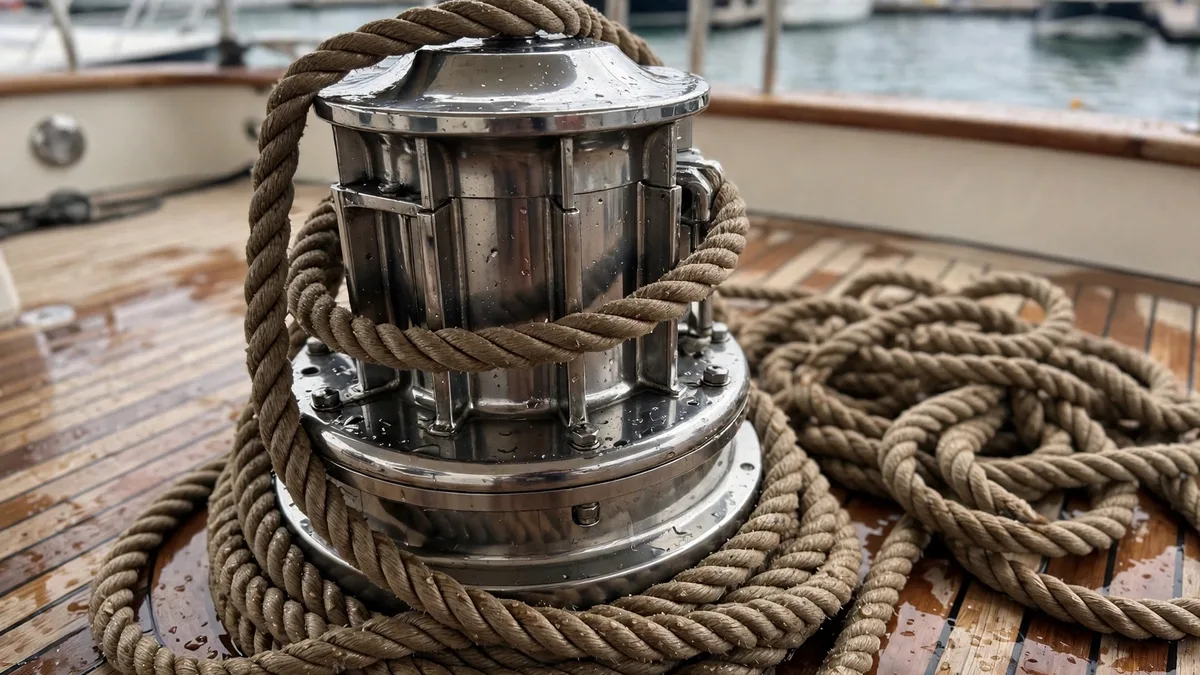
On the deck of a luxury ship, among the polished rails and the teak, sits a squat steel drum that most guests walk past without a second look. It has no screen, no buttons worth noticing, and no obvious glamour. It is a capstan, the machine that hauls mooring lines, and when the shipyard invoice arrives, that unassuming drum can cost more than a small car. Owners ask why, and the answer is not one thing. It is a stack of them: a motor built to pull tonnes without complaint, a gearbox sealed against salt, a drum machined to grip rope without cutting it, and a finish that has to look like furniture while working like a crane.
First, What a Capstan Actually Is
A capstan is a vertical-axis drum that hauls rope. The crew wraps a mooring line around it a few turns, the motor turns the drum, and friction does the rest, pulling a line that a dozen strong people could not move by hand. It is different from its cousins. A windlass hauls anchor chain, with pockets shaped to grip chain links, while a winch winds rope onto a horizontal drum and stores it there. A capstan never stores the line. The line passes around the drum and the crew takes it in on the other side, which means the drum is always working under load and never gets a rest while a line is moving. That constant, loaded duty is the first reason for the price. A capstan on a luxury ship is rated to pull several tonnes, smoothly, in both directions, in rain and salt spray, with guests standing a few metres away. Nothing about that is cheap to build.
The Motor: Small, Sealed, and Enormously Strong
The biggest single cost inside a capstan is the motor and its drive. A luxury ship capstan typically uses a hydraulic or electric motor rated at 15 to 40 kilowatts, tucked under the deck in a sealed housing. It must deliver full torque from a dead stop, hold a loaded line without slipping, and reverse instantly when the crew needs slack. That is a hard life for a motor, and marine motors are built to a different standard from industrial ones. The windings are sealed against salt air, the bearings are oversized for shock loads, and the whole unit is rated to keep working after a wave breaks over the deck. Either way, the drive package alone can cost as much as a family car before the drum is even fitted.
The Gearbox That Never Gets a Day Off
Between the motor and the drum sits a gearbox, usually a worm or planetary set, that turns fast motor speed into slow, immense pulling force. The gears are cut from hardened alloy steel, ground to tight tolerances, and bathed in oil inside a sealed case. They have to survive shock loads every time a line comes taut, and they have to do it silently, because a grinding gearbox on a quiet evening in port would embarrass the owner and disturb the guests. Silence costs money. It means precision machining, backlash kept to a minimum, and a case stiff enough not to ring like a bell. When a capstan fails, it is usually the gearbox that fails first, which is why yards refuse to fit a cheap one.

The Drum: Machined to Grip, Not to Cut
The drum itself looks simple, a steel barrel with a slightly waisted shape, but its surface is a piece of careful engineering. It has to grip a rope hard enough to haul tonnes, yet never cut or glaze the fibres. Too smooth and the line slips, too rough and it shreds a rope worth thousands. The drum is machined, then finished with a profile that holds the wraps in place as the load rises, and the top and bottom flanges are shaped so the line cannot ride off under tension. On a luxury ship the drum is usually stainless steel or bronze, polished to match the deck hardware, and that finish is not vanity. A polished surface resists corrosion, sheds salt, and lets the crew see damage early. A plain painted drum would be cheaper, but it would rust at the waterline of attention, right where guests look.
Where the Money Goes
The table is approximate, and the shares move with size, but the pattern holds across the market. The visible drum is only a fifth of the price. The rest hides below deck, in the motor, the gearbox, and the controls. Installation adds its own cost, because a capstan that pulls tonnes needs a reinforced deck, a sealed penetration through it, and load testing before the ship sails. A yard that skips the testing invites the drum to tear its foundation out on the first hard pull, which is a repair measured in weeks, not days.
| Cost driver | Share of the price | Why it costs so much |
|---|---|---|
| Motor and drive | About 35 percent | Sealed marine motor, full torque from stop |
| Gearbox | About 25 percent | Hardened gears, silent, sealed for years |
| Drum and casing | About 20 percent | Stainless or bronze, machined and polished |
| Controls and safety | About 10 percent | Foot pedals, brakes, overload protection |
| Installation | About 10 percent | Deck reinforcement, sealing, testing |
Controls, Brakes, and the Price of Safety
A capstan that can pull tonnes can also hurt people, so the controls carry safety hardware that adds cost. There is a foot pedal or a hand control that the operator can release instantly, a brake that holds the line the moment power is cut, and an overload device that stops the drum before the line parts. The brake is the expensive part. It must hold a fully loaded line indefinitely without power, in the wet, without fading. That means a spring-applied, hydraulically released brake with friction surfaces sized for the worst case, not the average one. The controls themselves are built to be used with wet hands and gloves, and they are placed so the operator can see the line, the drum, and the dock at the same time. None of this is visible in a photograph, which is why the price surprises people who only see the drum.

Why Not Just Buy a Cheaper One
Cheap capstans exist, and they work, for a while, on small boats in calm water. On a luxury ship they fail in three predictable ways. The motor overheats on a long pull, the gearbox starts to whine and then to grind, and the drum finish pits and stains. Each failure arrives at the worst moment, during a tricky mooring in wind, when the crew needs the machine most. A luxury ship also moors far more often than a working ship, in more ports, with more eyes watching. The owner pays for reliability, for silence, and for a machine that looks like it belongs on the deck. Spread over twenty years of service, the expensive capstan is often the cheaper one, because it is serviced rather than replaced. The small-car price tag buys a machine that pulls tonnes, holds them safely, stays quiet, and still looks polished after a decade at sea. That is what the money is for. To compare the capstan with its closest relative, read why a luxury anchor windlass is so expensive, our guide to how a luxury ship anchor winch works, and how luxury ship mooring works.