A gangway looks like the simplest thing on a luxury ship: a ramp, a pair of handrails and a few metres of metal, and it seems impossible that such a plain object could cost as much as a family car. And yet a gangway for a large luxury ship is estimated to cost between $150,000 and $600,000, depending on its size, finish and ship, and when you understand what it has to do, the number starts to make sense.
The gangway is not a plank. It is a moving bridge carrying hundreds of people a day, swinging with the tide, folding away for sea, and still looking smart enough for a ship that cost a fortune. Every part is built to a higher standard than an ordinary ramp, and in small numbers, often just once, for one ship.

Custom Sizing: Built Once, for One Ship
The first cost driver is simple: no two gangways are the same. A gangway is measured for one ship, one side door, the ports it will visit and the tides it will meet there. The builders look at how high the door sits above the water, how far the tide rises and falls, and how steep a ramp passengers can walk, and from those numbers they fix a length that exists nowhere else. A gangway for a ship visiting the Mediterranean, where the tide barely moves, differs from one built for ports with a four metre tide.
That one-off nature is where the first serious money goes: no production line for gangways, no warehouse of standard sizes, and no discount for buying ten at once. Each one is designed from scratch, modelled in three dimensions, and built once, by hand, in a workshop that may only make a handful a year. The how a luxury ship gangway is made guide shows the workshop steps, but the price comes from every step being done for the first and only time.
Materials: Aluminium, Stainless Steel and the Sea
The second cost driver is the material: a luxury ship gangway is built from metals costing far more than the steel of an ordinary ramp. The frame is almost always aluminium, because a gangway must be swung out by a small crane or davits, so every kilogram counts, and aluminium shrugs off salt spray far better than bare steel. Marine grade aluminium costs several times as much as ordinary structural steel, and it is harder to weld, so the welders who work on it are specialists, and their time costs more.
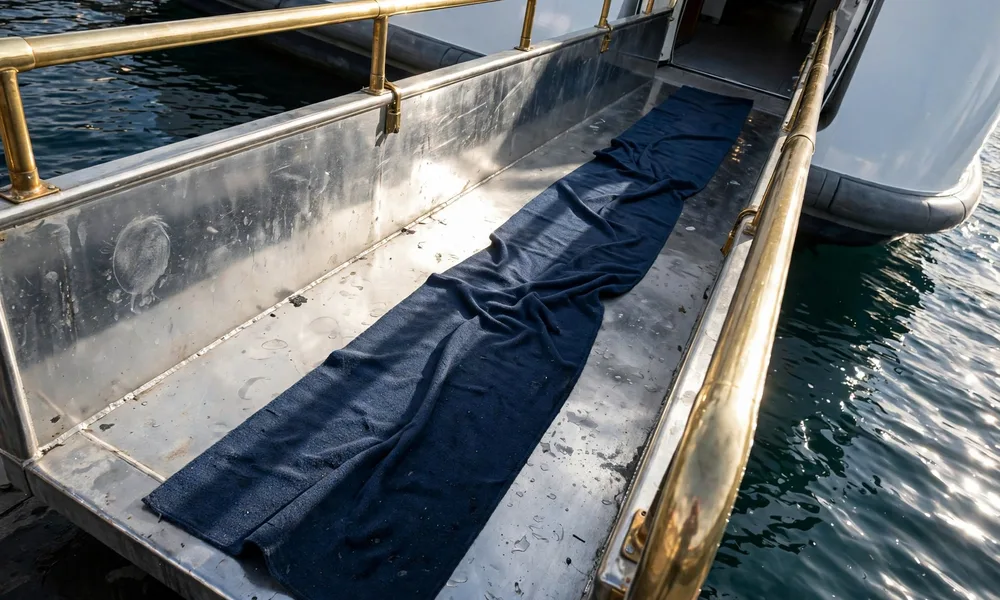
The handrails add to the bill: stainless steel tubes bent to follow the slope and polished until they catch the light. The deck is aluminium grating or diamond-plate tread, chosen to grip wet shoes, and on a luxury ship it is often dressed with a strip of carpet or a wooden tread down the centre for first-class boarding. The fittings, bolts, pivot pin and rollers are all marine grade too, because a fitting that rusts is a fitting that fails under a hundred passengers.
Certification, Testing and the Cost of Failure
The third cost driver is the testing, and on a gangway it is taken very seriously. Before a gangway enters service it is load-tested with weights, and the test is repeated every year. The welds are inspected, the pivot checked for wear, and the handrails pulled hard to make sure they will hold a falling passenger. Each test is witnessed, recorded and signed off by a classification society, the body that certifies the ship, and that certification is not cheap.
The cost of failure is what makes the testing worth it. A gangway that drops, jams or breaks under load can hurt people and strand a ship in port. The luxury ship mooring specifications show the same thinking on the mooring deck, where every line and winch is rated and tested, and the gangway is held to the same standard, because it carries people rather than ropes.
Installation, Finish and the Fitting That Matches the Ship
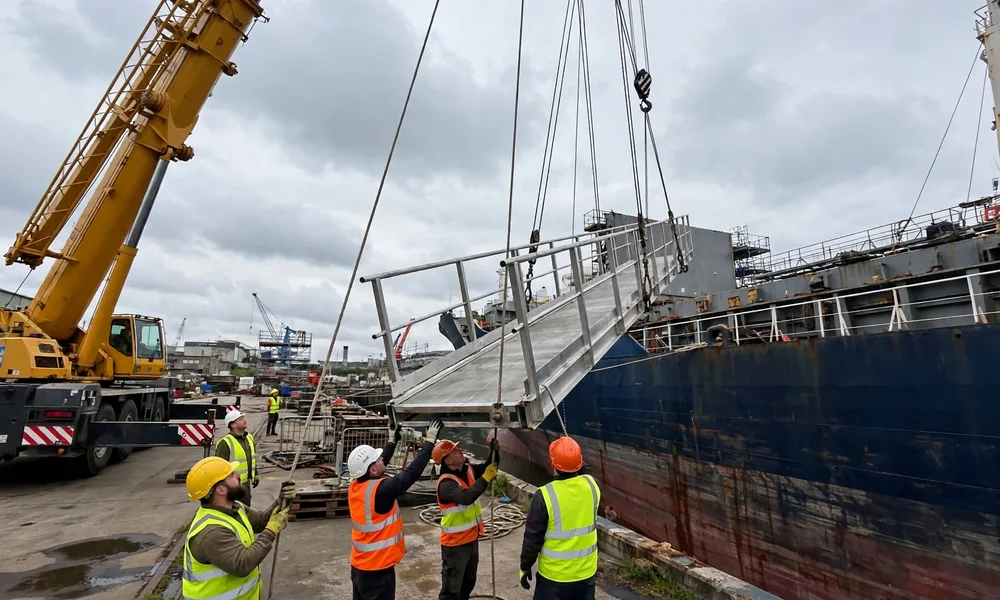
The fourth cost is installation, and it adds up fast. A small team fits the gangway in a port or shipyard, with a crane, davits and barely enough room to work, and the pivot, hoist and rollers must all be aligned to the millimetre, or the ramp will bind every time it moves. The crew test it again and again, raising and lowering it, rolling it along the quay, and checking it sits flat at every tide, because a gangway that drops too fast can hurt someone.
The finish is the last cost, and on a luxury ship it must match the ship. The edges are painted in the ship’s colours, the carpet runner fitted to the exact width of the walkway, and the entrance dressed with polished brass and warm lighting, so the first step aboard feels like an arrival rather than a climb. The luxury ship deck specifications describe the decks the gangway leads onto, and the gangway is finished to the same standard, as the first thing a passenger touches.
The Price, in Plain Terms
Add it up, and a luxury ship gangway typically costs an estimated $150,000 to $600,000, whether a well-equipped single-section ramp for a smaller ship or a long, telescoping gangway with a carpeted deck and polished finish for a large one. Custom design and materials account for the largest share, certification and testing for the next, and installation and finish for the rest. On a one-off gangway with a bespoke entrance, a hydraulic hoist and custom paint the figure climbs higher still, because the ramp is built once, for one ship, and every part is made to order.
A Rare Fact About the Luxury Ship Gangway
The gangway has a surprisingly grand ancestor. In the age of sail, it was a plank, often no wider than a foot, laid between ship and dock, and passengers crossed it carrying their luggage, hoping the tide would not move the ship while they were halfway across. The first proper gangways were built for the great ocean liners, where first-class passengers expected to board in comfort, and the liners competed to make the step aboard feel like entering a hotel. The modern gangway keeps that same job, only now it is aluminium instead of wood, it rolls on the quay instead of scraping it, and it folds away when she sails, so the ramp that was once a plank is now a precision machine that costs as much as a house deposit.
What the Price Means for You
If you ever inspect a luxury ship gangway, look at the welds first: good welds are even and smooth, with no cracks or rough edges, and the handrails should feel solid, with no wobble when you pull them. Look at the deck: the tread should grip your shoes even when wet, and the ramp should sit flat on the quay, with no gap and no bounce. Ask how the gangway is tested and how often, because a ramp that is never tested is an expensive risk, and a good crew will show you the certificate before you step aboard.
The gangway is the smallest bridge on a luxury ship, and its price makes sense once you see what it carries. It is a custom-built, certified, moving bridge, made once for one ship, and priced like the precision machine it is.