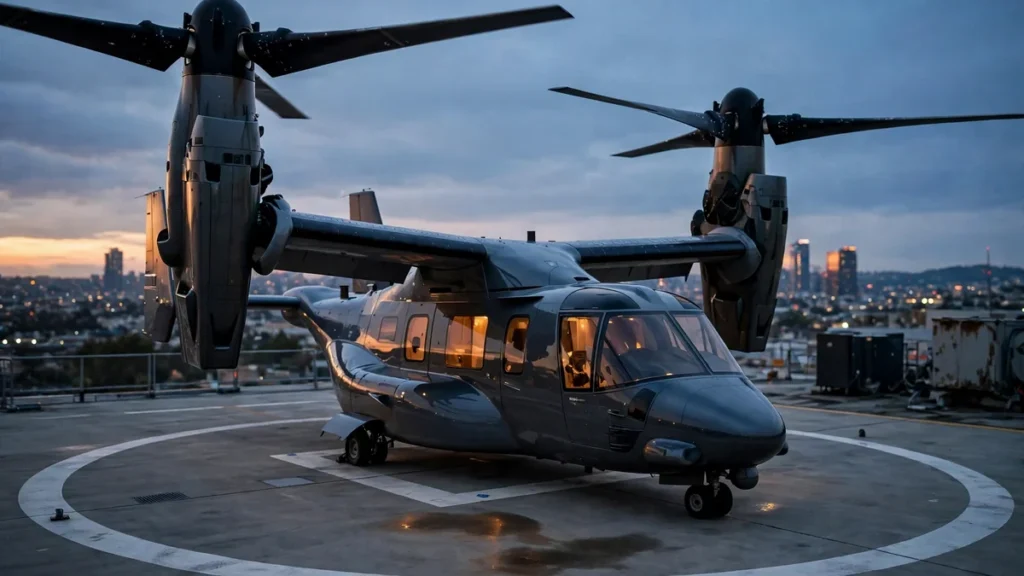
The aircraft lifts off the pad vertically, like a helicopter, rotors horizontal above its wings. Then, as it climbs, the engine nacelles tilt forward until the rotors face ahead like propellers. The wings take over, the speed builds, and within a minute the machine is flying like an aeroplane, twice as fast as any helicopter. It is the oldest trick in aviation, and the hardest to get right: a machine that is two aircraft at once.
A tiltrotor is the most mechanically ambitious aircraft in civilian service. It needs the rotor system of a helicopter, the wing of an aeroplane, and a tilting mechanism that must never fail while carrying people. The luxury end adds a proper cabin and advanced avionics. But the price is not about luxury. It is about a machine that does something no other aircraft can do, and the engineering that makes it possible.
This is why a luxury tiltrotor is so expensive, and where the money actually goes.
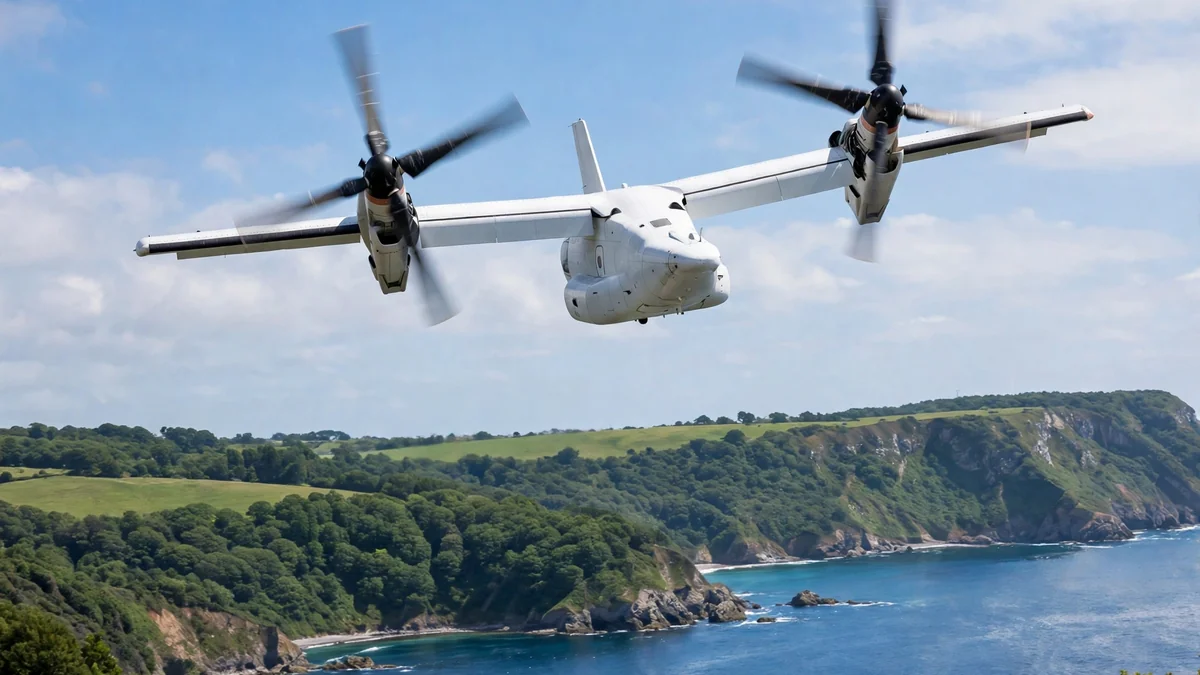
How a luxury tiltrotor works
A tiltrotor is a system of compromises, and every part serves two kinds of flight. The machine must hover safely and fly fast with the same rotors, engines, and wing.
1. The rotors lift the aircraft vertically
For take-off, the engine nacelles point straight up, and the two large rotors act like helicopter rotors, lifting the aircraft off the ground. The rotors are bigger than aeroplane propellers and smaller than helicopter rotors, a compromise that lets them do both jobs. The pilot controls the lift with the rotor pitch, and the aircraft rises vertically from a pad, a deck, or a clearing.
2. The nacelles tilt forward in flight
Once the aircraft is climbing, the nacelles begin to tilt forward, driven by powerful actuators. The transition takes about twelve seconds, and during it the wing gradually takes over the lift from the rotors. It is the most demanding part of the flight, and the flight control computers manage it automatically, adjusting rotor pitch and engine power as the angle changes.
3. The wing takes over for fast flight
With the nacelles fully forward, the rotors act as propellers and the wing carries the aircraft, like a turboprop aeroplane. The tiltrotor cruises at about 500 kilometres per hour, twice the speed of a helicopter, with a range of over 1,500 kilometres. The wing is high-mounted and straight, built to carry the loads of both flight modes.
4. The engines are powerful turboprops
Each nacelle houses a turboshaft engine of several thousand horsepower, driving its rotor through a gearbox. The engines are connected by a cross-shaft through the wing, so if one engine fails, the other can drive both rotors. That redundancy is what makes the tiltrotor safe enough for civilian use.
5. The flight controls blend two aircraft
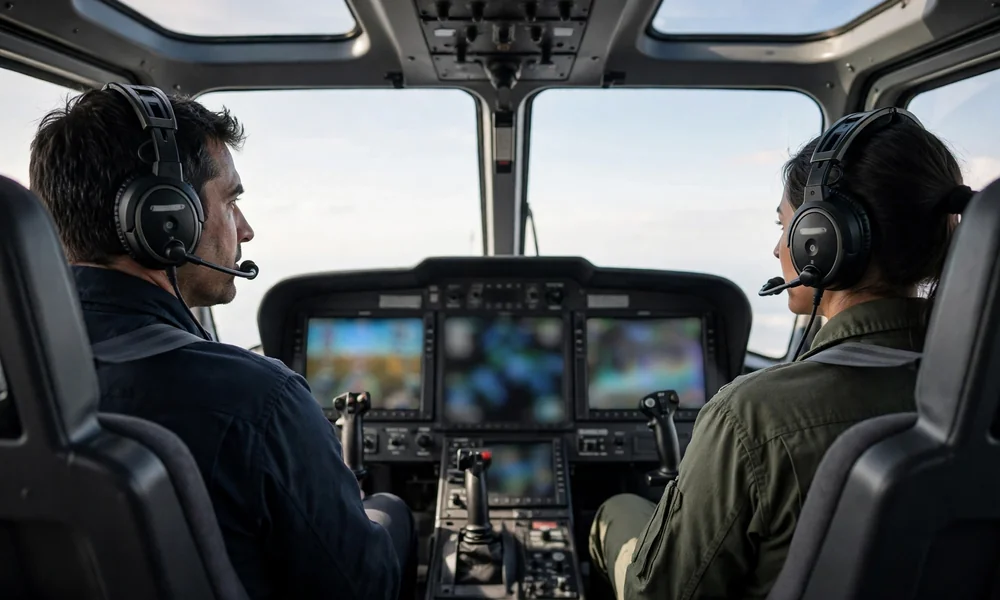
The flight control system blends helicopter controls and aeroplane controls, shifting gradually as the nacelles tilt. In helicopter mode the pilot flies with a cyclic and collective. In aeroplane mode the pilot flies with a yoke and pedals. The computers manage the blend, and the pilot feels one aircraft throughout.
6. The cabin is fitted like a business aircraft
A luxury tiltrotor carries eight to twelve passengers in a pressurised cabin with proper seats and air conditioning. The cabin is wider than a helicopter’s and quieter than most, because the rotors are out on the wingtips. Owners use the aircraft to reach places no aeroplane can land and no helicopter can reach quickly: offshore platforms, mountain resorts, and city rooftops.
7. Landing reverses the whole process
To land, the pilot slows down, the nacelles tilt back up, and the wing hands the lift back to the rotors. The aircraft descends vertically onto its destination, just as it took off. It is the most demanding part of flying a tiltrotor, because the machine is changing from one aircraft into another while it is in the air.
The numbers that matter
The headline figures for a modern civilian luxury tiltrotor:
| Specification | Typical figure |
|---|---|
| Rotor diameter | About 7.9 metres each |
| Engines | Two turboshafts, about 4,700 horsepower each |
| Maximum take-off weight | About 7,600 kilograms |
| Cruise speed | About 500 kilometres per hour |
| Range | About 1,600 kilometres |
| Service ceiling | About 7,600 metres |
| Passengers | 8 to 12 |
| Transition time | About 12 seconds |
The figure that deserves the most attention is the cruise speed, because it is the whole reason the tiltrotor exists. Five hundred kilometres per hour is twice the speed of a fast helicopter, and it turns a three-hour helicopter journey into ninety minutes. That speed is what owners pay for: the ability to leave a city rooftop, fly like an aeroplane, and land on an offshore platform without ever touching a runway.
Engine power is the number behind the speed, and it is what makes the tiltrotor so expensive. Two engines of nearly 5,000 horsepower each, driving rotors through gearboxes that must work in two orientations, is a level of complexity no other civilian aircraft carries. The gearboxes, the tilting mechanism, and the cross-shaft are all bespoke, built in small numbers. The guide to how a luxury tiltrotor works explains the mechanics in detail, and it shows why there are so few aircraft like this in the world.
What a luxury tiltrotor costs
A civilian luxury tiltrotor costs an estimated 25 to 75 million dollars, depending on the model, the cabin fit, and the avionics. The estimate covers the aircraft as delivered, but not the training or the maintenance that follows. The tilting mechanism, the gearboxes, and the flight control computers are the most expensive systems, and they cost so much because they are built in tiny numbers for a market of a few dozen aircraft a year.
Running costs are high too. The engines and gearboxes need specialist maintenance, and the parts supply chain is small and slow. Owners accept this because the capability is unique: the tiltrotor does the job of a helicopter and an aeroplane at once, and for the routes it serves, there is no cheaper alternative. The comparison with the newest electric aircraft is instructive, and the specs of a luxury eVTOL aircraft show a different answer to the same problem, with batteries and multiple motors instead of tilting rotors, and a price that is lower but a range that is far shorter.
A rare fact about tiltrotors
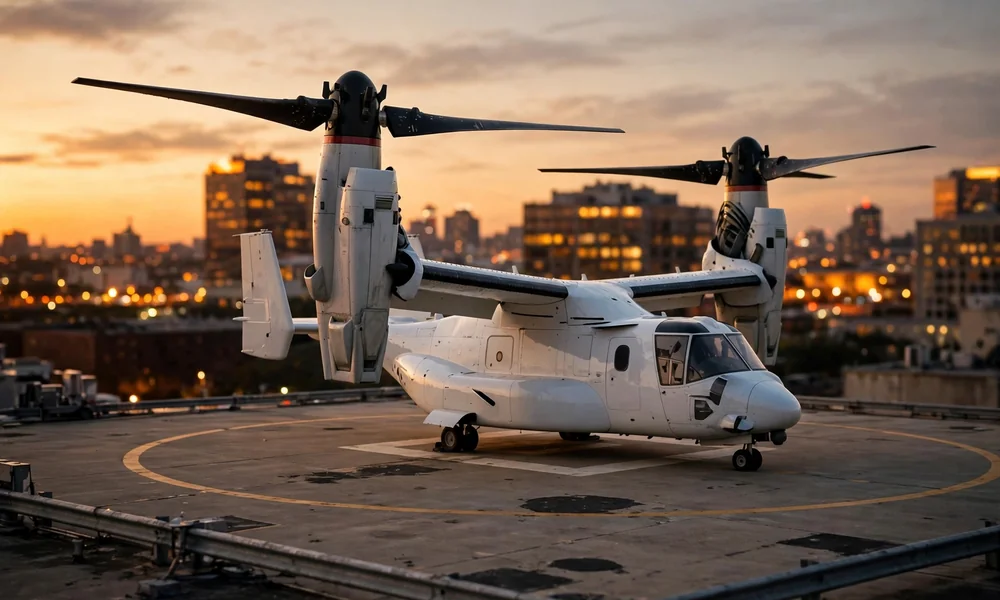
A tiltrotor’s rotors spin in opposite directions, so the torque from one cancels the torque from the other, and the aircraft does not need a tail rotor. The cross-shaft through the wing is the hidden hero: it links the two engines, so a single engine can keep both rotors turning, and it is the reason the aircraft can survive an engine failure in the hover, the most dangerous moment of any vertical flight.
The build behind this is worth understanding, because the making of a luxury eVTOL aircraft shows how the newest generation of vertical-flight machines is made, and how much simpler manufacturing becomes when batteries replace gearboxes. The tiltrotor is the older, harder answer, and it is still the faster one.
A luxury tiltrotor is expensive because it is two aircraft in one, and two aircraft in one means two sets of engineering, two sets of certification, and a market too small to spread the cost. Every dollar is there for a reason, and most of those reasons are things you will never see: gearboxes that work upside down, computers that fly two aircraft at once, and a wing that carries a helicopter into the sky. Read the numbers, then look up. The aircraft climbing away from the rooftop, rotors tilting forward, is doing something no other machine can do.