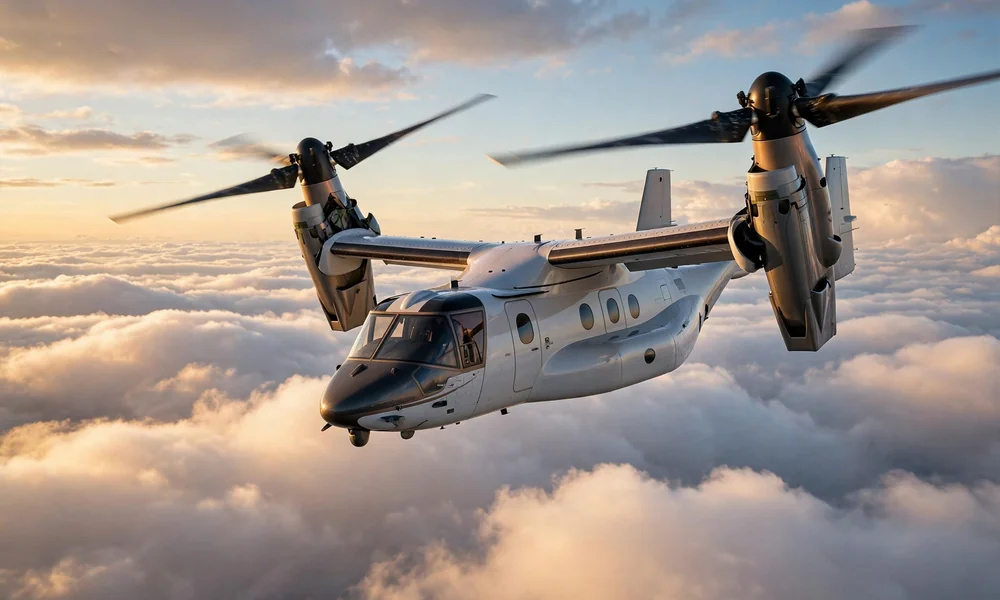
Watch a luxury tiltrotor lift off and your brain files a complaint. The aircraft rises straight up like a helicopter, hangs in the air for a moment, and then its two giant rotors tilt slowly forward until the whole machine is flying like an aeroplane. Nothing in your experience quite prepares you for the transition, because the tiltrotor is two aircraft sharing one airframe, and its spec sheet reads like a compromise negotiated between two very different kinds of flying.
That dual life is the point. A helicopter can land anywhere but crawls through the sky; an aeroplane is fast but needs a runway. A tiltrotor promises the best of both, and the price of that promise is written into every number on its spec sheet: bigger rotors than a helicopter of the same weight, more complex gearboxes than any aeroplane, and a flight control system that has to think in two languages at once. Decode the numbers and you can see exactly where the money went.

How a Luxury Tiltrotor Works
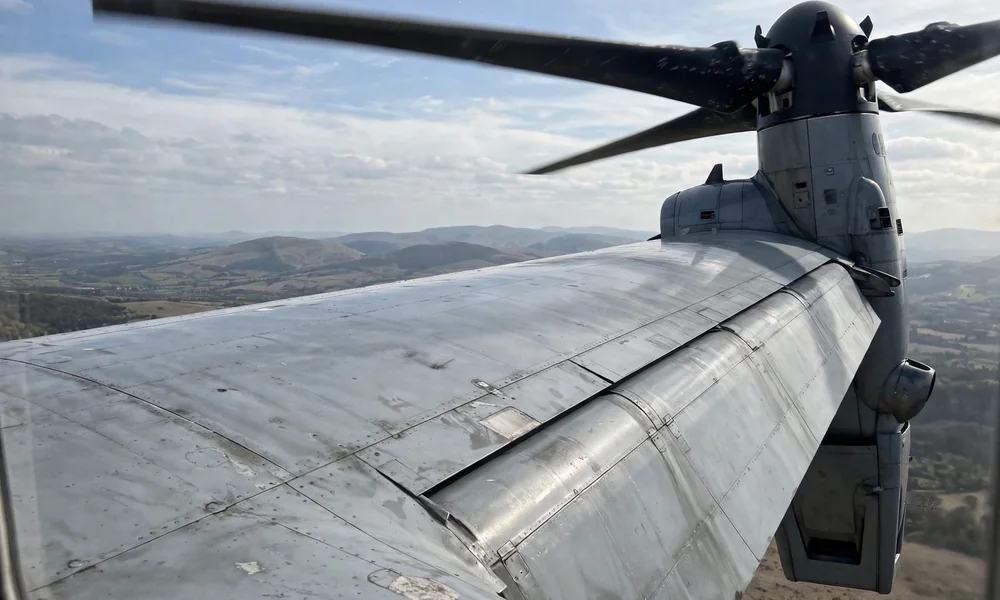
The machine’s trick is a hinge. Each wingtip carries a nacelle holding an engine and a rotor, and the nacelle rotates between vertical and horizontal. Everything else on the aircraft exists to make that hinge safe, smooth and repeatable.
1. Vertical lift, helicopter style
For take-off the nacelles point straight up and the rotors act like helicopter rotors, lifting the aircraft vertically off a pad, a yacht deck or a clearing barely bigger than the wingspan. The pilot controls height with collective pitch, changing the angle of all the rotor blades at once, while small differences between the two rotors keep the aircraft level. At this stage the tiltrotor is a helicopter in every way that matters, including its appetite for power.
2. The nacelles tilt forward
Once clear of obstacles and climbing steadily, the pilot begins the conversion. The nacelles rotate forward over about ten to fifteen seconds, and as they do, the rotors stop lifting the aircraft and start pulling it forward. The wing takes over the job of holding the aircraft up, which is the whole point of the exercise: a wing lifts far more efficiently than a rotor. The transition is the most demanding part of the flight, and it is rehearsed in simulators until it feels routine. The full flight sequence is explained step by step in how a luxury tiltrotor works.
3. Cruise flight on the wing
With the nacelles fully forward, the tiltrotor is an aeroplane. It cruises roughly twice as fast as a helicopter of similar size, at higher altitude, in smoother air, and with far better fuel economy per mile. The rotors spin slower in cruise to save wear, and the cabin settles into something close to the calm of a small business jet. City to city, pad to pad, without ever touching a runway.
4. The gearbox does the heavy thinking
Behind the hinge sits the most expensive piece of machinery on the aircraft. A cross-shaft runs through the wing connecting the two rotors, so that if one engine fails, the surviving engine can drive both rotors and the aircraft can still land safely. The gearboxes that make this possible are machined to tolerances measured in thousandths of an inch, and they are inspected on strict schedules because a failure here has no graceful backup. The gearbox is the reason tiltrotor maintenance bills look nothing like helicopter maintenance bills.
5. Landing reverses the whole dance
Approach reverses the conversion: nacelles tilt back up, the wing hands lift back to the rotors, and the aircraft descends vertically onto its pad. The pilot must manage the descent rate carefully, because a tiltrotor descending into its own rotor wash can lose lift suddenly. Modern flight controls handle much of this automatically, blending pilot inputs with stability systems that a generation ago would have needed a test pilot’s reflexes.
6. The cabin is a business jet inside
Step inside and the military ancestry disappears. Luxury tiltrotors are fitted like small business jets: leather seats for six to nine passengers, sound insulation, a small galley, large windows, and a pressurised cabin for high-altitude cruise. The fit-out adds weight, and weight is the enemy of vertical lift, so every interior panel is engineered to be as light as the budget allows. What that cabin costs, and why, is the subject of why a luxury tiltrotor is so expensive.
The Spec Sheet, Decoded
The table below translates the headline figures into plain English, using typical values for a large modern luxury tiltrotor now in service or in late development.
| Specification | Typical value | What it means |
|---|---|---|
| Rotor diameter | About 11 to 12 metres each | Huge rotors, needed to lift the aircraft vertically. |
| Wingspan | About 14 to 15 metres | Measured tip to tip across the rotors’ hubs. |
| Engines | Two turboshafts, about 6,000 shaft horsepower each | Each engine can drive both rotors if the other fails. |
| Maximum take-off weight | About 15,000 kilograms | The heaviest the aircraft may be at lift-off. |
| Cruise speed | About 250 to 280 knots | Roughly twice as fast as a comparable helicopter. |
| Range | About 700 to 800 nautical miles | How far it flies with reserves, pad to pad. |
| Service ceiling | About 25,000 feet | High enough to cruise above most weather. |
| Passengers | Six to nine, plus two pilots | A small group, in business-jet comfort. |
| Hover ceiling | About 10,000 feet | The altitude where it can still hover safely. |
| Conversion time | About 10 to 15 seconds | How long the nacelles take to tilt between modes. |
The cruise speed is the number that sells the aircraft, but the hover ceiling is the number that limits it: on a hot day at altitude, vertical lift gets marginal fast, and operators plan around it. For a look at another aircraft that refuses to need a runway, luxury seaplane specs explained shows how water take-off shapes a very different spec sheet.
What It Costs
The price of a luxury tiltrotor is an estimate, because so few are built and each one is heavily customised. A reasonable current estimate is roughly 70 to 90 million dollars per aircraft, before the interior fit-out. That buys an aircraft that no helicopter or jet can replace, but it also buys running costs to match: gearbox inspections, rotor servicing, simulator training for two kinds of flying, and a parts supply chain far smaller than anything in the business jet world.
A Rare Fact
Here is the detail that surprises even experienced pilots: a tiltrotor can fly perfectly well on one engine, and it does so by sharing. A shaft running through the wing connects the two rotors, so the surviving engine drives both of them and the aircraft keeps flying and lands vertically. It is the aviation equivalent of two rowers sharing one oar when the other breaks, and it is the single piece of engineering that convinced regulators the tiltrotor could ever carry paying passengers.
Read the spec sheet of a luxury tiltrotor and you are really reading a list of trade-offs, each one bought with money and complexity. The giant rotors buy vertical lift and cost speed; the tilting nacelles buy speed and cost simplicity; the cross-shaft buys safety and costs weight. What emerges is not the best helicopter or the best aeroplane, but the only machine that can do both jobs in a single trip, and that is exactly what its owners are paying for.


