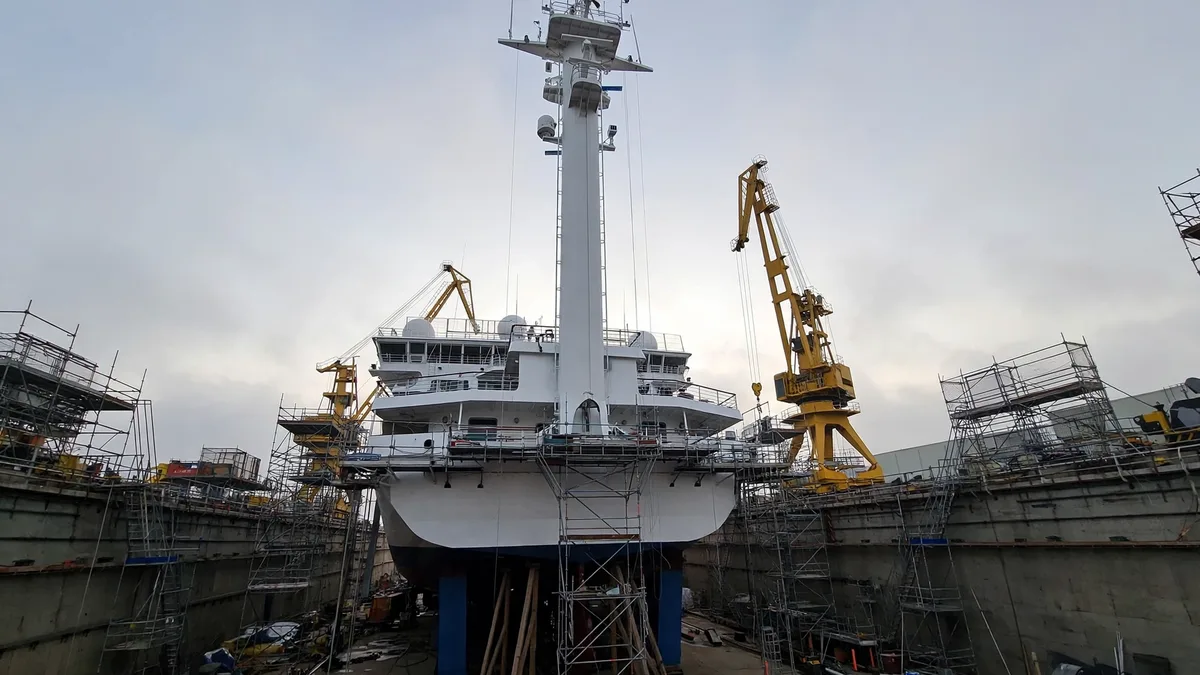
Stand on the open deck of a luxury ship and look up, and the mast is the first thing that pulls your eye. It rises above every deck, above the funnel and the bridge, a slim steel tower carrying radar scanners, antennas and lights, and it seems far too slender for the job it does. In a storm it bends in the wind, it carries tonnes of equipment, and it must hold all of it steady enough for the radar to pick out a small boat miles away in the rain.
A mast is not a single pole lifted into place. This is how a luxury ship mast is made.
How It Is Made
Step 1: The shape is drawn and the loads are worked out
Every mast starts as a drawing, a slim tapering shape worked out by naval architects who balance two things that pull against each other. A taller mast sees further and carries more equipment, but it also catches more wind, weighs more, and sways more in a storm. A shorter mast is stiffer and lighter, but it leaves the radar looking through the funnel and the superstructure instead of over them.
Once the shape is settled, the engineers work out the loads: the weight of the radar scanners and antennas, the push of the wind at full storm strength, and the shake of the ship rolling in a heavy sea. The mast must bend without breaking and sway without shaking its equipment loose, so the drawing fixes the thickness of the steel at every height, thicker at the foot where the bending is greatest, thinner near the top where the load is lighter.
Step 2: The steel sections are rolled and welded
The mast is built from steel plate, rolled into tubes and welded into sections, each one a few metres long. A luxury ship uses high-strength steel for the mast, because the tower must be light enough to lift and strong enough to stand forty or fifty metres above the water, and ordinary plate would need to be far thicker to do the same job.
Each section is rolled from flat plate, the edges are prepared, and the seam is welded along its length, then the sections are checked for straightness, because a mast that leans a fraction of a degree at the foot will be metres off true at the top. Inside each section, the yard fits stiffening rings, the steel hoops that stop the thin tube from buckling when the wind presses on it, and brackets for the cables that will run up inside.
Step 3: The platforms and brackets are fitted on the ground
Before the mast ever leaves the ground, the yard fits the platforms, the small steel decks that stick out from the mast at different heights and carry the radar scanners, the antennas and the navigation lights. Each platform is cut to shape, welded to the tube, and fitted with a handrail, because the crew will stand on it later to service the equipment, fifty metres above the deck, in wind and rain.

Step 4: The radar, antennas and cables go in
With the steelwork done, the delicate work begins. The radar scanners are bolted to their platforms and levelled with great care, because a scanner that sits a fraction out of level will paint a picture that leans, and the bridge will see the coastline in the wrong place. The satellite antennas are fitted on gimbals, the pivoted mounts that let them stay pointed at the sky while the ship rolls beneath them.
Step 5: The mast is lifted and stepped
Lifting the mast is the day the whole yard watches. The sections are lifted by crane, one at a time, and joined together above the deck, each joint welded or bolted and checked before the next section goes up. The lowest section is stepped onto its foundation, the heavy steel base built into the deck below, and bolted down through a flange that spreads the load across the structure of the ship.
Stays and shrouds, the steel wire ropes that brace the mast from the sides, are fitted and tensioned with turnbuckles, pulled just tight enough to hold the mast true without bending it. Too slack, and the mast will sway too far; too tight, and the wire will pull the mast out of straight. The riggers check the mast with a plumb line and a telescope, and they do not stop adjusting until it stands dead upright.
Step 6: The mast is painted, lit and tested
When the last section is joined, the mast is painted, usually white so it reflects the sun and stays cool, with the navigation lights fitted at the heights the rules demand: a white masthead light at the top, red and green sidelights on the platforms, and a stern light that shows from behind. Each light is tested at night, from the dock and from a boat out in the harbour, to prove it can be seen from the distance the rules require.
| Part | Detail |
|---|---|
| Sections | Rolled steel tubes, thicker at the foot, thinner at the top, welded and checked straight |
| Stiffening rings | Steel hoops inside each tube that stop the thin wall buckling under wind load |
| Platforms | Small steel decks at several heights, carrying radar, antennas and lights |
| Radar and antennas | Scanners levelled by hand, satellite domes on gimbals that stay aimed as the ship rolls |
| Cables | Dozens of armoured runs pulled up inside the mast, clipped and labelled at both ends |
| Stepping | Lowest section bolted to a foundation in the deck, braced by stays tensioned with turnbuckles |
What One Costs
Building a luxury ship mast typically costs an estimated $2 million to $8 million, set mostly by its height, the weight of the equipment it carries and the hours of fitting and testing. A shorter mast with a single radar sits near the bottom, while a tall mast with several scanners, satellite domes and tuned dampers inside costs far more. The reasons behind the price are a different story, and why a luxury ship mast costs so much walks through where the money goes, while the story of the steel at the other end of the ship, how a luxury ship bow is made, shows the same care taken at the front of the vessel.
A Rare Fact
Old sailing ships carried a lookout in a crow’s nest, a small barrel-shaped platform lashed to the top of the mast, and the lookout’s job was to spot land, other ships and whales, shouting down to the deck below. The platform was so small that the lookout could barely stand, and in heavy weather he was lashed in so he would not be thrown out. When steel and radar took over, the crow’s nest went, but the habit of putting the ship’s eyes as high as possible never did, and the radar scanner sits today in almost exactly the place the lookout once stood.

A luxury ship mast is drawn to a compromise between height and stiffness, built up from rolled steel sections on the ground, fitted with platforms, radar and cables before it is lifted, then stepped onto its foundation, braced with stays and tested at sea. It is the tallest thing on the ship and the hardest working, and the room it serves sits just below it, where how a luxury ship bridge is made covers the glasshouse the mast looks out for.