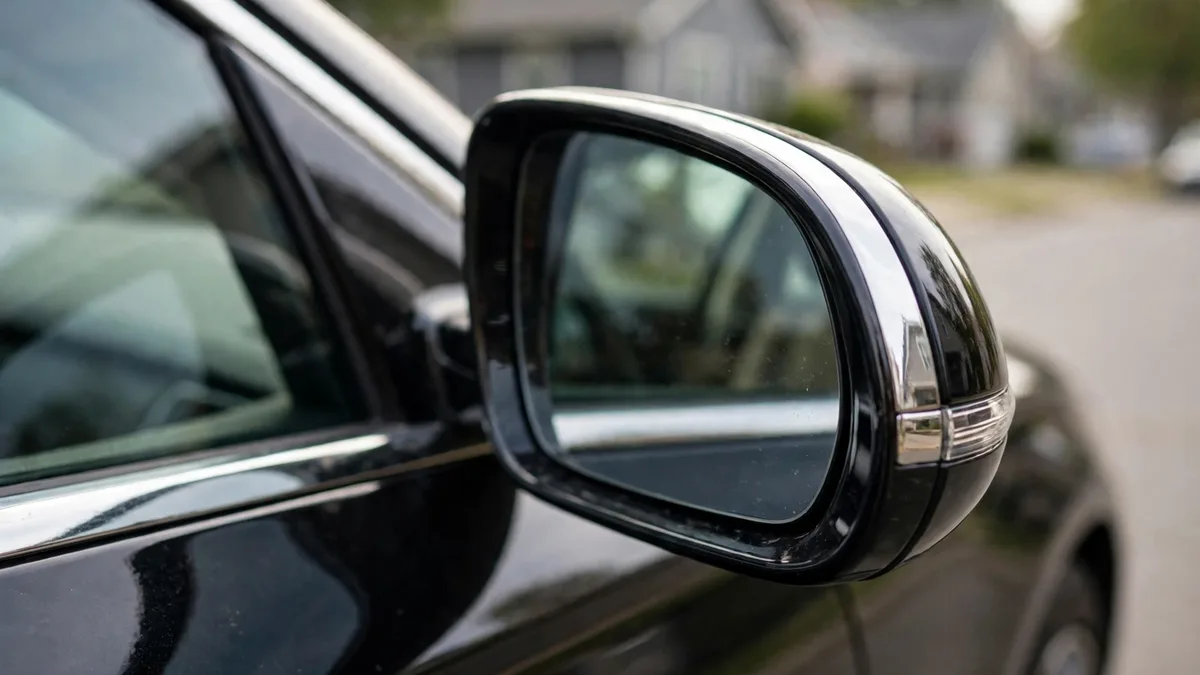
A luxury car mirror looks like a simple piece of glass on a stick, and that is exactly the point. It sits outside the car in rain and wind, it folds itself away when you lock the doors, and it gives you a clear view of the road behind you at motorway speed, all without shaking, fogging or rattling. The mirror does its job so quietly that most drivers never think about it at all, until the day it stops moving or the glass clouds over.
Behind that calm surface is a small machine. The housing holds motors, heaters, sensors and a carefully shaped piece of glass, and every part must work together in a space no bigger than a paperback book. This is how a luxury car mirror is made, from a moulded shell to the glass that shows you the road.
How It’s Made
Step 1: The housing is moulded and shaped
Every luxury mirror begins as a shell of tough plastic, injection moulded in two halves that fit together like a clamshell. The plastic is chosen to stay strong in summer heat and winter cold, and the mould is polished to a mirror finish so the painted surface will look deep and smooth. A rough mould would show every flaw through the paint, so the tooling is checked again and again before the first housing is made.
Once moulded, the halves are trimmed, the mounting points are drilled, and the inside is fitted with ribs that stop the shell from flexing at speed. A housing that bends in the wind would make the glass shake, and a shaking mirror is useless at seventy miles an hour, so the shell is tested by hand and by machine for stiffness before it moves on.
Step 2: The housing is painted and polished
The shell is painted in the same paint shop as the car body, so the colour matches exactly, panel to panel. It is primed, sprayed with colour and clear coat, then baked until the finish hardens into a deep gloss. The painter checks the shell under bright lights, turning it slowly to catch any dust, orange peel or thin patch, and any shell that fails is sanded back and painted again.
Chrome trim is fitted next, a thin strip that runs along the edge of the shell and catches the light. The trim is clipped and glued in place, then checked for a tight fit all the way round, because a loose strip would whistle in the wind and peel away in the car wash. The finished shell is wiped, wrapped and sent to the assembly line.
Step 3: The glass is cut and coated
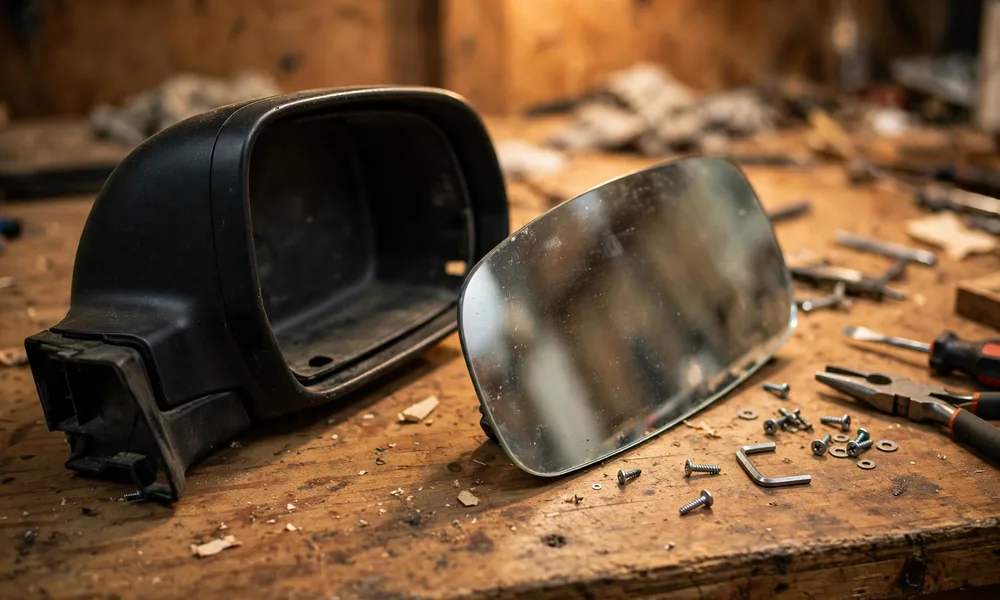
The glass itself is cut from a large sheet of flat glass, then ground to a gentle curve that widens the view without bending the world out of shape. The edges are polished smooth, and the back is coated with a thin layer of silver that turns the glass into a mirror. A second coating protects the silver from damp and salt, because a mirror that tarnishes from behind cannot be cleaned.
Step 4: The motors are fitted and wired
Inside the shell sits a small motor pack, usually two tiny motors that tilt the glass up and down and side to side. The motors are no bigger than a thumb, but they must move the glass smoothly and hold it still against wind pressure at speed. They are screwed into the shell, wired to a small circuit board, and tested by moving the glass through its full range while the current is watched.
A second, larger motor folds the whole mirror against the door, a movement that must work thousands of times without wearing out. The folding gear is greased, the hinge is checked for play, and the mirror is folded and unfolded again and again on a test rig, because a mirror that sticks halfway out in a tight car park is a mirror that will be knocked off.
Step 5: The heater and sensors are added
The heating element is bonded to the back of the glass, and its wires are routed through the shell to a connector that plugs into the door. The heater is switched on and the glass is watched with a thermal camera, to make sure the warmth spreads evenly across the whole surface and not just in one hot patch. A heater that warms only the middle would leave a ring of frost around the edge.
Step 6: The mirror is fitted, tested and checked
The last step is the full assembly. The glass is clipped into the motor pack, the shell halves are closed around it, and the whole mirror is bolted to a test door and wired to a control panel. Every function is run in turn, the glass tilts, the heater warms, the mirror folds, and the blind spot light flashes, while a tester watches and listens for any grind, click or hesitation.
| Spec | Detail |
|---|---|
| Housing | Moulded tough plastic, painted to match the car body |
| Glass | Curved glass with silver coating and protective layers |
| Dimming | Auto dimming layer that dulls headlights at night |
| Heater | Thin heating element that clears frost and mist |
| Motors | Two glass motors plus a folding motor and gear |
| Sensor | Blind spot radar with a warning light in the glass |
The hardest part of making a luxury car mirror is the balance between size and strength. The mirror must be small enough to slip through traffic and fold into a tight space, yet strong enough to hold its glass steady at speed, warm enough to clear frost in minutes, and clever enough to dim itself and warn of cars it cannot see. A mirror that shakes, fogs or sticks feels cheap at once, so the makers test every movement until the mirror feels like a part of the car, not an extra bolted onto it.
What One Costs
A luxury car mirror typically costs an estimated 400 to 1200 dollars for one side, set mostly by the motors, the heated and dimming glass, and the blind spot sensor inside. A simple heated mirror sits near the bottom, while a mirror with folding, dimming and radar costs far more, and a painted shell in a rare colour adds to the bill. The same care runs through the rest of the car, and the best hypercar mirrors ranked show how far the best makers take the idea, while the way luxury car paint is made explains the finish on the shell itself.
A Rare Fact
Some luxury mirrors can remember their position for different drivers. When a second driver unlocks the car with their own key, the mirror moves itself to the angle they set last time, and the seat and steering wheel follow, so the car is ready before the driver has even sat down.
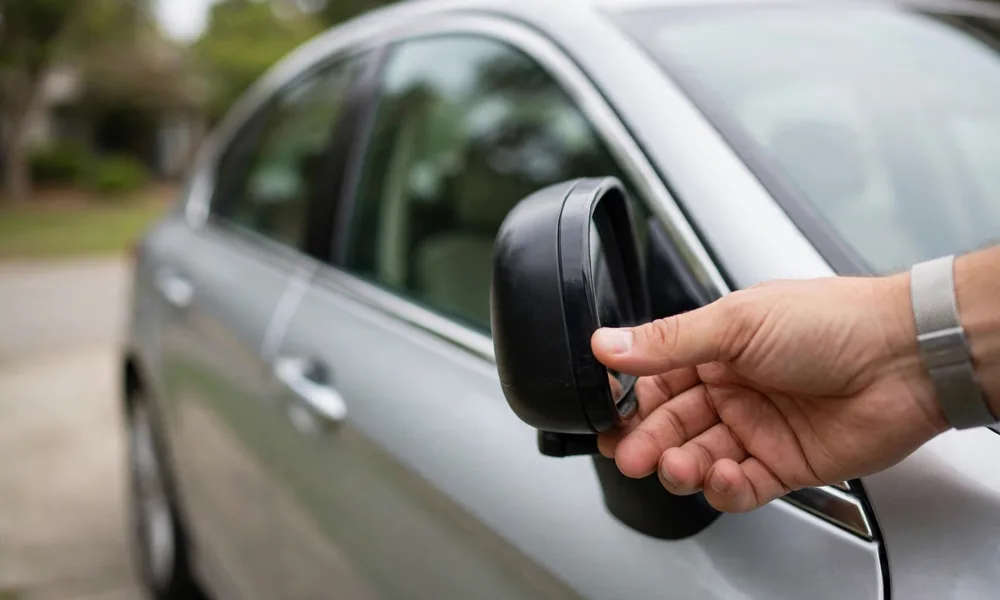
A luxury car mirror is made to be forgotten: a moulded shell, a painted finish, a coated glass, small motors, a heater and a sensor, all tested until every movement is smooth and quiet. It is a small machine with a large job, showing the driver the road behind them in rain, at night and at speed. The same quiet engineering runs through the rest of the cabin, and the way luxury car dashboard is made shows how the view ahead is built to the same careful standard.


