Stand in front of the brightest television in the showroom and the picture looks almost painted on — blacks that are truly black, colours that do not wash out when the sun hits the screen, a brightness that makes every other set beside it look tired. The technology behind that picture is Micro-LED, and the screen in front of you may cost more than a family car. Walk a few steps to the ordinary sets and the difference is still visible from across the room.
A Micro-LED display is not one panel but millions of tiny lights, each smaller than a grain of sand, each making its own red, green, or blue glow. There is no backlight and no colour filter — every pixel is its own lamp, switched on and off alone. It is the most direct way ever devised to make a picture, and also one of the hardest things ever attempted on a factory floor. That difficulty is the price tag.
The cost is not the glass or the frame. It is the act of placing millions of microscopic lights exactly where they belong, and throwing away the panels where even a handful land wrong. Here is where the money goes.
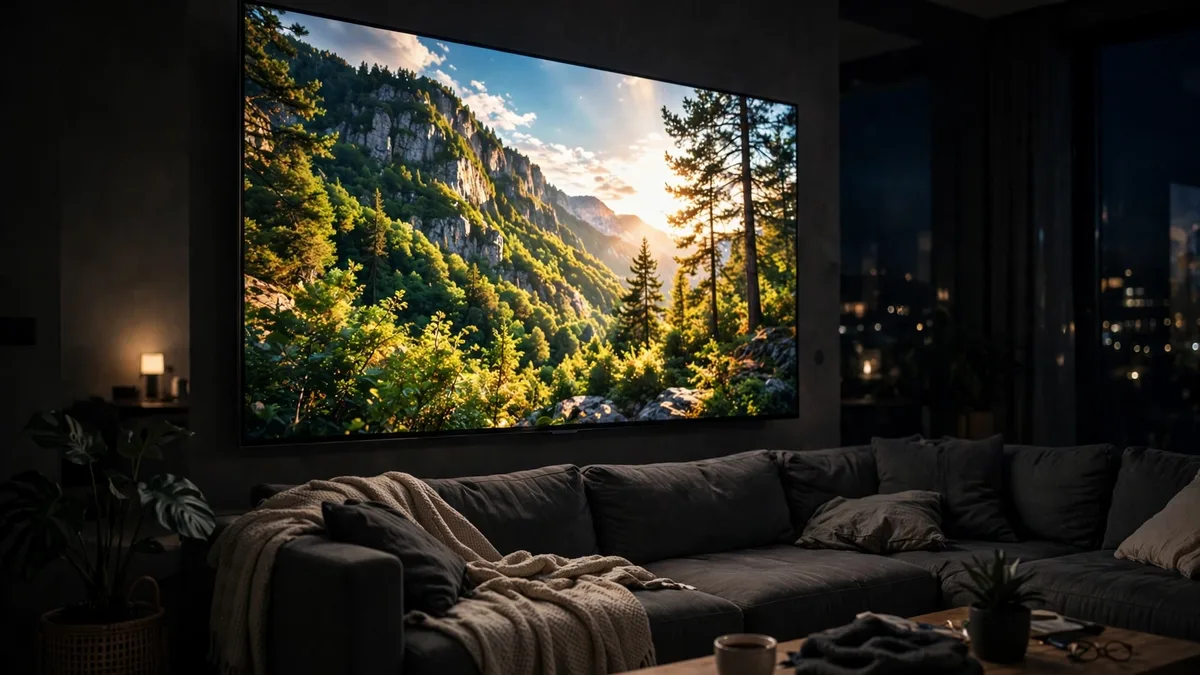
Why a Micro-LED Display Costs So Much
1. Millions of lights, each one placed by machine
A 4K Micro-LED television needs more than eight million pixels, and each pixel holds three microscopic LEDs — over twenty-five million individual lights on a single screen. They are grown on wafers, cut apart, and then transferred onto the display backplane one group at a time by machines that pick them up and set them down with micron accuracy. If a transfer head misses or a chip lands a hair off, the pixel is dead. The transfer step is the hardest manufacturing problem in the display industry, and the machines that do it cost tens of millions of dollars each. How the panels are assembled, from the first wafer to the final test, is covered in our guide to how a Micro-LED display is made.
2. Yields that punish every mistake
With twenty-five million lights on a panel, even a success rate of 99.99 percent leaves thousands of dead pixels — and a television buyer will not accept a single one. Factories therefore repair panels dot by dot, replacing faulty chips with spares, or scrap the panel entirely. Early production yields were so low that most of the cost of a screen was the panels that never sold. Yields are improving year by year, but the repair step still takes time, specialist equipment, and patient operators. The numbers behind yield, brightness, and pixel size are explained in our guide to Micro-LED display specs.
3. The chips themselves are expensive to grow
Each microscopic LED is grown as a crystal layer on a sapphire or silicon wafer, using processes borrowed from semiconductor making. The wafers are costly, the growth runs take hours, and only a fraction of each wafer becomes usable display chips — the rest is lost to edge defects and cutting. Gallium nitride, the material behind the blue and green lights, is not cheap to deposit in perfect layers. The display is, in effect, a semiconductor product wearing a television’s clothes, and it is priced like one.
4. A backplane that must drive millions of pixels alone
Behind the lights sits the backplane, a grid of transistors that switches each pixel on and off and sets its brightness. For a Micro-LED screen it must carry far more current than a normal display backplane, because each tiny LED is driven directly, and it must do so without heating up or dimming at the edges. Some makers build the backplane on silicon, like a computer chip, which gives superb control but limits the screen size; others use glass with thin-film transistors, which scales bigger but is harder to make uniform. Either way, the backplane is a second precision product hiding behind the first, and it adds its own yield losses.
5. Testing at a scale no human can do by eye
Every finished panel is photographed by cameras that inspect millions of points of light, checking brightness and colour against a reference. A pixel that is slightly too dim or slightly too green is flagged for repair or rejection. The inspection rigs work in clean rooms, because a single speck of dust can kill a pixel or short a connection. Clean rooms cost a fortune to build and run, and the air inside them is filtered a hundred times cleaner than a hospital operating theatre. The physics of how each pixel makes its light is covered in our look at how a Micro-LED display works.
6. Small production runs, no economies of scale
Micro-LED screens are still made in small numbers, mostly for very large televisions, luxury installations, and specialist uses. The factories, transfer machines, and repair lines cost roughly the same whether they make a thousand screens or a million, so each screen carries a huge slice of the setup cost. As more factories open and yields climb, prices are falling — the first Micro-LED televisions cost hundreds of thousands of dollars, and today’s large sets cost a small fraction of that — but the technology is still years from the volumes that make ordinary televisions cheap.
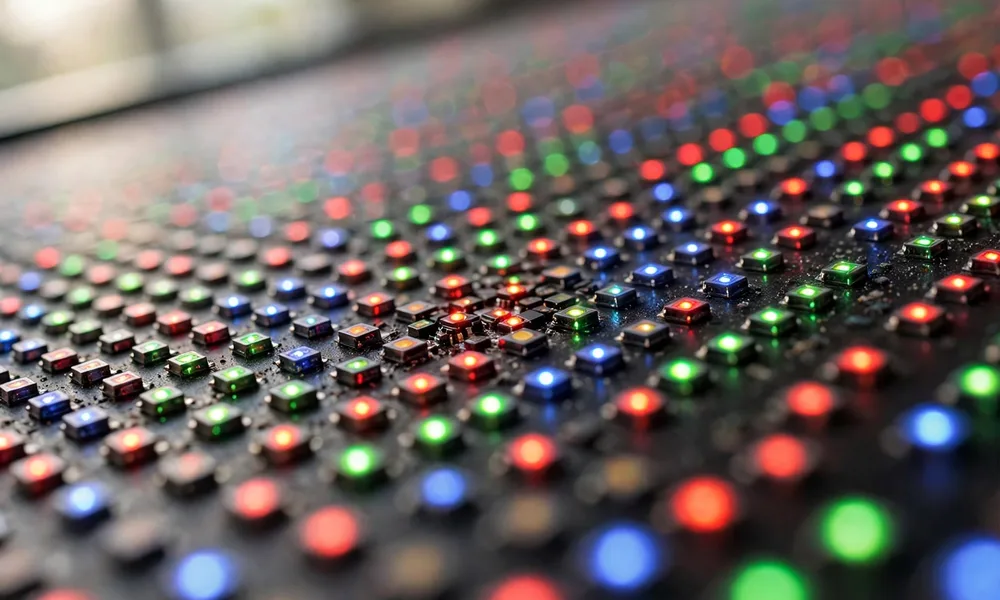
Micro-LED Display Costs at a Glance
| Part of the cost | What drives it |
|---|---|
| Mass transfer | Placing 25 million microscopic LEDs with micron accuracy |
| Yield and repair | Dead-pixel repair dot by dot, scrapped panels |
| LED chips | Crystal growth on sapphire or silicon wafers |
| Backplane | High-current transistor grid driving every pixel alone |
| Testing | Machine inspection in clean rooms |
| Scale | Small production runs spreading huge factory costs |
What Does a Micro-LED Display Cost?
A large Micro-LED television is estimated at $50,000 to $150,000, depending on size, with the biggest luxury screens estimated well above that. Smaller Micro-LED panels for watches and specialist displays are estimated at hundreds to thousands of dollars. Prices are estimates only and vary with size, resolution, and maker. The gap between a Micro-LED set and an ordinary television is the gap between a technology built at scale for decades and one still climbing out of the laboratory.
A Rare Fact
The first Micro-LED display ever demonstrated was not a television at all — it was a tiny screen built by researchers in 2000, and it was so small you could have covered it with a coin. It took more than twenty years of work on transfer machines, repair methods, and backplanes before anyone could build one big enough to hang on a wall. The television in the showroom is the end of a research project that outlasted whole generations of other display technologies, which is why it still carries a pioneer’s price.

A Micro-LED screen earns its price one pixel at a time, and there are twenty-five million of them to earn it with. As yields rise and factories multiply, the price will keep falling — but for now, the brightest picture money can buy is also one of the hardest pictures ever made.


