Point your phone at a bird on a distant rooftop and pinch to zoom. The bird fills the frame, sharp as a photograph taken with a lens the size of a coffee mug, yet the phone in your hand is barely eight millimetres thick. Nothing about that moment feels expensive. But hidden in one corner of your phone, folded sideways like a periscope in a submarine, sits one of the most costly optical assemblies ever put into a consumer device, and it is the reason flagship phones can see so far.
The trick is the fold. A normal camera lens needs a long straight path for light to travel, and a phone has no room for one. So engineers bounce the light off a prism, turning it ninety degrees so it runs sideways across the phone, through a stack of lenses, before it reaches the sensor. That sideways journey makes a long zoom possible in a thin body. It also makes the module fiendishly difficult to build, because every element in that folded path must be perfect.

Why It Costs So Much
A periscope zoom lens looks like a small metal box with a square window. Inside is a folded optical system that borrows ideas from submarines, telescopes and watchmaking at the same time. The cost comes not from any single part, but from how many near-impossible things have to be done right in a space smaller than a matchbox.
Reason 1: The prism has to be optically perfect
Everything starts with the prism, a small block of glass that catches the light coming through the phone’s back and bends it sideways. If the prism’s faces are not flat to within a fraction of a wavelength of light, or if its angles are off by even a few seconds of arc, the whole image goes soft. Prisms are cut from high-grade optical glass, ground and polished in stages that take hours, and then coated to reflect almost all the light that hits them. A prism with a flaw the size of a speck of dust is scrap.
Reason 2: The lens stack is long and unforgiving
Once the light turns sideways it passes through five to seven lens elements, more than most ordinary phone cameras use, because a zoom must stay sharp at several magnifications. Each element is aspheric, shaped to a curve no sphere can match, and each one is made from a different glass or moulded plastic chosen for how it bends light. The tolerance for tilt or sideways shift is measured in microns. The same obsession with stacking tiny parts in perfect order drives the motors that move a camera’s autofocus lens, where parts smaller than a grain of rice must work flawlessly millions of times.
Reason 3: The zoom mechanism moves on rails thinner than a hair
A periscope lens does not just sit still. To zoom, one or more groups of lens elements slide back and forth along tiny rails inside the module, driven by voice-coil motors or piezoelectric actuators. Those rails must be straight to within a micron over their whole travel, and the moving groups must return to exactly the same position every time, or the focus drifts. Building a precision linear stage the size of a fingernail, then making it survive a drop onto concrete, is closer to watchmaking than to ordinary manufacturing.
Reason 4: Stabilisation has to fight in two directions
At ten times zoom, the shake of your hand is magnified ten times too. A periscope module therefore carries its own stabilisation system, tilting the prism or shifting a lens group dozens of times a second to cancel the tremor. The system reads gyroscopes, calculates the correction and moves the optics, all in a few milliseconds, while the zoom mechanism is also moving. Designing two precision mechanisms that share the same tiny box without interfering with each other is a problem few engineering teams in the world have solved.
Reason 5: Coatings are applied one atom at a time
Every glass surface in the folded path carries several anti-reflective coatings, laid down layer by layer in a vacuum chamber. Without them, light would bounce between the elements and wash the image out with flare and ghosting, and the effect is worse in a folded system because the light crosses more surfaces. Each coating recipe is tuned to that exact lens design and takes hours to apply in a spotless cleanroom.
Reason 6: Dust is the enemy, and the box must be sealed
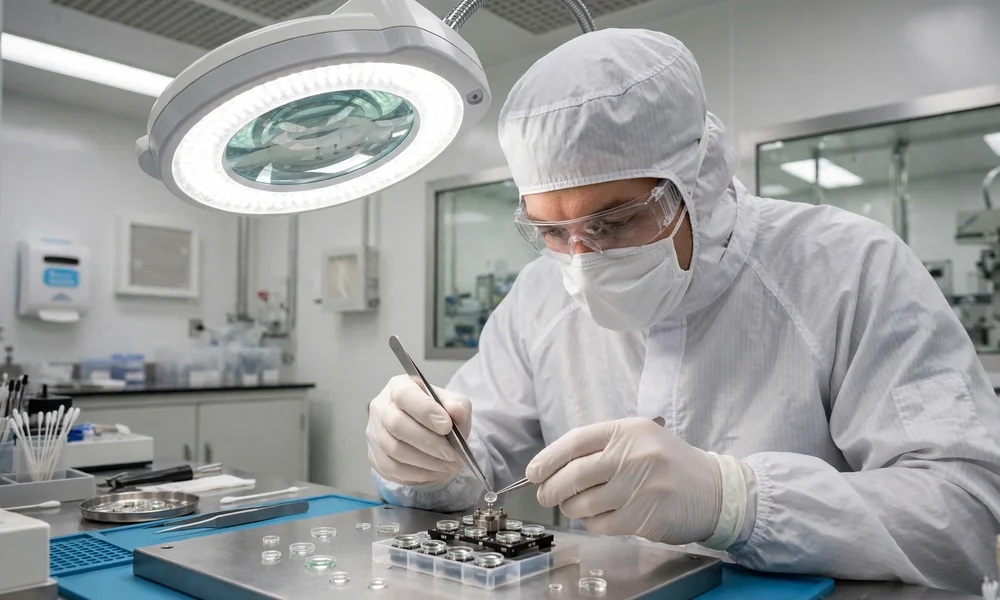
A speck of dust inside a normal lens is a nuisance. Inside a periscope module it sits in the folded light path, where it can cast a shadow on every photograph the phone ever takes. Assembly therefore happens in cleanrooms, with workers in full suits, and the module is sealed against dust and moisture before it leaves the factory. Keeping a delicate mechanism steady under shake and shock is a challenge shared with flying cameras, where the gimbal inside a camera drone performs a similar balancing act in the air.
Reason 7: Only a handful of factories can build it
The whole process, exotic glass, precision prisms, aspheric moulding, vacuum coatings, micron assembly, lives in a small number of factories run by companies such as Largan Precision and Sunny Optical. Building a competing line costs hundreds of millions of dollars and takes years to reach acceptable yields, so phone makers pay a premium for capacity. The periscope module alone can cost more than some whole budget phones, which is why it still appears only in flagships. The same economics govern other exotic sensors, where a thermal camera sensor costs a fortune for reasons that have little to do with its size.
Specifications
| Specification | Detail |
|---|---|
| Optical design | Folded periscope, light bent 90 degrees by a prism |
| Lens elements | Typically 5 to 7, mostly aspheric |
| Zoom range | Usually 3x to 5x optical, up to 10x in some flagships |
| Prism material | High-grade optical glass, polished and coated |
| Alignment tolerance | Within a few microns across the folded path |
| Zoom mechanism | Voice-coil or piezoelectric motors on precision rails |
| Stabilisation | Prism or lens-shift optical stabilisation |
| Module size | Roughly the size of a matchbox, a few millimetres thick |
Price
A periscope zoom module is one of the most expensive parts of a flagship phone. Industry estimates put a complete flagship rear camera system at roughly $50 to $100 per unit in volume (estimate), with the periscope module accounting for a large share of that. A replacement camera module through an official repair programme can cost several hundred dollars (estimate). The glass itself is cheap; the price is in the prism, the coatings, the moving parts and the yield losses.

Rare Fact
The prism inside a periscope phone lens is polished so flat that its surface deviates by less than a fraction of the wavelength of visible light, a standard once reserved for telescope mirrors and submarine periscopes. The same folded-optics idea was used in military periscopes a century ago; the modern version simply shrank it to the size of a fingernail and taught it to zoom, focus and steady itself dozens of times a second.
That is the quiet extravagance hiding in the corner of a flagship phone: a folded telescope built from exotic glass, coated one atom at a time, aligned by machines that watch what the lens sees. It costs so much because there is no cheap way to bend light around a corner and keep it perfect.


