Your phone is thinner than a pencil, yet its camera can read a street sign a hundred metres away. That should be impossible: a real zoom lens needs length, and a phone has almost none. The trick is a piece of glass the size of a grain of rice, folded sideways into the phone, bending light through a right angle like a submarine’s periscope. It is one of the cleverest optical illusions in modern engineering — made from materials more exotic than most people realise.
The periscope zoom lens takes the long optical path a telephoto needs and lays it flat along the phone’s width, using a prism to fold the light. Inside that tiny folded tunnel sit lens elements so precisely shaped that a fingerprint would ruin them, moved by motors smaller than a match head. Every material in there fights the same enemy: size.
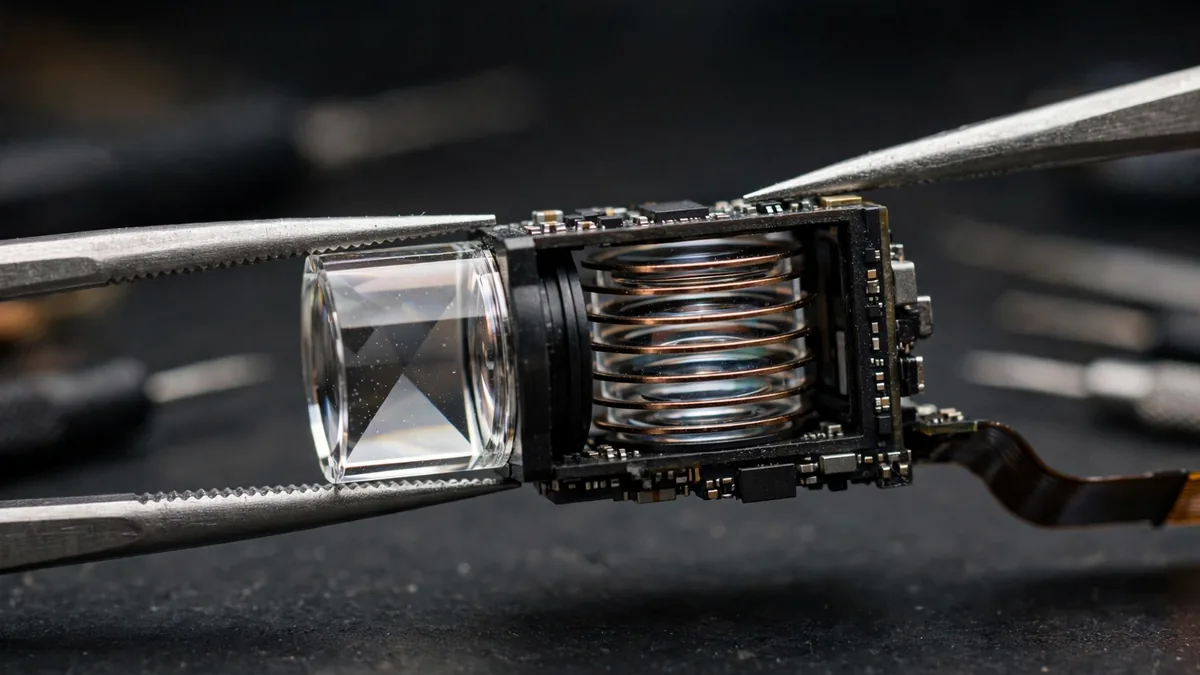
The Materials Behind the Periscope Zoom Lens
The star material is optical glass — not window glass, but specialist formulations with precisely controlled refractive indices, including high-index glass that bends light sharply and low-dispersion glass that keeps colours together. The prism is usually dense optical glass or a glass-ceramic, polished to a mirror finish on its angled face. The barrel and housing are moulded from engineering plastics and aluminium, the moving elements ride on ceramic ball bearings or a liquid-metal guide, and focus and stabilisation are driven by voice-coil motors using neodymium magnets and copper coils.
Step 1: Designing the folded light path
Optical engineers start with the focal length they need — often a 100 mm or 120 mm telephoto equivalent — and the thickness they have, usually under 9 mm. The solution is to turn the light 90 degrees with a prism at the camera window, then run it sideways through a stack of lens elements to the sensor at the far end. Every extra element sharpens the image but steals light and space, and every fold adds a surface that can scatter light. The materials are chosen here, because a lens element’s glass decides how much it bends light and how much colour fringing it introduces.
Step 2: Making the prism
The prism is the heart of the module. A block of high-index optical glass is cut, ground and polished until its faces are flat to a fraction of a wavelength of light and its angled face reflects light by total internal reflection — no mirror coating needed, just glass and physics. The prism must be flawless: a bubble or scratch inside it becomes a smear across every photo. Polishing uses cerium oxide slurry on machines that measure the surface with lasers, and a prism that fails inspection is ground down and started again. The glass used here is the same family that makes a periscope zoom lens so expensive to produce at all.
Step 3: Grinding and moulding the lens elements
Each lens element begins as a blank of optical glass, ground on diamond wheels and polished until its curve matches the design to within nanometres, then coated with anti-reflective layers a few atoms thick that stop light bouncing off the surface. Some elements are moulded instead: glass heated until soft and pressed into a precision mould, which is how the tiny aspherical shapes that correct distortion are made affordably. A module may hold five to seven elements, each thinner than a coin, and each is cleaned in an ultrasonic bath before assembly — a speck of dust between two elements is a permanent blur.

Step 4: Building the moving lens group
Zooming and focusing happen by sliding a group of lens elements along the folded path, moved by a voice-coil motor — a copper coil in a neodymium magnet’s field — that positions the group to within a micrometre. The moving group rides on tiny ceramic ball bearings or a polished guide rod, because any tilt blurs the image. The same motor technology stabilises the image, shifting the lens to cancel hand shake, many times a second. It is the miniature cousin of the camera autofocus motor in a full-size camera, shrunk to fit in a phone.
Step 5: Assembling the module in a cleanroom
Assembly happens in a cleanroom: the module is sealed for life, and anything trapped inside stays there. Workers in gloves and gowns place the prism, lens stack, motors and sensor into a housing no bigger than a sugar cube, aligning each element under a microscope and fixing it with ultraviolet-cured adhesive. Alignment is checked with a test chart: if the image is sharp in the centre but soft at the edges, an element is tilted by a fraction of a degree and the module goes back for rework. A finished module is tested for focus speed, stabilisation and zoom range before it meets a phone.
Step 6: Bonding the module into the phone
The module is mounted to the phone’s frame, aligned with the camera window in the back glass, and connected to the main board with a flexible ribbon cable. The window glass itself is part of the optics — coated to resist scratches and fingerprints, its thickness accounted for in the lens design. Around the module, the phone’s body provides the stiffness that keeps the folded light path straight; a flexing phone would throw the prism out of alignment, which is why the camera area of a flagship phone is built like a tiny chassis.
Step 7: Calibration and the first zoom
Before the phone ships, the periscope lens is calibrated. The factory measures its focus at several zoom positions, maps its distortion and colour fringing, and stores correction data in software so the image processor can clean up what the glass cannot. The camera app then blends optical zoom with digital cropping to stretch the reach further — a trick that only works because the optical image is sharp to begin with. The result is a phone that zooms like a camera with a lens ten times its thickness, a feat that owes as much to glass as to the smartphone camera lens craft before it.

Periscope Zoom Lens at a Glance
| Specification | Detail |
|---|---|
| Key optical material | High-index and low-dispersion optical glass |
| Prism | Dense optical glass, total internal reflection |
| Lens elements | Five to seven, ground or moulded, coated |
| Typical optical zoom | 5× to 10×, around 100–120 mm |
| Focus and stabilisation | Voice-coil motor, neodymium magnets, copper coils |
| Guides | Ceramic ball bearings or polished guide rods |
| Module size | A sugar cube, under 9 mm thick |
What Does It Cost?
A periscope zoom module costs several times more than an ordinary phone camera module (estimate) — typically tens of dollars per unit (estimate), against a few dollars for a basic fixed lens. The premium comes from the precision glass, the prism polishing, the miniature motors and the cleanroom assembly, all lower-yield than standard camera parts. For the phone maker it is one of the most expensive components after the display and the processor.
A Rare Fact
The periscope lens descends from a military invention: the first periscopes let submarines and trench soldiers see without being seen, folding light around a corner with prisms and mirrors. The phone version uses the same physics, shrunk a thousandfold. There is a pleasing symmetry in it — a technology built to let a submarine peer above the waves now lets a phone peer across a stadium — and the glass in your pocket is polished to the same standard as a surveyor’s telescope.