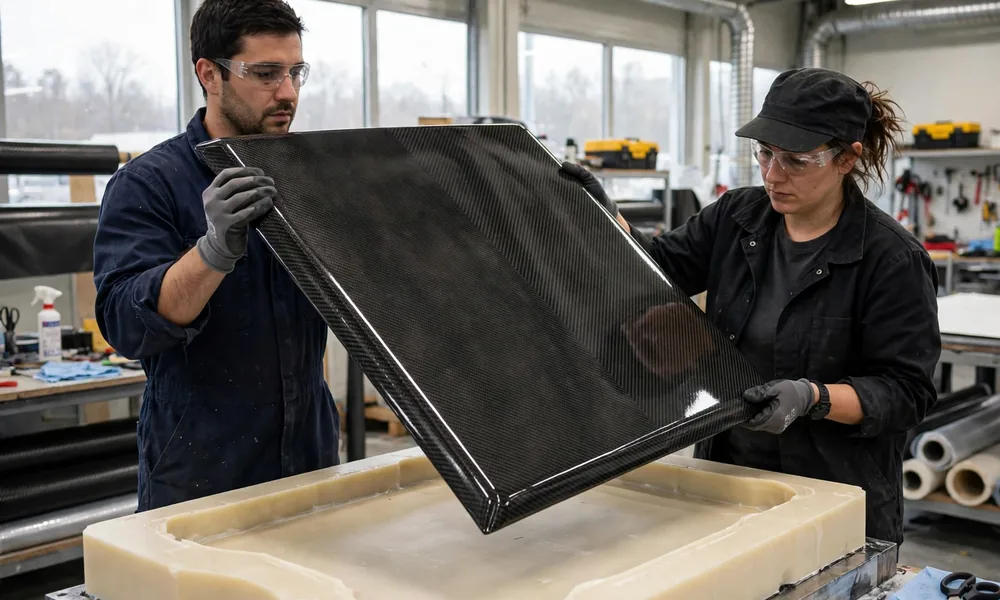
The mould is a smooth white shape the size of a small boat, and across it lies layer after layer of black carbon fibre cloth, each one smoothed down by hand so that no wrinkle or bubble remains. Over the top goes a clear plastic bag, sealed around the edges with tape, and a pump begins to hum. The bag tightens against the cloth as the air is drawn out, and then, through a thin spiral tube, dark resin begins to creep across the fabric, slow as honey, filling every gap between the fibres. Nobody touches the part again until the resin has cured. That quiet, patient process is vacuum infusion, one of the most expensive ways to make a composite part.
Vacuum infusion makes parts that are lighter, stronger, and cleaner than parts made by hand-laying resin onto cloth with a brush. It is how racing yacht hulls, aircraft panels, and high-end car parts are built, prized because it produces a part with exactly the right amount of resin and almost no trapped air. The price of that quality is paid in materials, in time, and in skill, and it is paid on every single part.

Why It Costs So Much
Reason 1: The materials are expensive before work begins
Carbon fibre cloth is costly by the square metre, and a large part can need many layers of it, plus peel ply, flow mesh, spiral tubing, bagging film, sealant tape, resin, and hardener, all single-use. The resin is a specialist epoxy, chosen for the part, mixed in exact ratios and used within its working time. Every consumable is thrown away after one use, so the materials bill includes a pile of expensive disposables that never appear in the finished product. The process is described in how vacuum infusion is made, and the list of what goes into a single infusion is long.
Reason 2: The layup is slow, skilled handwork
Before the bag goes on, every layer of cloth must be cut to shape, laid into the mould by hand, smoothed, and checked for wrinkles, gaps, and contamination. A stray hair, a fingerprint of grease, or a fold in the cloth can become a weak spot, so the work is done in a clean area by people who have spent years learning how the cloth behaves. A large hull or panel can take a team days to lay up, and that careful handwork is a large share of the final price.
Reason 3: One leak can ruin the whole part
Vacuum infusion depends on a perfect seal. If the bag leaks, air enters the resin, the flow stalls, and the part can end up with dry patches where the fibres never wetted out. Finding a leak means listening for a hiss, brushing soapy water over the seams, and patching the bag while resin flows, all against the clock. A bad leak can mean stripping the whole layup off the mould and starting again, losing days of work and costly material. The figures that define a good infusion are explained in the vacuum infusion specifications, and the vacuum level is the number the whole team watches.

Reason 4: The mould is a major investment
A vacuum infusion part is only as good as its mould, and a mould for a large part is a major engineering project in itself. It must be stiff enough not to flex under vacuum, smooth enough to give a fair finish, and fitted with flanges and ports and a surface that releases the cured part without damage. A mould for a yacht hull can cost as much as a house, and only pays if many parts are made from it. For a one-off part, the mould alone can cost more than the part it produces.
Reason 5: Curing takes time, heat, and control
Once the resin has flowed, the part must cure, and curing is not simply waiting. Many epoxies need a controlled post-cure at elevated temperature, so the part must go into a large oven, or be heated with blankets and monitored with sensors, for hours. The temperature must rise and fall on a schedule: a cure that is too fast can crack the resin, and one too slow can leave it soft. The oven, the energy, and the monitoring all add cost. The cloth itself is covered in the carbon fibre weave specifications, which explain why the fabric costs what it does.
Reason 6: The parts are made in small numbers
Vacuum infusion is used for parts that are too large, too complex, or too demanding for a press or a moulding machine, and those parts are almost always made in small numbers. A racing yacht hull, a prototype aircraft fairing, or a bespoke car panel may be one of a handful ever made, so the cost of the mould, the tooling, and the team’s learning curve is spread across a few parts, not thousands. That is the fundamental economics of the process: superb quality, in small numbers, at a high price per part.
Vacuum Infusion at a Glance
| Specification | Detail |
|---|---|
| Main reinforcement | Carbon fibre or glass fibre cloth |
| Resin type | Epoxy, sometimes vinyl ester or polyester |
| Vacuum level | Typically 90 to 99 percent of full vacuum |
| Fibre content | Often 55 to 65 percent by volume |
| Void content | Usually under 1 percent in a good part |
| Mould type | Single-sided mould with vacuum bag |
| Cure method | Room temperature plus heated post-cure |
| Main advantage | High strength, low weight, consistent quality |
| Main drawback | Slow, labour-intensive, leak-sensitive |
What Does It Cost?
All figures below are estimates, not quotes, and the real numbers vary with the size of the part, the fibre and the workshop.
| Cost item | Typical estimate |
|---|---|
| Carbon fibre cloth and resin | $500 to $3,000 per part (estimate) |
| Vacuum bagging consumables | $200 to $800 per part (estimate) |
| Hand layup labour | $1,000 to $5,000 per part (estimate) |
| Mould cost, shared per part | $500 to $5,000 per part (estimate) |
| Curing, oven time and finishing | $300 to $1,500 per part (estimate) |
| Finished part, mid-size panel | $2,500 to $15,300 per part (estimate) |
Those estimates are for one mid-size part, and they rise steeply with size: a full yacht hull can cost tens of thousands of dollars in materials and labour alone. The money buys a part lighter and stronger than a hand-laid equivalent, with almost no voids, and for a racing yacht or an aircraft, that difference is worth paying for.
A Rare Fact
Vacuum infusion was once a boatbuilder’s trick, developed to make large hulls without the heavy, resin-rich laminates of hand layup. It worked so well that aerospace engineers adopted it, and today the same basic process is used for aircraft parts and wind turbine blades. The largest vacuum-infused parts in the world are wind turbine blades, some longer than a football field, infused in a single pour that can take hours and must not be interrupted.
Vacuum infusion is expensive because the materials are costly and single-use, the layup is slow skilled handwork, one leak can ruin the part, the mould is a major investment, the cure takes time and heat, and the parts are made in small numbers. Pay for all of that, and black cloth and a bag of air become a part stronger than steel for its weight; cut corners, and the resin will find the gap you left.


