On a workbench in a composites workshop, a sheet of black carbon fibre cloth lies dry in a mould, looking like nothing more than dark fabric. An hour later it will be a rigid panel stronger than steel and lighter than aluminium, with a glossy surface that needs no paint. No brush has touched it. The change happened under a sheet of clear plastic, pulled tight by nothing but air pressure — or rather, the lack of it.
This is vacuum infusion, a way of making composite parts by letting a vacuum suck liquid resin through dry fibre. It is how boat hulls, wind turbine blades, racing car panels and aircraft parts are made when they need to be both light and strong, without the bubbles and weak spots that hand-applied resin leaves behind. The process is quiet, clean and oddly simple to watch, and the results are spectacular. Here is how it is made.

How It’s Made
Step 1: Laying up the dry fibre
Everything starts with the mould, a smooth form shaped exactly like the finished part. Workers lay dry sheets of carbon fibre or glass fibre into it, one layer at a time, each sheet cut to a pattern and smoothed into the curves by hand. A boat hull might take six or eight layers; a turbine blade many more. The fibres must lie flat with no wrinkles or gaps, because a wrinkle becomes a weak spot in the finished part. This dry lay-up is the slowest part of the job, and the most skilled, since the shape of the part is decided here, long before any resin arrives.
Step 2: Building the vacuum bag
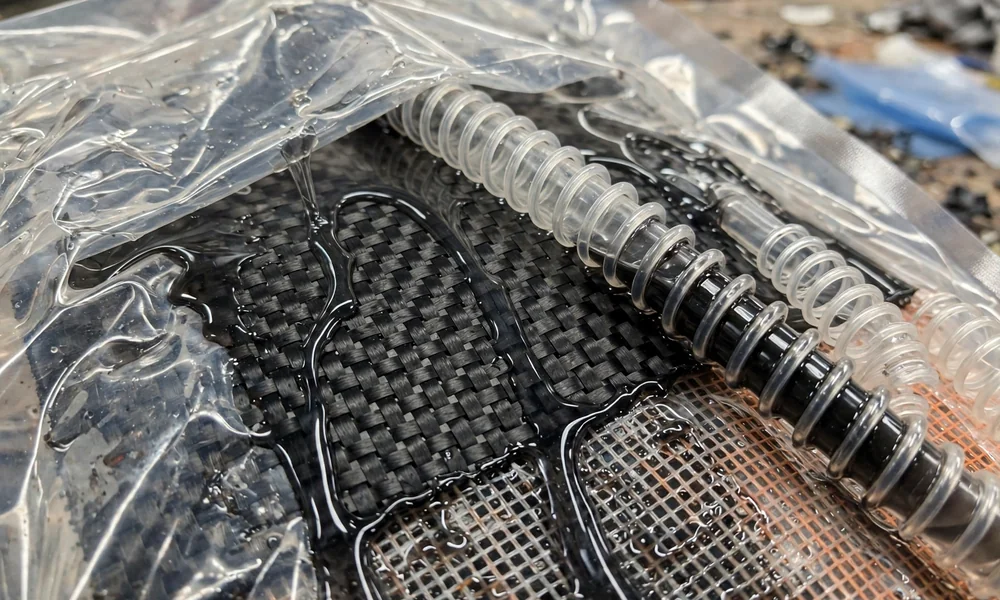
Over the dry fibre goes a stack of helper layers: a peel ply that will let the finished part release, a flow mesh that gives the resin channels to travel through, and spiral tubes that act as feed lines. Then the whole mould is covered in a sheet of clear plastic film, sealed around the edges with sticky tape to make it airtight. Hoses are fitted through the bag: one set connected to a vacuum pump, another leading to buckets of liquid resin. When the pump starts, the bag is sucked down hard onto the fibre, squeezing the layers together and pulling out every pocket of air. The atmosphere itself becomes the clamp.
Step 3: Infusing the resin
With the vacuum holding steady, the resin lines are opened. Liquid resin, mixed with a hardener that will set it solid, is drawn by the vacuum through the feed tubes and into the fibre, spreading slowly across the mould like ink through blotting paper. The workers watch the flow front move under the clear bag, and they can open or close lines to steer the resin into dry corners. The process takes minutes for a small panel and hours for a boat hull. If it moves too fast it traps air; too slowly and it sets before the mould is full. A good infusion fills every fibre with resin and leaves no dry patches at all.
Step 4: Curing under vacuum
Once the fibre is fully wet out, the resin lines are clamped shut and the vacuum is left running while the resin cures. The chemical reaction hardens the resin into a solid plastic that locks the fibres in place, and the vacuum keeps squeezing out any last bubbles while it sets. Small parts cure at room temperature; larger ones go in an oven. The same care with fibres and resin that goes into a carbon fibre weave part applies here, since the weave is what gives the finished panel its strength. When the cure is finished, the pump is switched off and the bag is peeled away, revealing a hard, glossy part still sitting in its mould.
Step 5: Demoulding and trimming
The finished part is lifted carefully out of the mould, and the helper layers are peeled off its surface. What comes out is remarkably close to the final shape: the mould surface gives one side a smooth, glossy finish that needs no painting. The edges are trimmed with a diamond saw or a router, and any holes for bolts or fittings are drilled or cut. The part is then inspected for defects — dry spots, bubbles or wrinkles — and any flaw is repaired with a patch of fresh fibre and resin. A part that passes inspection is light, stiff and strong, with a fibre content far higher than any hand-made composite.
Step 6: Finishing and fitting
The last step is finishing. The part is sanded where it needs to be bonded to another piece, and a clear coat or paint is applied if the customer wants it. Then it goes to its destination: a hull fitted to a boat, a blade bolted to a turbine, or a body panel fitted to a racing car. It uses up to half the resin of a hand lay-up for the same strength. A workshop that once made parts by brush can now make them by vacuum, and the parts it makes are better in every way that matters.

Specs
| Specification | Typical figure |
|---|---|
| Fibre types | Carbon fibre, glass fibre, aramid |
| Resin types | Epoxy, vinyl ester, polyester |
| Vacuum level | About 90–99% of full vacuum |
| Fibre content | 55–65% by weight |
| Infusion time | Minutes for panels, hours for hulls |
| Cure time | 4–24 hours, faster in an oven |
| Part size | Up to 60 m for turbine blades |
| Typical use | Boats, turbines, racing cars, aircraft |
Price
Vacuum infusion equipment is modest by industrial standards. As an estimate, a small workshop setup — pump, hoses, bagging film and consumables — costs roughly $5,000 to $20,000, while a large setup for hulls or blades can cost $50,000 to $200,000 — these are estimates, and the moulds are often the biggest expense. The real saving is in materials: because the vacuum uses resin so efficiently, a part can cost 20 to 40 per cent less in materials than the same part made by hand. For a boatyard building dozens of hulls, that saving pays for the equipment many times over.
A Rare Fact
The longest single pieces ever made by vacuum infusion are wind turbine blades, some longer than a jumbo jet, infused in one continuous pour that can take a whole day. Workers run shifts just to watch the resin front creep along. And the technique has an unlikely ancestor: it was adapted from the vacuum bagging used to make plywood in the 1940s. The same idea — let the air do the pressing — now makes some of the lightest and strongest structures on Earth, from racing yachts to spacecraft parts.
Vacuum infusion turns cloth into structure. The fibres at the heart of it are the same carbon materials that carry the loads in a yacht carbon mast, where weight and stiffness decide everything. For the numbers behind the process, the vacuum infusion specs set out the pressures, times and fibre contents in detail. A dry sheet of cloth, a bag of air, and a bucket of resin: from those three simple things comes a panel stronger than steel.