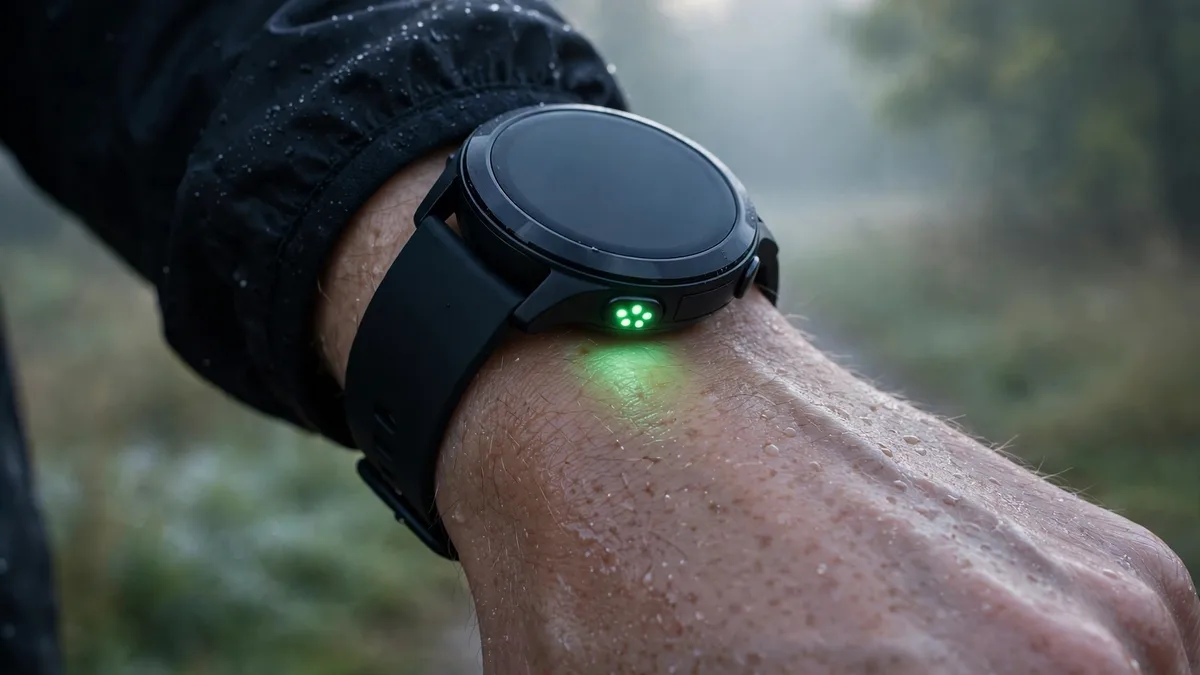
It is 6 a.m. on a cold morning, and a runner is three miles into her route when her watch buzzes against her wrist. Her heart rate has drifted above the zone she set the night before, so she eases off, watches the number settle, and carries on. She never sees the light flashing under the case, or wonders how a device the size of a biscuit knows her blood oxygen and the rhythm of her heart. It just knows — or claims to.
That claim is written in the specification sheet, and the sheet is where the truth lives. A smartwatch health sensor is really a bundle of sensors sharing one small window on your wrist: a light-based pulse reader, an electrical heart monitor, a temperature sensor, and a motion chip that works out whether you are running, sleeping, or simply waving at a neighbour. Each one has numbers attached — sampling rates, accuracies, ranges — and those numbers decide whether the watch is a genuine health tool or an expensive step counter.
This guide reads those numbers in plain English. Sampling rate, oxygen accuracy, ECG resolution, temperature sensitivity, motion range, GPS precision, and power draw — each one tells you something different about what the watch can measure and how much you can trust it.
The Specs That Matter
1. Heart-rate sampling rate
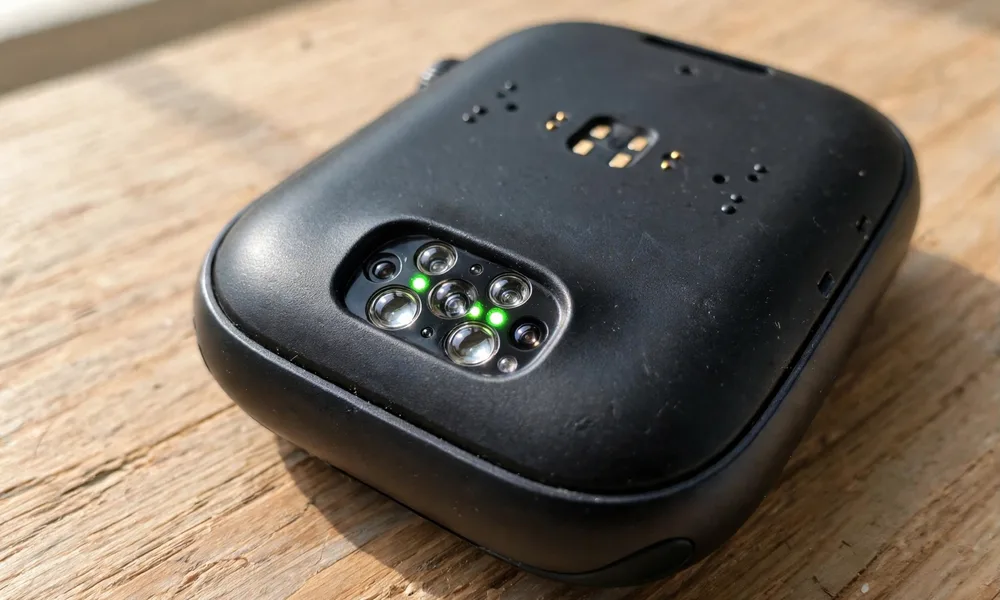
The optical heart sensor, known as PPG, shines green light into the skin and watches how much bounces back as blood pulses through the vessels. Sampling rate is how many times per second it takes that reading, usually about 25 to 100 times a second during exercise, dropping lower at rest. The way that light becomes a pulse reading is the heart of the device, as explained in how a smartwatch health sensor works, from LED to heartbeat.
2. Blood oxygen accuracy
Blood oxygen, or SpO2, is measured with red and infrared light, and it is quoted as an accuracy range, usually plus or minus 2 to 3 percent, across a range of about 70 to 100 percent. A reading of 96 percent could really mean anything from 93 to 99, and the number gets less reliable when your hands are cold, when you move, or when the watch sits loose. Below about 90 percent the sensor is outside its comfort zone, and a watch is not a medical device.
3. ECG sampling and electrodes
An ECG watch measures the heart’s electrical signal, and the key figures are its sampling rate, typically 250 to 500 samples per second, and its electrodes — usually one on the back of the case and one in the crown that you touch with a finger. A 30-second trace at 500 samples a second gives the software 15,000 data points to look for an irregular rhythm. A single-lead trace can flag possible atrial fibrillation, but a shaky finger can turn a clean trace into noise.
4. Skin temperature resolution
Skin temperature is measured in tiny steps, and resolution is the smallest change the sensor can report — often about 0.01 degrees Celsius, though accuracy is far looser, around plus or minus 0.5 degrees. The watch does not really care about your absolute temperature; it watches for changes from your own baseline over days and weeks. A rise of half a degree across several nights can be an early sign of illness.
5. Accelerometer and gyroscope range
Motion is measured by an accelerometer and a gyroscope, quoted in g-force and degrees per second. A typical watch accelerometer covers plus or minus 8 g, with some reaching 16 g, while the gyroscope covers about 2,000 degrees per second. Those ranges are wide enough to tell a gentle walk from a sprint, to count steps, and to spot the sudden stop of a fall. Too narrow a range and the sensor saturates during hard effort.
6. GPS accuracy
GPS accuracy is usually quoted in metres, and a good watch holds about 3 to 5 metres in open sky, drifting to 10 metres or more between tall buildings or under tree cover. Dual-band GPS, which listens on two frequencies at once, tightens that figure and keeps your running route from cutting corners through houses on the map. The catch is power, so many watches sample position once a second.
7. Sensor power draw and battery life
Every measurement costs battery, and power draw is the hidden number behind the headline battery life. Continuous heart-rate and GPS tracking can cut a watch rated for two weeks down to a single long day. The hardware that has to survive all of this — sweat, knocks, and daily charging — is built to tight tolerances, as shown in how a smartwatch health sensor is made, where the sensor stack is assembled and sealed.
Smartwatch Health Sensor Specs
| Specification | Typical range |
|---|---|
| Heart-rate sampling rate | About 25 to 100 samples per second in exercise |
| Blood oxygen accuracy | About plus or minus 2 to 3 percent, 70 to 100 percent SpO2 |
| ECG sampling rate | About 250 to 500 samples per second, single lead |
| Skin temperature resolution | About 0.01 degrees; accuracy about plus or minus 0.5 degrees |
| Accelerometer range | About plus or minus 8 g, some models to 16 g |
| GPS accuracy | About 3 to 5 metres in open sky; about 10 metres in towns |
| Battery life with sensors on | About 10 to 30 hours with GPS; up to 14 days in watch mode |
| Water resistance | About 5 ATM, suitable for swimming but not diving |
What Does a Smartwatch Health Sensor Cost?
A health-focused smartwatch is estimated to cost roughly $250 to $800, depending on the brand, the sensor set, and the materials, with the sensor module itself estimated at roughly $30 to $80 of that total. The optical sensor array is the most expensive part of the health stack, followed by the ECG electrodes and the temperature sensor, and the software that turns raw readings into trends costs manufacturers far more over the life of the product than the hardware itself. All prices are estimates only and vary widely by brand, model, and region.
A Rare Fact
The green light is not a design choice — it is physics. Blood absorbs green light far more strongly than red, so the tiny rise and fall of blood volume under the skin shows up most clearly in green. The same physics is why the sensor glows green in the dark, and why it struggles on very dark tattoos, where the ink absorbs the light before the blood gets a chance.
A smartwatch sensor is a set of compromises wearing a specification sheet: fast enough to catch a sprint, accurate enough to be useful, and thrifty enough to last the week. Read the sampling rates and accuracy ranges together, and the watch becomes a small laboratory on your wrist. The vibration motor that taps you when a reading is ready is a small marvel of its own, covered in haptic motor materials engineering, and it is the quiet partner in every alert the sensors raise.