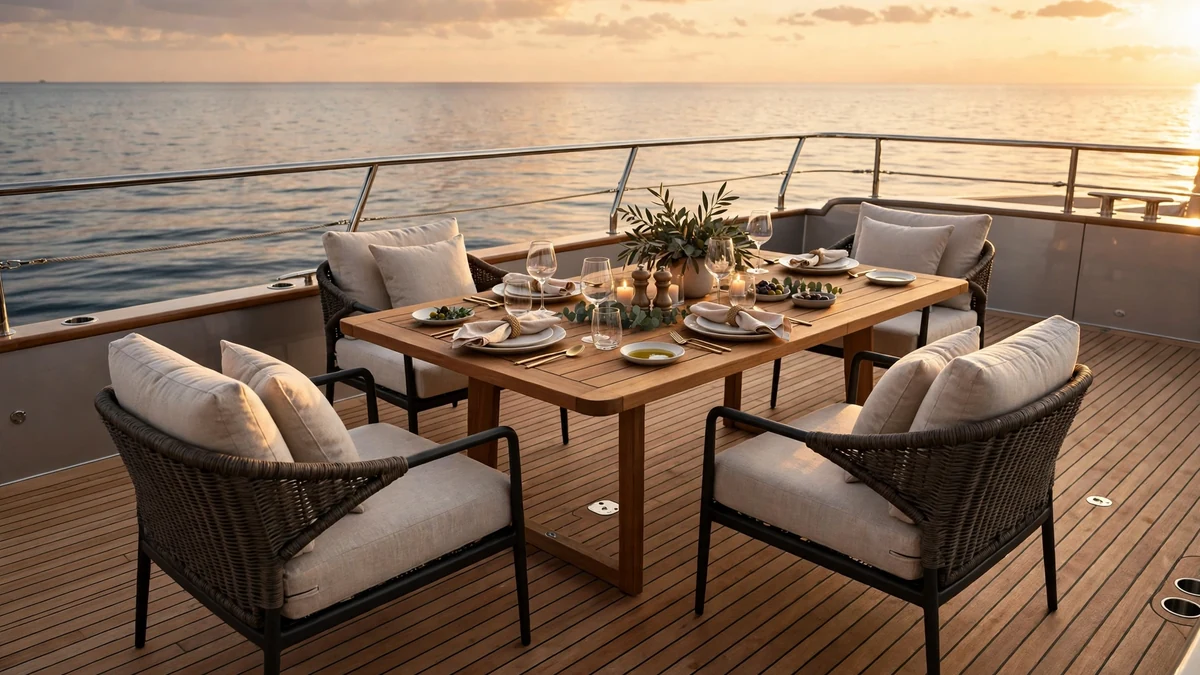
Step aboard a yacht at anchor on a warm evening and the first thing you notice is not the sails or the navigation screens. It is the deck: a wide teak floor, low armchairs that do not slide, a table set for dinner, and a sun pad where someone is already asleep with a book on their chest. None of it looks like engineering. All of it is. Yacht deck furniture is built to survive sun, salt, spray, and a rolling sea while looking like it belongs in a living room, and every piece hides a trick.
A chair that works in a house will fail on a yacht in a week. It will slide, it will rust, its cushions will soak, and its varnish will peel in the sun. Deck furniture has to be light enough to move, heavy enough to stay put, waterproof, sun-proof, and beautiful, all at once. It is fastened down, folded away, or weighted so precisely that it stays still in weather that sends everything else flying. This is how it works.
How It Works
Step 1: Designing for a floor that moves
Everything on a yacht deck is designed around motion. A yacht at anchor rolls a few degrees with every wave, and under sail it can heel twenty degrees or more, which turns a normal chair into a sled. Designers give deck furniture a low centre of gravity, wide feet, and a footprint that spreads the load, so it grips rather than tips. Many pieces are made to be secured: sockets in the deck accept a table leg or a chair post, and hidden latches lock a lounger in place. The furniture must also be easy to move when the crew clears the deck for sailing, so nothing is ever truly bolted down forever.
Step 2: Materials that ignore salt and sun
The classic deck furniture material is teak, which is naturally oily and resists rot, but modern pieces mix teak with marine-grade stainless steel, powder-coated aluminium, and synthetic rattan woven from weatherproof fibre. Real rattan would rot in a season; the synthetic version looks the same and survives years of spray. Cushions use open-cell foam that drains instead of holding water, covered in solution-dyed acrylic fabric that keeps its colour in harsh sun and dries in minutes. Every screw is stainless steel, because a single rusting screw will stain a white deck brown in a week.
Step 3: Sun pads, loungers, and the art of doing nothing
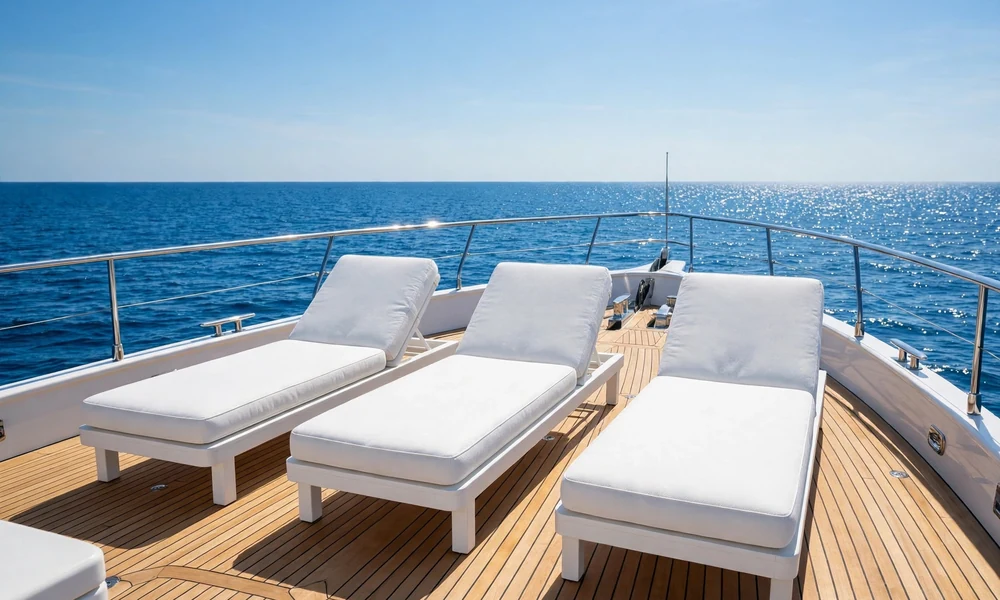
The sun pad is the most used piece of furniture on any yacht, and the most engineered. Its base is a raised platform with drainage channels underneath, so rain and spray run off instead of pooling. The mattress is thick, segmented so it can fold, and covered in a fabric that stays cool in direct sun. Many sun pads lift on gas struts to reveal storage beneath, and some convert into a double bed or a dining area. The best ones are positioned where the wind is blocked by the superstructure but the sun still reaches, a piece of naval architecture disguised as laziness.
Step 4: Tables that fold, stow, and survive dinner
A deck dining table has to seat eight for dinner and disappear before the boat sails. Most use a folding or telescopic pedestal: a single central leg that drops the table to coffee-table height or collapses flat for stowage, with leaves that fold out to double the size. The top is usually teak or a stone composite, heavy enough to stay steady and hard enough to shrug off plates, glasses, and dropped cutlery. Some tables are height-adjustable so the same piece serves as a dining table, a drinks table, and a sun pad base. The crew can clear a deck for sailing in minutes, and the furniture is designed to help them.
Step 5: Shade, wind, and the outdoor room
Furniture alone does not make a deck comfortable; shade and shelter do. Many yachts carry a retractable awning or a bimini that unfolds over the aft deck, tensioned by carbon poles and secured against gusts. Windbreaks of glass or clear acrylic panels shield the seating area without blocking the view, and they fold flat when not needed. The furniture is arranged inside this sheltered room, with chairs angled to the view and the sun, and the whole layout is tested at sea: if the cushions blow away at twenty knots, the design has failed.
Step 6: Cleaning, covers, and the long season
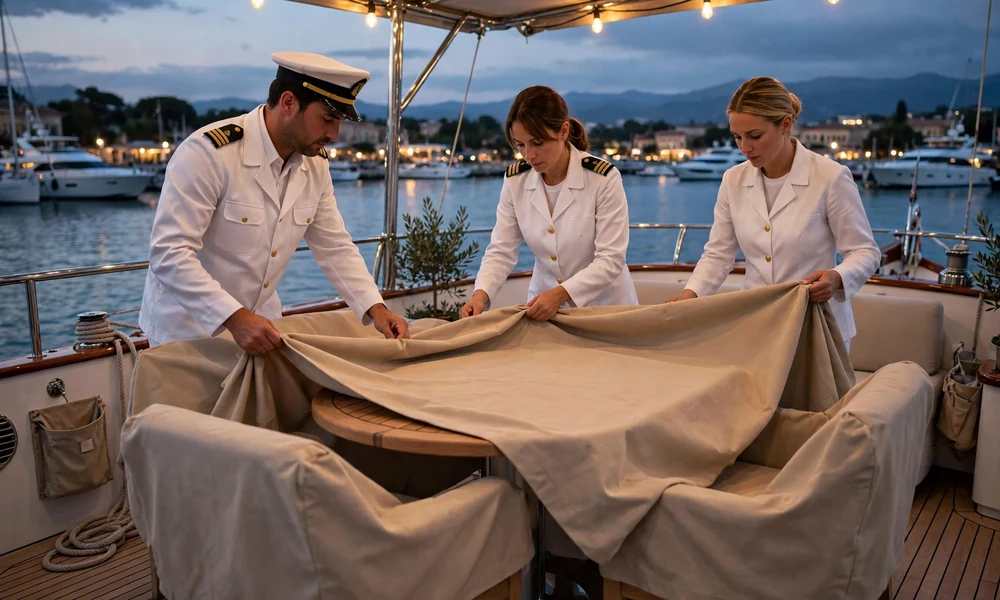
Deck furniture is maintained like the rest of the yacht: rinsed with fresh water after every sail, cushions stood on edge to dry, and teak scrubbed across the grain so it keeps its silver-grey colour. At night or in bad weather the crew fits tailored covers, each one cut to the exact shape of its piece, which keep salt and sun off the fabric. A well-made set can last a decade or more, re-covered once or twice, while a cheap set fades, cracks, and ends up in a skip after two seasons. On a yacht, the furniture is part of the boat, and it is treated that way.
Specs
| Specification | Typical figure |
|---|---|
| Frame materials | Teak, stainless steel, powder-coated aluminium |
| Weave | Synthetic rattan or marine-grade rope |
| Cushion foam | Quick-dry open-cell foam |
| Cushion fabric | Solution-dyed acrylic, UV and water resistant |
| Table types | Folding, telescopic, and height-adjustable pedestals |
| Fixing method | Deck sockets, latches, and weighted bases |
| Shade options | Retractable awning, bimini, glass windbreaks |
| Typical lifespan | 8–12 years with covers and care |
Price
Yacht deck furniture is priced like the boat it sits on, not like garden furniture. As an estimate, a single quality deck armchair can cost $1,500 to $4,000, a teak dining table with a telescopic pedestal $5,000 to $15,000, and a full furniture set for a 50-foot yacht $30,000 to $80,000 or more — these are estimates, and the final price depends on size, materials, and whether pieces are custom-made to fit the deck. Custom work dominates: most furniture is measured, built, and upholstered for one specific boat, which is why two yachts of the same model can have entirely different decks.
A Rare Fact
The most expensive piece of furniture on some yachts is not a chair or a table but a sun pad, because it hides a secret. On several large yachts the forward sun pad lifts on hydraulics to reveal a tender garage, a jet ski bay, or a storage hold underneath, and the mattress is engineered to carry the weight of a dozen people while concealing a hatch. Guests sunbathe on top of a garage door without ever knowing it. The furniture is not just furniture: it is the lid on the boat’s hidden rooms.
From a folded table to a sun pad over a secret garage, deck furniture turns an open deck into a home. It sits on the same timber as how a yacht teak deck is made, it shares the waterline with the superyacht beach club, and it is handled daily alongside the yacht winch and the rest of the working deck gear. Outdoors, but never ordinary.


