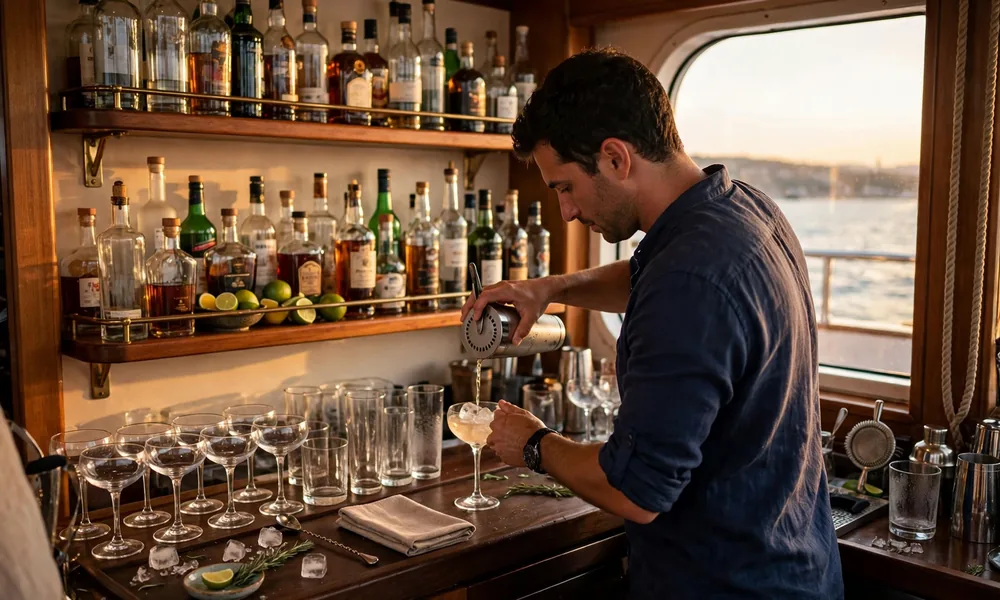
A yacht bar looks like a quiet corner for a drink at sunset, a curved counter, a row of bottles catching the light, and glasses that never seem to slide. On a boat that rolls with every wave, that calm is not luck. Every bottle is held, every glass is racked, and every drink is made by a bartender who has learned to work with the sea moving under their feet.
Running the bar is a nightly performance, and it starts long before the first guest arrives. The fridges are checked, the ice is made, the glasses are polished and the stock is counted, so that when the sun goes down the bar is ready for anything, This is how a luxury yacht bar works, from the morning stock check to the last glass washed at night.

How It Works
Step 1: The bar is stocked before sunset
Every morning the steward counts the bar, bottle by bottle, against a list kept in a drawer under the counter. Anything low is written on the order for the next port, The stock is kept in a cool locker below deck, and only the bottles needed for the evening are brought up, so the shelves behind the counter never hold more than a night’s worth.
The glasses are counted too, and any that are chipped are thrown out at once, because a chipped rim on a rolling yacht is a cut waiting to happen. Fresh linen is folded for the counter, the bar is wiped down until the wood and brass shine.
Step 2: Fridges and ice keep everything cold
Cold is the bar’s hardest job at sea. The drinks fridge under the counter holds wine and beer at serving temperature, the spirits stay cool in a second fridge, and a separate ice machine makes fresh cubes all day, The fridges are marine units, built to keep their temperature when the yacht rolls, with latches on the doors that hold shut in a swell. The ice machine is emptied and wiped each morning, so the first cubes of the day are always fresh.
The ice is made from the yacht’s fresh water, and the machine is cleaned every week, because ice that tastes of the machine ruins a drink faster than a warm glass.
Step 3: The bartender works the counter
When the guests arrive, the bartender works from a small space behind the counter, with everything in reach. The bottles are in racks that grip them, the tools hang on a rail, and the shaker, the strainer and the jigger sit in a row on a non-slip mat, so nothing slides when the yacht rolls.
Drinks are made to order, and the classics rule at sea, a gin and tonic, a martini, a glass of champagne, because they are quick, reliable and hard to get wrong in a moving room.

Step 4: The glasses stay put in a roll
Glasses are the bar’s biggest risk, and they are handled like treasure. Wine glasses hang upside down from slotted racks above the counter, tumblers sit in deep wells lined with rubber, and a glass that is being carried goes on a tray with a non-slip surface and a raised edge.
When the yacht is under way, the bar slows down on purpose. Drinks are served in heavier glasses that are harder to knock over, the bottles are locked in their racks, and the bartender pours smaller measures, because a full glass slops in a roll and a half-full one does not. It is a small compromise, and the guests rarely notice it.
Step 5: Service reaches every deck
The bar is not just the counter. A steward carries drinks to the sun deck, to the dining table and to the cabins, on a tray that is balanced with one hand while the other holds a rail. Orders come in by radio from the deck crew, and the bartender makes them in the order they arrive, calling the steward by name when a tray is ready, so no drink waits long enough to warm up or lose its fizz.
On a big evening the bar runs like a small restaurant, with one person pouring, one carrying and one washing glasses, and the galley sends up canapés on a dumb waiter or a tray. The crew keep a quiet count of who has had what,
Step 6: The bar closes down for the night
When the last guest leaves, the bar is closed down properly. The bottles are counted again and locked away, the open bottles are stoppered, the glasses are washed by hand and hung back in their racks, and the counter is wiped with a damp cloth and then a dry one, so no sticky ring is left for the morning.
The next morning the whole routine starts again, with a fresh count, fresh ice and fresh garnishes. A yacht bar that is closed down well is a bar that opens well, and the crew who do it right can have the counter gleaming and the first bottle open within minutes of the guests waking.
| Spec | Detail |
|---|---|
| Stock | Counted every morning, kept cool below deck, only a night’s worth up top |
| Fridges | Marine units with latches, wine, beer and spirits at serving temperature |
| Ice | Fresh cubes made all day from the yacht’s water, machine cleaned weekly |
| Glassware | Wine glasses hung in racks, tumblers in rubber-lined wells, trays non-slip |
| Service | Stewards carry trays to every deck, orders by radio, water refilled unasked |
| Close-down | Bottles counted and locked, glasses washed by hand, counter wiped dry |
The hardest part of a yacht bar is the roll. A bartender who can pour a perfect martini on land has to learn it all again at sea, bracing, waiting for the deck to settle, and pouring between the waves, because a drink poured at the wrong moment ends up on the counter instead of in the glass.
What One Costs
Stocking a luxury yacht bar typically costs an estimated $20,000 to $100,000, set mostly by the owner’s taste, the champagne in the fridge and how often the yacht entertains. A modest bar with good wine and spirits sits near the bottom, while a cellar of vintage champagne and rare whisky costs far more. The food comes from nearby too, and how a luxury yacht galley is made shows where the crew cook the canapés that go with the drinks, while the salon specifications set the size of the grand room the bar usually sits in.
A Rare Fact
Some superyacht bars keep a bottle of champagne from the day the yacht was launched, unopened, on the top shelf for luck. It is never served and never sold, and it stays there through every party and every storm, a reminder of the day the ship first touched the water.
A luxury yacht bar is a morning count, a fridge full of cold bottles, an ice machine that never stops, a bartender who pours between the waves and a steward who carries the tray to every deck, all closed down clean at night. It is the smallest restaurant on the ship, and the busiest after dark. The room itself is a joiner’s puzzle, and how a luxury yacht bar is made shows how the curved counter and the racks that grip every bottle come together.


