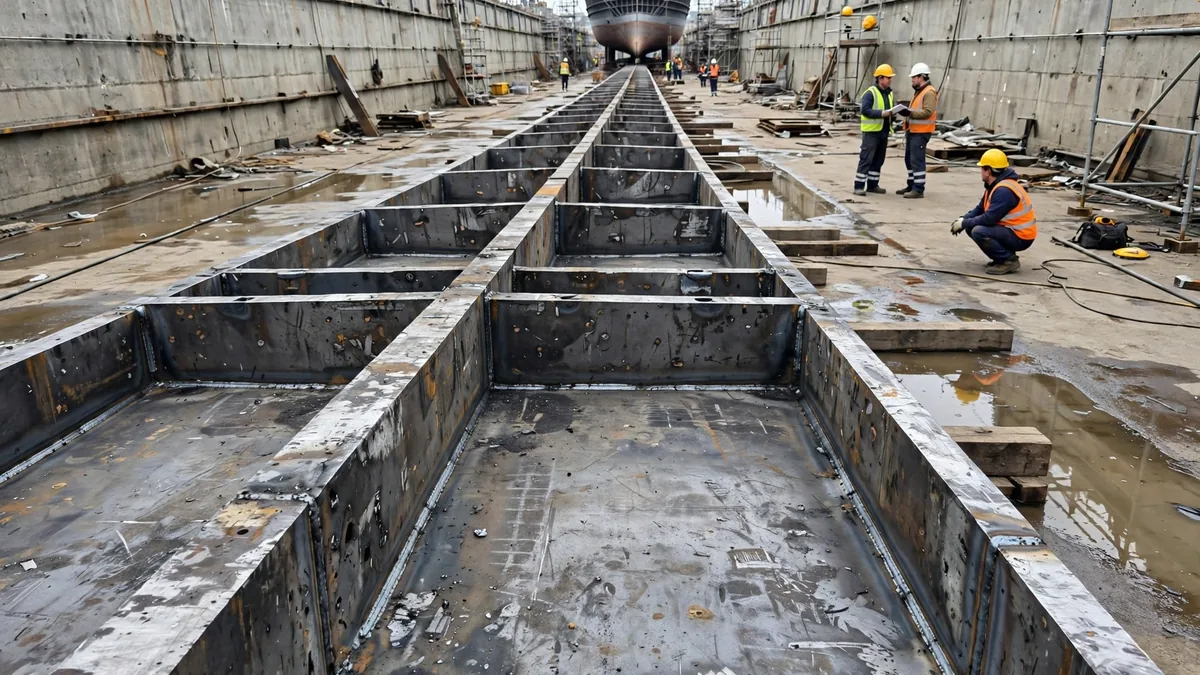
Stand on the quayside beside a luxury ship in dry dock and look along her belly, and the first thing you notice is a long, straight ridge of steel running from bow to stern along the very bottom. That ridge is the keel, the backbone of the ship, and everything else in the hull hangs from it, rests on it, or is measured from it.
A keel on a large ship is not a single beam but a great structure of thick steel plates, built up over months in a shipyard, welded, checked, faired and painted before the rest of the hull grows around it. It carries the whole weight of the ship when she sits in dry dock, takes the first shock of any grounding, and keeps the hull straight through every sea. This is how a luxury ship keel is made.
How It’s Made
Step 1: The steel is chosen and the plates are cut
Every keel begins with steel picked for strength and toughness in salt water, usually thick plates of high-grade shipbuilding steel that can bend a little without cracking. The plates arrive at the yard by lorry or barge, are checked for flaws, and are then cut to shape with plasma torches or great cutting machines that follow the lines drawn by the naval architects.
Step 2: The backbone is laid on the building berth
The keel is laid on a row of heavy concrete and steel blocks on the building berth, the first part of the ship to take shape. Surveyors set the blocks to the millimetre with lasers and levels, because the keel must run dead straight: any bend here would run through the whole hull and make the ship steer badly for the rest of her life.
The first plates are lowered onto the blocks and clamped in place, and the ship begins to exist as a line of steel on the ground. From this moment every other part of the hull is measured from the keel, and the yard treats its line as sacred, checking it again and again as the work goes on.
Step 3: The plates are welded into one spine
Once the plates are set, welders join them into a single spine, working in short runs so the heat of welding does not pull the steel out of line. The welds are laid in layers, each one cleaned before the next is added, and the yard warms the steel before welding on cold days so the joints cool slowly and stay strong.
Step 4: The frames and floors are fitted to the keel
With the spine complete, the yard begins to fit the frames, the curved ribs of steel that rise from the keel and give the hull its shape. Each frame is lifted into place, lined up with marks on the keel, and welded to it, and then the floors, the flat steel plates that run across the bottom of the hull, are fitted between the frames.
Between the keel and the inner bottom a double bottom is built, a space that holds ballast water and fuel and gives the ship a second skin if the outer bottom is ever damaged. It is the keel that holds all of this together, tying the frames and floors into a single stiff box that can carry the weight of engines, cabins and thousands of tonnes of ship above it.
Step 5: The keel is faired and coated against the sea
When the welding is done, the keel is faired, which means its surface is ground smooth until the line from bow to stern is even and fair. Workers run long straight edges along the steel, mark the high spots, and grind them down by hand, because a smooth keel slips through the water quietly and saves fuel over the life of the ship.
Then comes the coating: a primer that grips the steel, several coats of hard protective paint, and a smooth antifouling layer that stops weed and barnacles from growing on the bottom. Zinc blocks called anodes are bolted to the keel as well, and they corrode slowly in place of the steel, so the keel itself stays sound for years between dockings. The care taken here is the same careful work that shapes how a luxury ship rudder is made, since rudder and keel meet at the stern and must work as one smooth underwater line.
Step 6: The keel is tested as the hull grows
The keel is tested long before the ship ever floats, as the hull grows around it and the weight on it increases day by day. Surveyors check its line again as each new section is added, and the yard watches for any movement in the blocks or any crack in the welds, because the keel carries more load with every tonne of steel that goes on above it.
When the hull is complete, the ship is launched or floated out of the dock, and the keel takes her full weight in the water for the first time, with the sea pressing up along its whole length. Only when she runs straight and true, with no groan from her backbone, is the keel judged a success.

| Spec | Detail |
|---|---|
| Backbone | A straight spine of thick steel plates laid on blocks, the first part of the ship to be built |
| Plates | High-grade shipbuilding steel, several centimetres thick, cut to shape and bevelled for deep welds |
| Frames | Curved steel ribs rising from the keel, tied to flat floors and a double bottom for strength |
| Welding | Layered welds inspected with sound waves or X-rays, any flaw cut out and welded again |
| Coating | Primer, hard protective paint and an antifouling top coat, with zinc anodes to fight corrosion |
| Support | Carries the whole ship in dry dock and ties hull, frames and floors into one stiff structure |
What One Costs
A luxury ship keel is an estimated 1,500,000 to 5,000,000 dollars as part of the hull steelwork, depending on the size of the ship, the thickness of the plates and how much of the structure is built around it. The steel itself is only part of the price; the cutting, the weeks of welding, the inspection and the dry dock time all add up, and the way a luxury ship bow is made shows the other end of the same spine, where the keel rises and curves up to meet the stem at the front of the ship.
A Rare Fact
There is an old shipyard tradition at the keel laying, when the first plate is set down: coins are placed under the keel for luck, and the ceremony is treated as the true birthday of the ship, long before she ever touches the water. Some yards still lay a coin beneath the keel block, and it stays there for the whole life of the ship, sealed under tonnes of steel.

A luxury ship keel is a quiet piece of engineering: thick plates, patient welding, careful fairing and layers of paint, all joined into a single straight spine that carries everything above it. It is never seen once the ship is afloat, yet without it the finest ship in the world would have no backbone, and the way a luxury ship stern is made shows the strong structure at the other end of the keel, built to carry the rudder and the weight of the ship through every sea.