Out at sea, a yacht can roll thirty degrees to each side with every wave, a slow, heavy swing that sends glasses sliding, guests staggering and, on a bad day, green faces over the rail. Then engineers gave the hull a pair of wings it could move, and the roll all but vanished. The yacht stabilizer fin is a small part of a very large boat, and it does one of the hardest jobs at sea: it argues with the ocean, and wins.
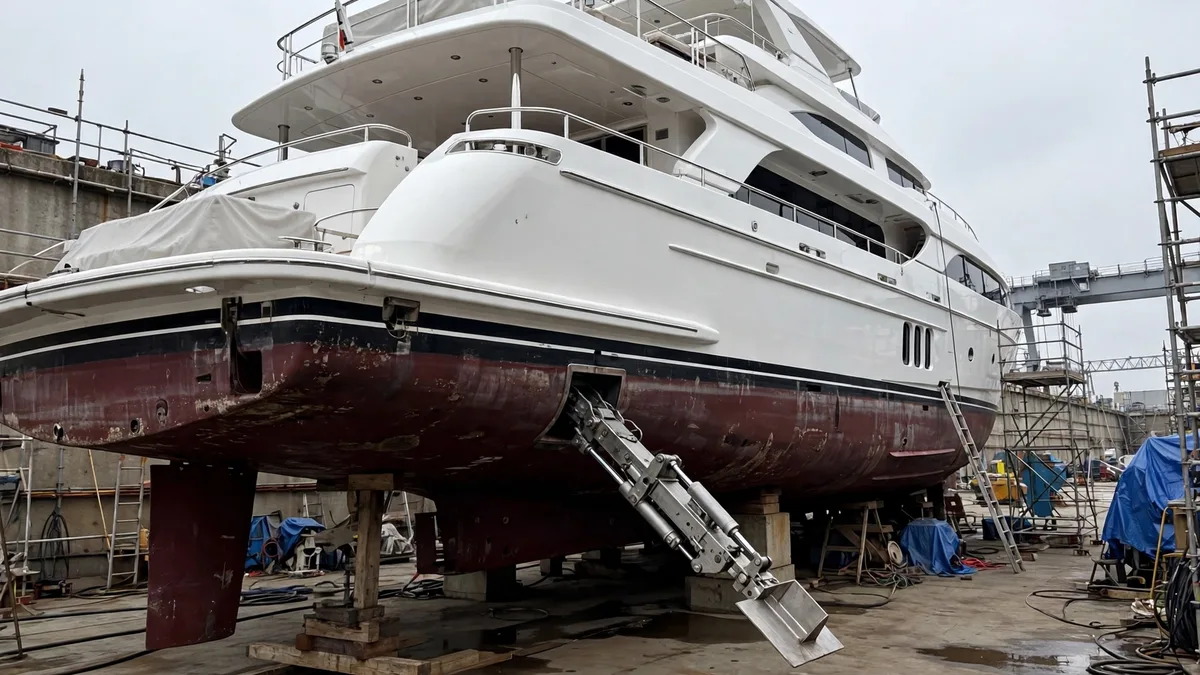
A stabilizer fin looks like a small aeroplane wing sticking out of the hull below the waterline, usually one on each side. It only fights roll, the side-to-side motion that makes life at sea miserable. Sensors feel the roll beginning, the fins tilt, and the water rushing past them pushes the hull back level. It happens in seconds, wave after wave, for as long as the yacht is under way. This is how yacht stabilizer fins work.
How It Works
Step 1: Feeling the roll before it grows
Everything starts with motion sensors, usually gyroscopes and accelerometers mounted near the yacht’s centre of gravity. A wave does not hit a yacht all at once; it lifts one side, the hull starts to lean, and the sensors catch that first movement while it is still small. The control system compares the measured roll with the yacht’s natural rolling rhythm, the slow period at which the hull prefers to swing, and works out how much counter-force is needed and in which direction.
Step 2: Tilting the fin to make lift
Each fin is a hydrofoil, a wing shaped to generate lift in water. When the fin is tilted, the water flowing past it pushes it up on one side and down on the other, exactly like an aeroplane wing in air. Because water is far denser than air, even a modest fin can generate a huge force: a fin of one or two square metres on a superyacht can push with several tonnes of lift. The two fins work as a pair, one pushing up while the other pushes down, and together they create a rolling moment that opposes the wave.
Step 3: Driving the fin with hydraulics
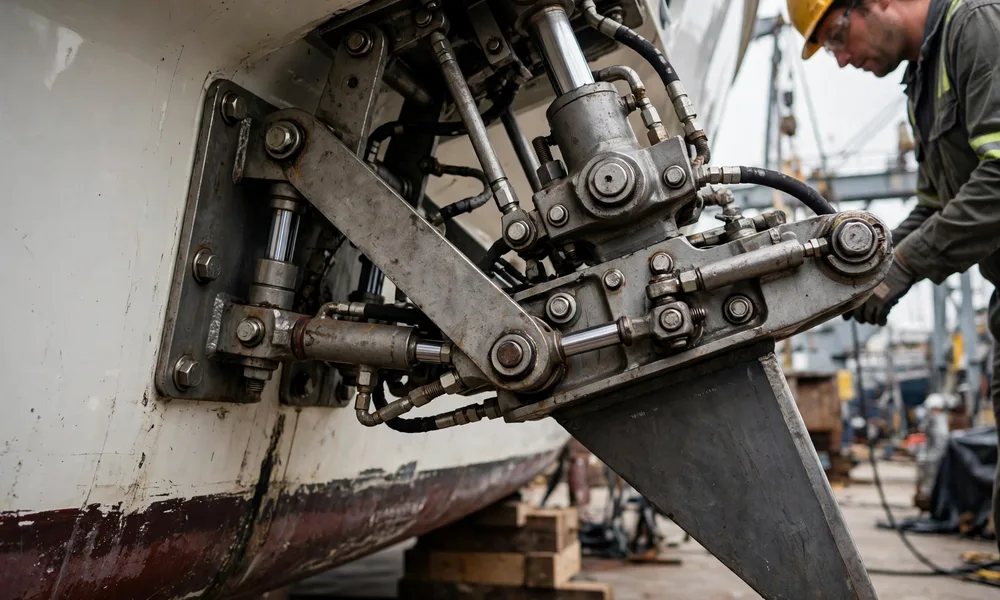
Tilting a fin against several tonnes of water pressure takes serious power, so each fin is driven by a hydraulic ram inside the hull. A pump pushes oil into a cylinder, the ram extends or retracts, and the fin rotates on its shaft, usually through an angle of up to 25 or 30 degrees each way. The shaft passes through the hull through a heavy seal that keeps the sea out while letting the fin turn, and the whole mechanism is built to survive a lifetime of salt water, vibration and shock. The fin itself is cast in stainless steel or bronze, shaped and polished to keep drag low, and its construction is a story of its own, as shown by how yacht stabilizer fins are made.
Step 4: Cancelling the roll, wave after wave
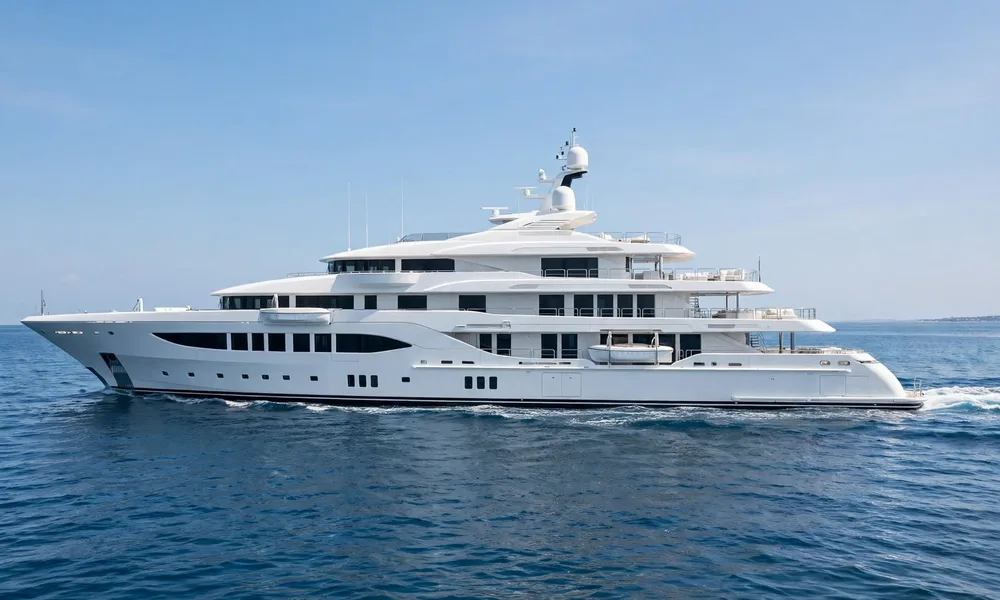
As each wave arrives, the cycle repeats: the sensors feel the roll, the controller calculates the correction, the hydraulics tilt the fins, and the water pushes the hull level. A well-tuned system can cut roll by 80 to 90 percent, turning a 20-degree swing into a gentle 2-degree sway that guests barely notice. The result is measured not in knots or horsepower but in comfort, and it is compared across ships in the same way, as in the ship stabilizer specs that list fin size, angle and roll reduction for larger vessels.
Step 5: Holding steady at anchor, the zero-speed problem
Traditional fins need water flowing past them, which means they stop working when the yacht stops. Modern systems solve this with zero-speed fins, which are larger and shaped to work differently: instead of relying on forward motion, they flap rapidly back and forth, paddling against the water to generate lift even when the boat is still.
Step 6: Retracting the fins when they are not wanted
Fins stick out from the hull, so they add drag, cost speed and risk damage in shallow water or in port. Most modern yachts therefore fit retractable fins, which fold back into recesses in the hull when they are not needed, leaving the hull smooth for high-speed running or for entering a marina. A fin left out in the wrong place can be bent or torn off by the seabed, and a lost fin is not just expensive; it leaves a hole in the hull that must be sealed, which is why the rudder, the other appendage below the waterline, is protected with the same care, as explained by how a yacht rudder works.
Step 7: Keeping the fins alive in salt water
A stabilizer fin lives in the harshest place on the yacht: permanently wet, battered by water pressure and coated in marine growth. The fin and its shaft are protected with antifouling paint, anodes that sacrifice themselves to corrosion so the steel does not have to, and seals that are inspected at every haul-out. Like everything below the waterline, the stabilizer is a part that earns its keep only when it is maintained, and the owners who maintain it best are the ones whose guests never notice the sea at all.
Specs
| Specification | Typical figure |
|---|---|
| Fins per yacht | Two, one on each side of the hull |
| Fin area, superyacht | About 1 to 2.5 square metres per fin |
| Fin material | Stainless steel or bronze, polished |
| Maximum fin angle | About 25 to 30 degrees each way |
| Swing time | About one second from one extreme to the other |
| Roll reduction under way | About 80 to 90 percent |
| Zero-speed fins | Larger fins that flap to make lift at rest |
| Drive | Hydraulic rams inside the hull |
Price
As an estimate, a pair of fin stabilizers for a large yacht generally costs in the region of $100,000 to $500,000 or more, fitted, with zero-speed systems at the higher end — these are estimates, and the true figure varies with the maker and the installation. A retrofit to an existing yacht costs more, because the hull must be opened, reinforced and sealed around the fin housings. Against the price of a superyacht, which can run into tens or hundreds of millions of dollars, the stabilizers are a small cost.
A Rare Fact
Fin stabilizers first went to sea almost a century ago. In 1931, the Italian liner Conte di Savoia was fitted with three pairs of retractable fins designed by the British engineer William Denny and the German firm Blohm & Voss, the first active fin stabilizer system on a large ship. The fins on a modern superyacht are faster, lighter and smarter, but they work on exactly the same principle that steadied that Italian liner in 1931.
From a sensor that feels a wave before it grows to a wing of steel that pushes back against the sea, the yacht stabilizer fin works by never letting the roll get started. It does not overpower the ocean; it out-thinks it, a second at a time, wave after wave. It is in a glass of water on a table in a rolling sea, staying where it was put, while the ocean does its worst outside.