The press operator does not watch the dial. He watches the metal. A titanium billet, heated until it glows the colour of a sunset, sits between two steel dies, and when the press closes, the whole machine seems to lean into the work. There is no spray of sparks, no drama — just a slow, immense squeeze, and when the dies open again the billet is shorter, wider, and one step closer to becoming something that will hold an aircraft together at thirty thousand feet. Titanium forging is the quiet end of heavy engineering: pressure, heat and patience, applied to a metal that resists almost everything.
Titanium earned its reputation the hard way. It is as strong as steel at roughly half the weight, it shrugs off salt water and jet fuel, and it keeps its strength when things get hot. It is also stubborn: it work-hardens quickly, grabs at cutting tools, and above a certain temperature starts drinking oxygen from the air, which makes it brittle. Forging tames it. Squeezing hot titanium between shaped dies lines up its internal grain, closes hidden flaws, and produces a part tougher than any casting of the same weight — which is why the parts that absolutely must not fail are forged, not cast.

The Materials Behind Titanium Forging
The star of the show is Ti-6Al-4V, an alloy of titanium with six percent aluminium and four percent vanadium. It accounts for the majority of all titanium used in engineering, balancing strength, weight, corrosion resistance and heat-treatability. Around it sit commercially pure titanium for parts that need corrosion resistance more than strength, beta alloys such as Ti-10V-2Fe-3Al for the very highest strength forgings, and titanium aluminides for the hottest parts of an engine. The dies are hot-work tool steels, machined to the part’s exact shape and coated with glass-based lubricants that stop the titanium sticking and shield it from the air.
Step 1: Choosing the alloy and the billet
Every forging starts as a billet — a solid bar of titanium cut from a larger ingot that was itself melted in a vacuum, because molten titanium reacts with almost everything it touches. Metallurgists check the ingot’s chemistry first, then cut billets to size, allowing extra material for the flash that will squeeze out between the dies. The alloy choice decides the rest of the job: Ti-6Al-4V for a landing-gear beam, a beta alloy where a part must be thinner and stronger, commercially pure grades where salt water is the enemy.
Step 2: Heating to the forging window
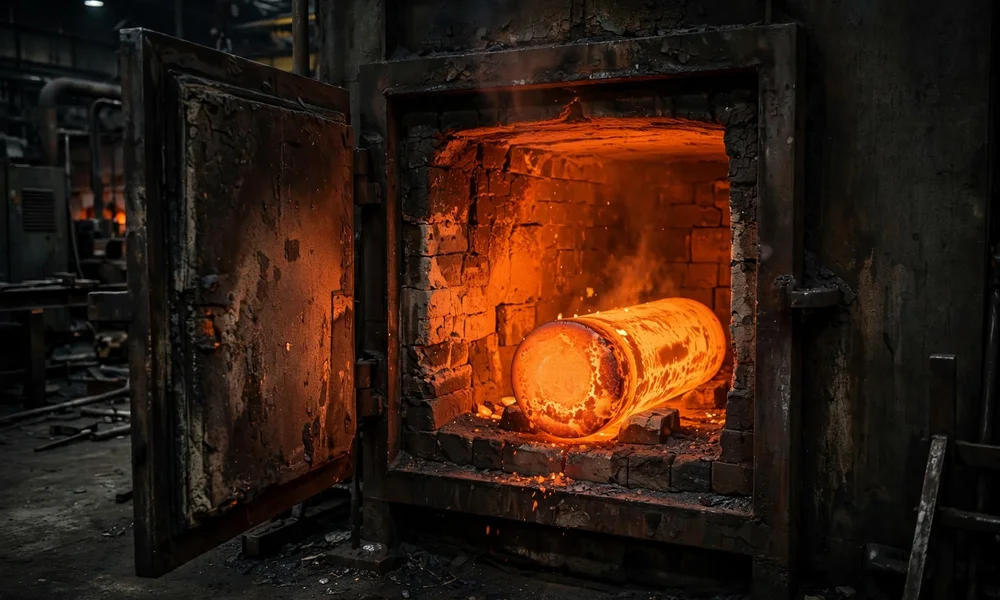
The billet is heated to between 900 and 980 degrees Celsius, just below the temperature at which titanium changes its crystal structure — the beta transus, which forgers guard jealously. Too cold and the metal cracks instead of flowing; too hot and the grain grows coarse, robbing the part of fatigue strength. Heating is slow and even, because a billet hot outside and cold inside will tear itself apart under the press, and in many shops it is coated with a glass lubricant that shields it from oxygen while it soaks.
Step 3: Forging under the press
The glowing billet is moved to the press — often in seconds, because titanium cools fast and its forging window is narrow. Hydraulic presses exerting thousands of tonnes close the dies around it, and the metal flows like very stiff clay, filling every corner of the die cavity. A part may take several press strokes, reheated between them, moving through dies that gradually bring it closer to final shape. The grain flows with the shape of the part, like wood grain following a carved chair leg, and that aligned grain is the secret of a forging’s strength. Forging aluminium follows the same principle at lower temperatures, but titanium demands far more force and far tighter control.
Step 4: Trimming the flash
As the dies close, excess metal squeezes out as a thin fin called flash. Once the forging cools enough to handle, the flash is trimmed away, leaving the rough outline of the finished part. Titanium is far too expensive to throw away, so trimmings are collected, cleaned and returned to the melting shop to be remelted into new ingots. In a titanium forge, the scrap bin is practically a vault.
Step 5: Heat treatment
The trimmed forging goes back into the furnace for heat treatment: solution treatment to dissolve the alloying elements evenly, quenching to lock them in place, then ageing at a lower temperature to let fine strengthening particles form. The result can be up to twice as strong as the untreated alloy. The exact recipe is a trade secret in many shops, tuned over decades for each specific part, and it is what turns a roughly shaped piece of metal into a component an airline will trust with hundreds of lives.
Step 6: Machining to final shape
A forging is deliberately made slightly oversized, and the final shape is cut by machining. Titanium is famously hard on cutting tools — it holds its heat at the cutting edge instead of carrying it away in the chips — so machinists use slow speeds, rigid setups and constant coolant. Shops that machine titanium have learned the same hard lessons as the teams who wrestle with the challenges of machining titanium, where one wrong feed rate can scrap a part worth thousands.
Step 7: Inspection and proof
No titanium forging leaves the shop on trust. Every critical part is inspected with ultrasound, which finds flaws deep inside the metal, and with dye penetrant, which reveals the finest surface cracks. Some are X-rayed; others from the same batch are tested to destruction so the rest can be certified. Only when the paperwork, chemistry and inspection all agree does the part get its stamp — a slow, expensive ending, and the reason forged titanium has such a spotless record in the parts that matter most. The discipline matches curing carbon fibre, where the process, not the material alone, decides whether the part can be trusted.

Titanium Forging at a Glance
| Specification | Detail |
|---|---|
| Main alloy | Ti-6Al-4V (6% aluminium, 4% vanadium) |
| Density | 4.43 g/cm³ — about 60% of steel |
| Tensile strength (heat-treated) | Up to ~1,100 MPa |
| Forging temperature | 900–980 °C, below the beta transus |
| Typical press force | Thousands of tonnes, hydraulic |
| Key uses | Landing gear, engine mounts, rotor heads, pressure vessels |
| Main weakness | Absorbs oxygen at high temperature; costly to machine |
What Does It Cost?
Titanium is one of the most expensive structural metals in common use, and forging adds to the bill. Raw billet costs several times more per kilogram than aerospace aluminium, and the energy, dies and inspection push the price higher still. A single forged titanium landing-gear component for a commercial airliner can cost several thousand dollars (estimate), while the forging dies alone can run into six figures before the first good part is made. That is why titanium is used sparingly, only where its strength-to-weight advantage earns its keep.
A Rare Fact
Titanium is so reactive at forging temperature that a titanium fire cannot be put out with water — water only feeds it. Forges keep special dry-powder extinguishers on hand, and one of the oldest tricks in the trade is the glass coating painted onto the billet before heating, which melts into a skin that keeps oxygen out while the metal is at its most vulnerable. The metal that shrugs off salt water and jet fuel for decades must be protected from plain air for the few minutes it spends glowing in the forge.


