Stand on the dock next to a superyacht and the first thing you notice is the paint. It is not just white, or blue, or black — it is a mirror. You can see the clouds in it, and your own reflection, and the surface looks a foot deep, as if you could fall into it. That finish is not paint in the way most people understand paint. It is a system: layer upon layer of primer, filler, base coats and clear coats, applied over weeks in a sealed hall, sanded between every coat, and polished until the surface is smoother than glass. A superyacht paint system is one of the most labour-intensive finishes on Earth, and it exists because the sea is one of the most hostile environments on Earth.
Salt water, ultraviolet light, constant flexing and the occasional bump against a dock all conspire to destroy a finish. A yacht’s paint has to be waterproof, flexible enough to move with a steel or aluminium hull, hard enough to resist scratches, and glossy enough to satisfy an owner who has spent tens of millions on the boat beneath it.
How It Works
Step 1: Preparing the hull until it is perfect
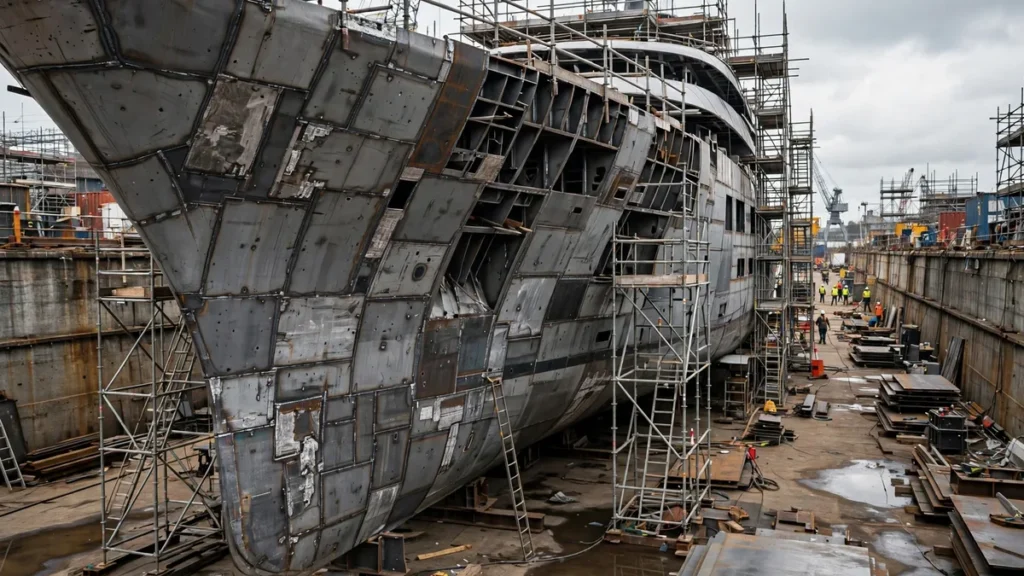
Paint is only as good as what lies beneath it, so the work starts long before any paint is sprayed. The hull is sanded, faired and checked with long straightedges and raking lights that reveal every ripple and dent. Fairing compound — a smooth paste — is spread over the steel or aluminium and sanded back, again and again, until the surface is fair to within a fraction of a millimetre. The superyacht hull underneath is a precision structure, and the paint team treats it like one.
Step 2: Priming against the sea
The first coats are primers, and they do the unglamorous work. An epoxy primer seals the metal against salt water and gives the later coats something to grip. On a steel hull the primer is also the corrosion barrier: if salt water ever reaches bare steel, rust spreads underneath the paint and lifts it from below. Several coats of primer go on, each one sanded smooth before the next, until the hull is a uniform, sealed surface. This is the layer nobody ever sees, and it is the layer that decides whether the whole system lasts two years or ten.
Step 3: Filling and fairing the topcoat base
Over the primer comes the filler and surfacer system — thick coats that are sprayed on and then sanded back to a perfectly flat surface. This is where the mirror finish is really made. Sprayers work in overlapping passes, then sanders follow with long boards and fine abrasives, working the surface down until a straightedge laid across it shows no gaps at all. The same pursuit of a perfectly fair surface shapes the steel hull beneath, which is faired before the paint team ever arrives.
Step 4: Spraying the colour coats
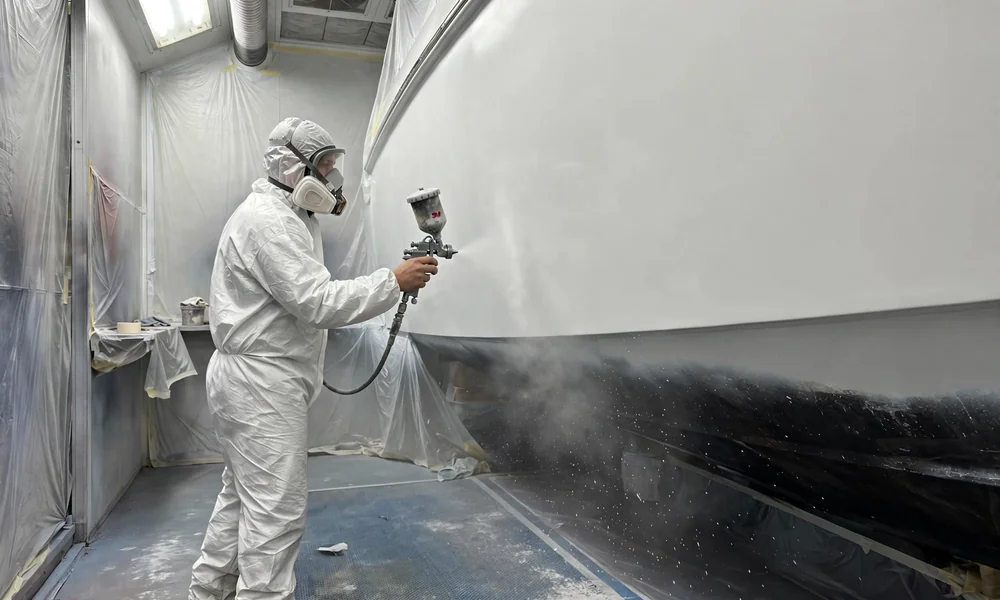
Only now does the colour appear. Two or three coats of a two-part polyurethane topcoat are sprayed on, each one a chemical reaction that hardens into a tough, glossy skin rather than a paint that simply dries. The sprayers work in teams, moving down the hull in a choreographed sequence so that each pass overlaps the last while it is still wet — a technique called keeping a wet edge. If a pass dries before the next one lands, the join shows forever as a faint line in the gloss.
Step 5: Clear coat and the deep gloss
On many yachts the colour is followed by a clear coat, a transparent layer that adds depth and protects the colour from ultraviolet light. The clear coat is what gives the finish its liquid look, the sense that the colour lies beneath a sheet of glass. It is also the sacrificial layer: minor scratches and swirl marks happen in the clear coat, and they can be polished out without ever touching the colour. Dark colours, especially black and deep blue, show every imperfection, so they demand the most clear coat and the most polishing — which is why a black superyacht is the hardest finish in the business to get right, and the most admired when it is.
Step 6: Sanding, polishing and inspection
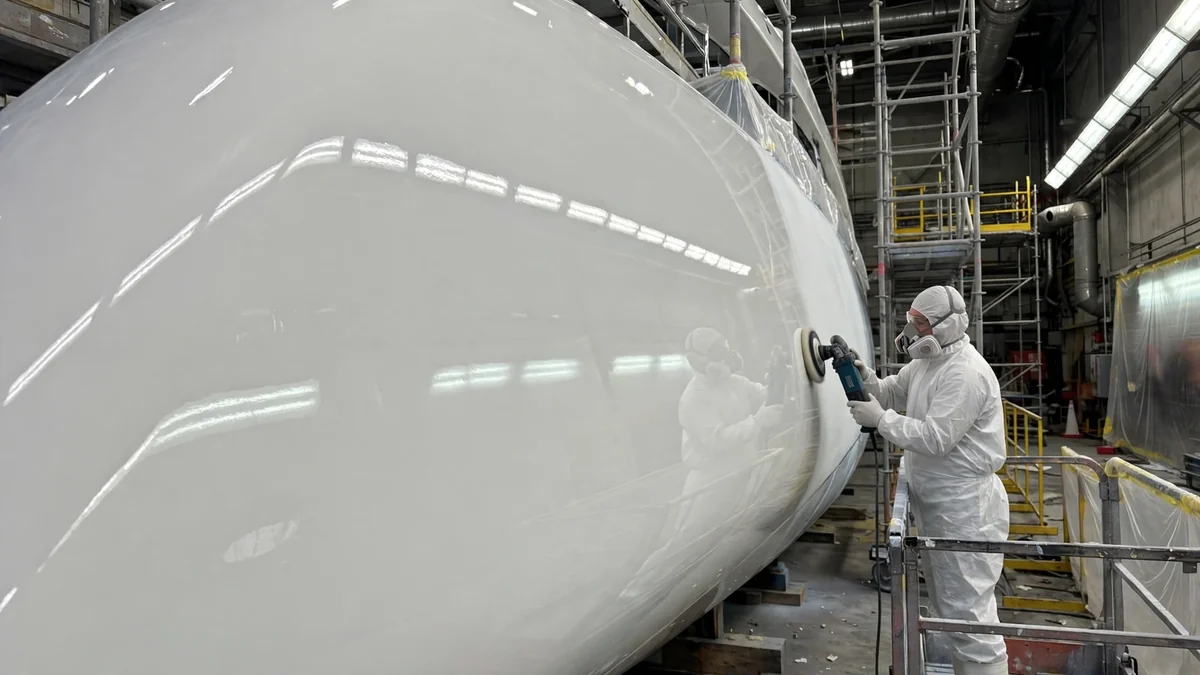
The final stage is not spraying but sanding. Once the paint has fully cured, the surface is wet-sanded with ever-finer abrasives, then polished with compounds until the gloss is measured with a meter rather than judged by eye. Inspectors walk the hull with lights held at a low angle, hunting for the tiniest orange-peel texture, dust speck or run. Anything they find is repaired by hand: a small area is sanded back and re-sprayed, then blended and polished until it disappears. Keeping that mirror steady at sea is a different job, handled by systems like the gyroscopic stabilizers that stop the hull rolling — but no stabilizer can hide a bad paint job.
At a Glance
| Specification | Detail |
|---|---|
| Total system | Typically 7–12 coats from primer to clear coat |
| Primer | Epoxy, for corrosion protection and adhesion |
| Topcoat | Two-part polyurethane, chemically cured |
| Total thickness | Roughly 300–500 microns when finished |
| Fairness tolerance | A fraction of a millimetre over the hull |
| Environment | Sealed hall, filtered air, controlled humidity |
| Typical lifespan | 5–10 years before a full repaint is needed |
What Does It Cost?
Painting a superyacht is priced by the square metre, and the numbers are startling. A full paint job on a 50-metre yacht typically costs in the region of $500,000–$1,500,000, depending on the yard, the colour and the condition of the hull, and a large yacht can cost several million (estimate). The paint itself is a small part of the bill: most of the cost is labour, with teams of fairers, sprayers and polishers working for weeks or months in a sealed hall. A partial repair — a scratched topside or a damaged bow — can still run to tens of thousands of dollars, because the repair must be blended invisibly into the surrounding mirror. Owners accept the bill because, on a yacht, the paint is the first thing anyone sees, and the last thing anyone forgets.
A Rare Fact
The glossiest superyachts are painted in halls so clean that the air is filtered like a hospital operating theatre — and the painters still cannot control everything. A single mosquito that lands in a wet coat can cost thousands of dollars: the insect must be removed, the area sanded back, the coats re-sprayed and the blend polished until it vanishes. Some yards keep the hall doors sealed for the entire spraying campaign, and the crew enter through airlocks, all to keep one fly out of a million-dollar mirror.

A superyacht’s paint is not decoration. It is a waterproof, flexible, ultraviolet-proof armour that also happens to look like a mirror, and it takes a small army of specialists weeks of work to create. The next time you see a yacht gleaming on the water, look at your reflection in the hull. What you are seeing is not a single coat of paint, but a dozen layers of chemistry, sanding and patience, polished until the sea itself seems to be looking back.