From the air, it looks like a floating city block: a steel box four hundred metres long, stacked ten storeys high with coloured containers, moving steadily across the ocean at the speed of a car on a motorway. The container ship is the machine that made the modern world possible — it carries the clothes you are wearing, the phone in your pocket, and most of everything else you own. And it all rests on one piece of engineering: the hull.
A container ship’s hull is the largest moving steel structure most people will ever see, and it works harder than almost any other. It carries up to 200,000 tonnes of cargo, flexes in waves taller than houses, resists corrosion from salt water every second of its life, and is expected to do all of this for twenty-five years with barely a pause. It is not a rigid box. It is a living structure that bends, twists, and breathes with the sea — and if it did not, it would break. Here is how it works.
The hull of a container ship is a study in scale. This is the engineering underneath the cargo.

How It Works
Step 1: Shaping steel into a hull
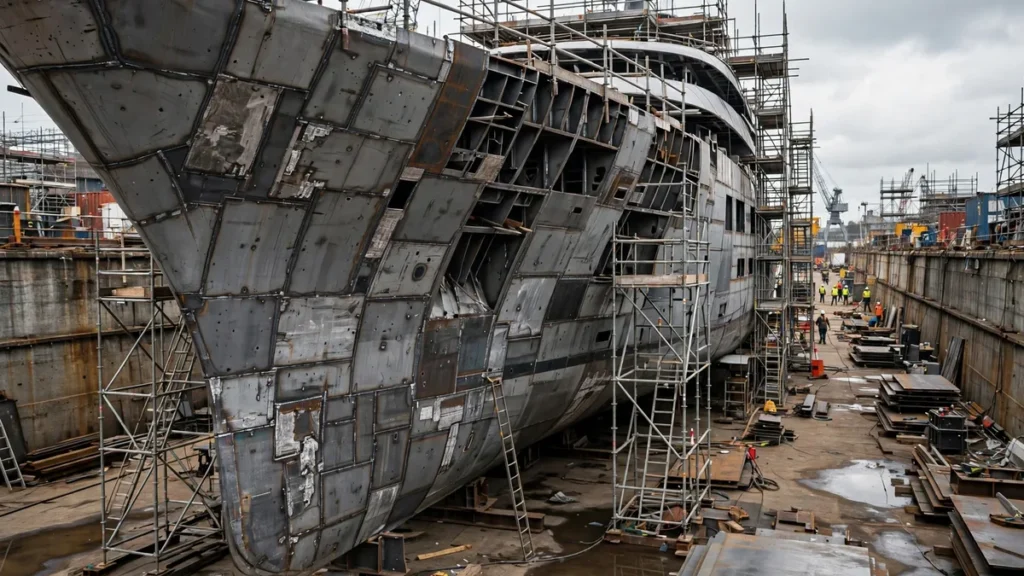
A container ship’s hull begins as flat steel plates, cut by computer-controlled torches and bent into curved sections in a shipyard. The double bottom — two layers of steel with a space between them — protects against grounding and provides tanks for fuel and ballast water. Building a hull this large is an exercise in welding on a scale few industries attempt, and the techniques descend from the same craft as modular ship construction, where entire vessels are assembled from prefabricated blocks.
Step 2: Cutting the waves with a bulbous bow
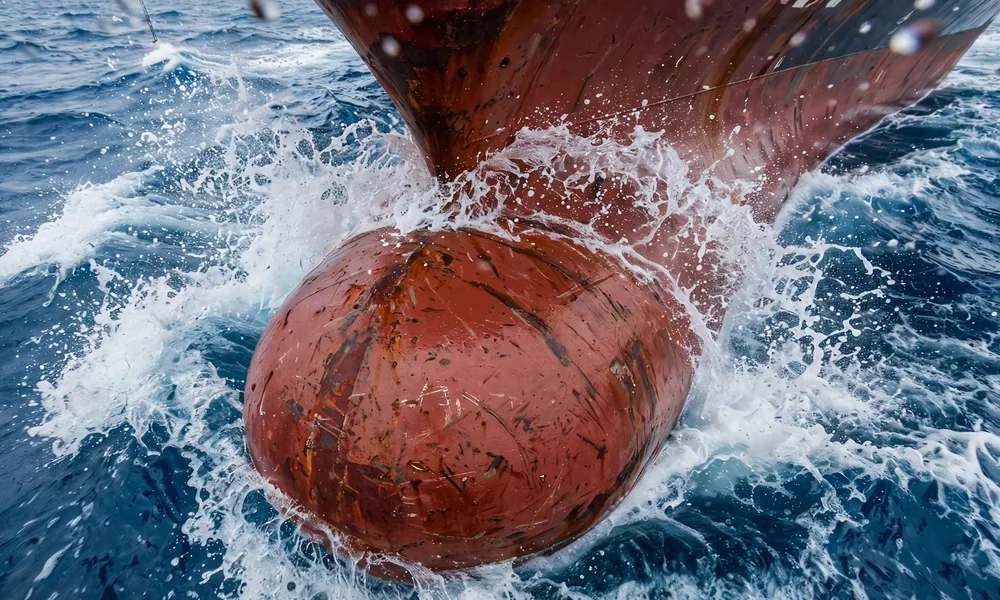
Look at the front of a container ship below the waterline and you will find something unexpected: a torpedo-shaped bulb sticking out of the bow. This is the bulbous bow, and it is one of the most important parts of the hull. As the ship moves, the bow pushes water aside and creates a wave; the bulb creates a second wave, timed to cancel the first out. The same hydrodynamic thinking shapes every hull, from the smallest yacht to the largest cargo vessel, and it is the same science that governs how a superyacht steel hull is made.
Step 3: Staying stable with ballast
A container ship is never loaded the same way twice. Some voyages it carries 20,000 containers; others it sails half empty, with the weight concentrated high above the waterline. To stay stable, the hull carries ballast tanks that fill with seawater — up to tens of thousands of tonnes of it. Pumping ballast low in the ship lowers the centre of gravity and keeps the vessel upright in rough seas; pumping it out when cargo is loaded keeps the ship from sitting too deep. The crew manages ballast constantly, adjusting it as containers are loaded and unloaded in port.
Step 4: Carrying the cargo on deck
The hull does more than float: it is the foundation for the cargo itself. Below deck, containers sit in cell guides — steel rails that slot each box into place like a drawer. Above deck, they are stacked up to ten high and lashed down with steel rods and twistlocks, so that the whole stack moves with the ship as one structure. The hull must be strong enough to carry that weight and stiff enough to keep the stacks from shifting, yet flexible enough to bend with the waves without cracking.
Step 5: Driving the ship from the stern
At the back of the hull sits the propeller, a bronze giant often more than nine metres across — taller than a house — turning slowly, about eighty revolutions per minute, driven by an engine the size of a small building. The propeller and rudder are the hull’s most vulnerable parts, which is why the hull’s stern is reinforced and the propeller is protected by the shape of the hull itself. The forces involved are enormous — the same principles of pressure and strength that protect a submarine’s hull at depth, as explained in how a submarine pressure hull is made, govern the steel of a container ship too.
Step 6: Fighting corrosion and fouling
Salt water is relentlessly destructive to steel, so the hull is protected in three ways. First, paint: multiple coats of epoxy and antifouling paint, the outer layer containing chemicals that discourage barnacles and algae from attaching. Second, sacrificial anodes — blocks of zinc bolted to the hull that corrode first, protecting the steel by giving the salt water something easier to eat. Third, regular dry-docking: every few years the ship is lifted out of the water, its hull inspected, blasted clean, and repainted.
Step 7: Flexing with the sea
The final secret of a container ship’s hull is that it is not rigid at all. In heavy weather, a 400-metre hull bends and twists — the bow and stern rise and fall on different waves, and the whole ship flexes by metres over its length. This is called hogging and sagging, and the hull is designed for it: the steel is elastic enough to bend and spring back, thousands of times, for decades. Instead it behaves like a spring, absorbing the sea’s energy and returning it. A container ship’s hull survives not by resisting the ocean, but by moving with it.
Container Ship Hull Specs
| Specification | Typical range |
|---|---|
| Length overall | About 350 to 400 metres for the largest ships |
| Beam | About 55 to 61 metres |
| Capacity | Up to about 24,000 TEU containers |
| Deadweight | About 200,000 tonnes |
| Draft fully loaded | About 16 metres |
| Hull steel weight | About 40,000 to 60,000 tonnes |
| Service speed | About 20 to 24 knots |
| Propeller diameter | About 9 to 10 metres |
| Design life | About 25 years |
What Does a Container Ship Hull Cost?
A new ultra-large container ship is estimated to cost roughly $150 million to $200 million, and the hull — steel, labour, and outfitting — accounts for a large share of that. Prices are estimates only and vary widely by shipyard, size, and market conditions. Compared with the cargo it carries over its lifetime — millions of containers, worth billions of dollars — the hull is remarkably cheap. It is the most cost-effective piece of transport infrastructure ever built.
A Rare Fact
A container ship’s hull flexes so much in heavy seas that the difference between the highest and lowest points of the deck can exceed two metres. Crew members standing at opposite ends of a 400-metre ship in a storm can be moving in opposite directions at the same moment — one rising while the other falls. The largest container ships are, in a very real sense, the biggest flexible structures ever built by humans.

The container ship’s hull is the quiet giant of the modern world: steel shaped to cheat the waves, ballast to stay upright, paint to hold back the sea, and flexibility to survive it.