Hold a quantum dot display up to the light and it looks like any other screen — a flat sheet of glass, dark when it is off. Switch it on, and the difference is startling: reds that look like real paint, greens like fresh leaves, blues deep enough to fall into. The secret is not the glass, and not the backlight. It is a film thinner than a human hair, filled with crystals so small that ten thousand of them could fit across the width of a single hair. Those crystals are quantum dots, and making a display out of them is one of the cleverest tricks in modern manufacturing.
A quantum dot is a tiny speck of semiconductor, usually just a few nanometres across. Change its size by a fraction of a nanometre and the colour of light it gives off changes too — smaller dots glow blue, larger ones glow red. Factories exploit that quirk to build screens that show colours no older television could manage. Here is how a quantum dot display is made, from a chemical bath to the television on your wall.

How It’s Made
Step 1: Growing the quantum dots
Quantum dots are not cut or machined; they are grown. In a chemical reactor, engineers mix cadmium or indium compounds with other chemicals and heat them carefully, and tiny crystals begin to form. The trick is stopping the growth at exactly the right size: a dot a few atoms wider glows a different colour. The dots are made in separate batches for red and green, while blue usually comes straight from the backlight. Each batch is checked with a spectrometer, and only dots that glow at precisely the right wavelength are kept. The finished dots are suspended in a liquid, ready to be coated onto film.
Step 2: Coating the quantum dot film
The dot solution is spread in an even layer onto a clear plastic film, then dried and sealed between two protective barrier layers. This sandwich — the quantum dot enhancement film — is the heart of the display. It has to be perfectly uniform: a patch that is even slightly thicker would show up as a brighter stripe on the finished screen. The coating is done in a cleanroom, because a speck of dust trapped in the film would block light and leave a dark spot. Rolls of the finished film are inspected under ultraviolet light, which makes any defect glow.
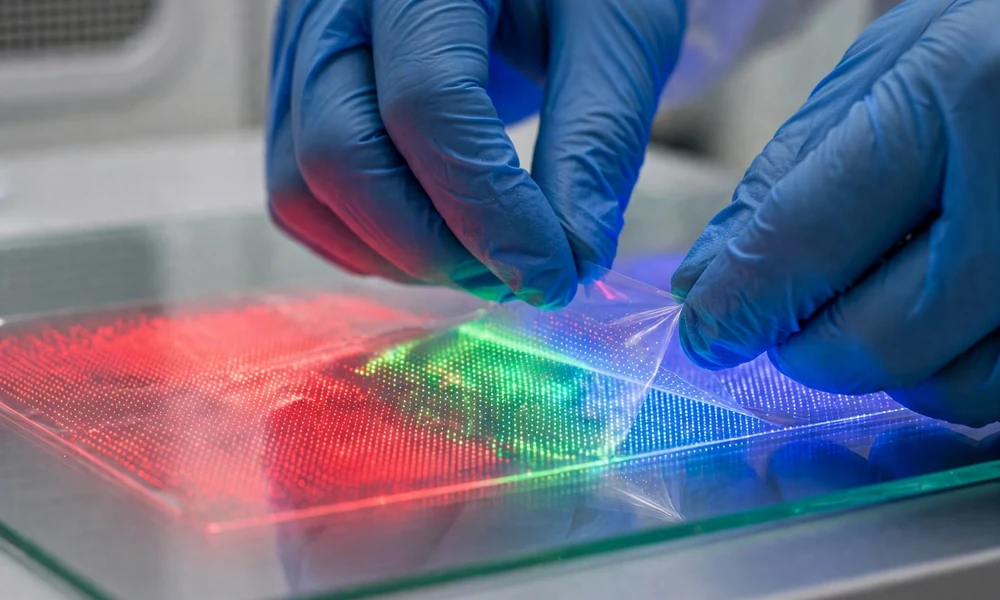
Step 3: Making the glass panel
Meanwhile, the display’s glass substrate is prepared. Huge sheets of ultra-thin glass — some larger than a king-size bed — are cleaned and coated with transparent electrodes and the thin-film transistors that will switch each pixel on and off. A single 4K television panel contains more than eight million pixels, each with its own transistor, and the wiring is printed with the same photolithography used for computer chips. The glass is so thin and so large that it must be handled by robots; a human touch could crack it or leave a fingerprint that ruins a pixel.
Step 4: Assembling the layers
The layers are stacked like a sandwich: the backlight at the bottom, then the quantum dot film, then the liquid-crystal layer that controls how much light reaches each pixel, then the colour filters and the front glass. Each layer is aligned to within a fraction of a millimetre, and the whole stack is sealed at the edges to keep out moisture — the great enemy of quantum dots, which can degrade if they get wet. The assembly happens in a cleanroom, with robots doing the heavy lifting and engineers watching every alignment on camera.
Step 5: Cutting the panels
The huge mother glass is cut into individual television or monitor panels with a diamond wheel, then the edges are polished and the driver chips that feed signals to the pixels are bonded on. Cutting is a delicate moment: a crack that runs the wrong way can scrap a panel worth hundreds of dollars. The same attention to thin glass shows up in other gadgets — a display panel’s specs reveal just how much engineering hides behind a flat screen — and here the stakes are the same, because a panel that is cut badly can never be fixed.
Step 6: Testing every pixel
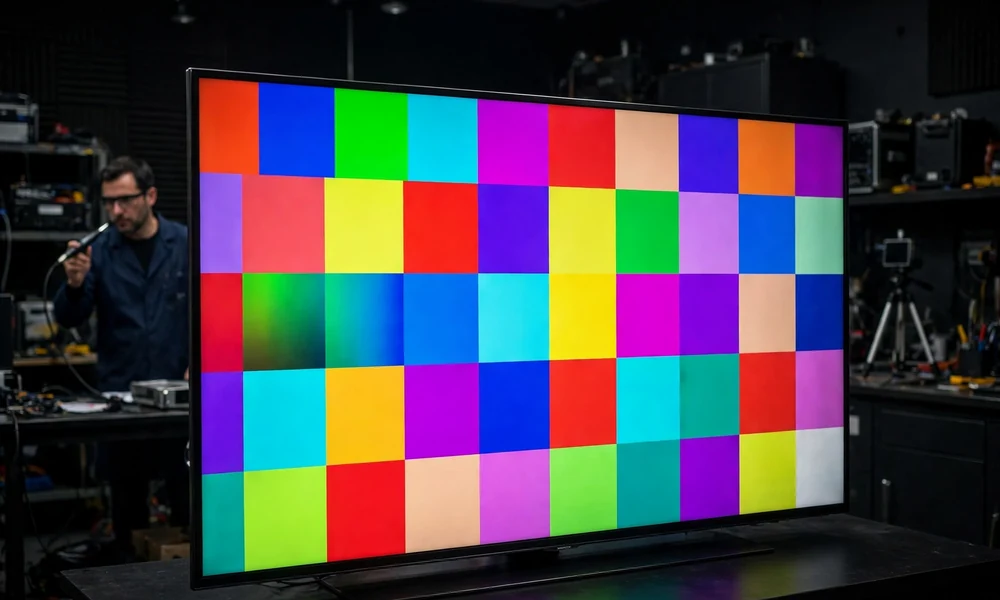
Each finished panel is switched on and photographed by cameras that check every one of its millions of pixels for dead spots, wrong colours, or uneven brightness. Panels are also tested for colour accuracy against a reference, because a quantum dot display’s selling point is colour that matches the real world. Panels that pass are fitted into a television or monitor casing with their electronics and speakers; panels that fail are downgraded to cheaper products or recycled. Only the best panels earn the brightest, most accurate screens.
Specs
| Specification | Typical figure |
|---|---|
| Quantum dot size | Roughly 2–10 nanometres across |
| Panel sizes | 27 inches to 85 inches and larger |
| Resolution | 4K (3,840 × 2,160) on most models |
| Colour gamut | Up to about 90% of the BT.2020 standard |
| Peak brightness | 1,000–2,000 nits on premium models |
| Backlight | Blue LED, converted by the quantum dot film |
| Film thickness | Less than 0.1 millimetres |
| Pixel count | Over 8 million pixels on a 4K panel |
Price
A 55-inch quantum dot television typically costs roughly $600 to $1,500, while a 65-inch premium model costs around $1,200 to $2,500 — these are estimates, and the real price depends on the size, the brand, and the backlight system. Computer monitors with quantum dot panels are cheaper, usually around $300 to $900. The quantum dot film itself is only a small part of the cost; most of the price comes from the glass panel, the backlight, and the electronics that drive eight million pixels.
A Rare Fact
Quantum dots were first studied as a scientific curiosity in the 1980s, and the scientists who worked out how to make them reliably won the Nobel Prize in Chemistry in 2023. The dots in your television are so small that they obey the rules of quantum mechanics — the same strange physics that governs atoms — and that is why their colour depends on their size. A display is, in a very literal sense, a quantum device sitting in your living room.
The quantum dot display turns a chemistry experiment into colour you can see. Its closest rival uses a different trick entirely — the materials behind Micro-LED displays show how tiny lights can replace the whole backlight — and both owe a debt to the optics that put images in front of your eyes. The lenses in a headset face the same challenge of bending light precisely, as how VR headset lenses work explains. The next time a sunset on screen looks almost real, remember the crystals smaller than a virus that made it possible.


