Every frame of the game you are playing is drawn by a chip smaller than your palm, a chip that holds tens of billions of transistors — more switches than there are people on Earth, packed into a space the size of a postage stamp. It renders light, shadow, and motion sixty times a second. The graphics card around it is a small supercomputer, and building one takes a journey across three continents.
It starts in a cleanroom cleaner than an operating theatre, where silicon wafers are printed with patterns finer than a virus. It ends on an assembly line, where the chip is married to memory, power circuits, and a cooler the size of a paperback book. Between those two points are hundreds of steps, any one of which can ruin the card.
Only a handful of companies in the world can make a gaming GPU, and the factories that build them are among the most advanced on the planet. This is how a gaming GPU is made.

How It’s Made
Step 1: Designing the chip on the computer
Years before a card reaches a shop, the GPU exists only as code. Engineers design the architecture: thousands of small processing cores that work in parallel, memory controllers, ray-tracing units, and the pathways between them. They simulate games and workloads to find bottlenecks, then lay out the transistors — tens of billions of them — in a pattern that must fit on a die a few hundred square millimetres in size. The design is checked and rechecked, because a single error in the layout can mean months of delay.
Step 2: Printing the chip on a silicon wafer
The design is sent to a semiconductor fab, where it is printed onto silicon wafers using lithography. A wafer is a disc of near-perfect silicon, and machines project the chip’s pattern onto it with ultraviolet light, layer by layer — sometimes more than a hundred layers. Each layer is etched, doped with tiny amounts of other elements, and coated again, building transistors just a few nanometres wide. A single wafer holds dozens of GPU dies, and the whole process takes months. The wafer itself is the heart of the card, and its making is described in inside gaming GPU production, where the cleanroom work is laid out step by step.
Step 3: Cutting, testing, and sorting the dies
Once printed, the wafer is cut into individual dies, and each one is tested. Not every die is perfect: dust, a flawed layer, or a single bad transistor can spoil one. Test rigs probe each die, checking its cores and memory paths, and the good ones are sorted by quality. The best dies become the fastest cards; dies with a few dead cores are sold as slower models, with the faulty parts switched off. This sorting, called binning, is why the same chip design can appear in cards at very different prices. Dies that fail every test are scrapped.

Step 4: Mounting the die and memory on the board
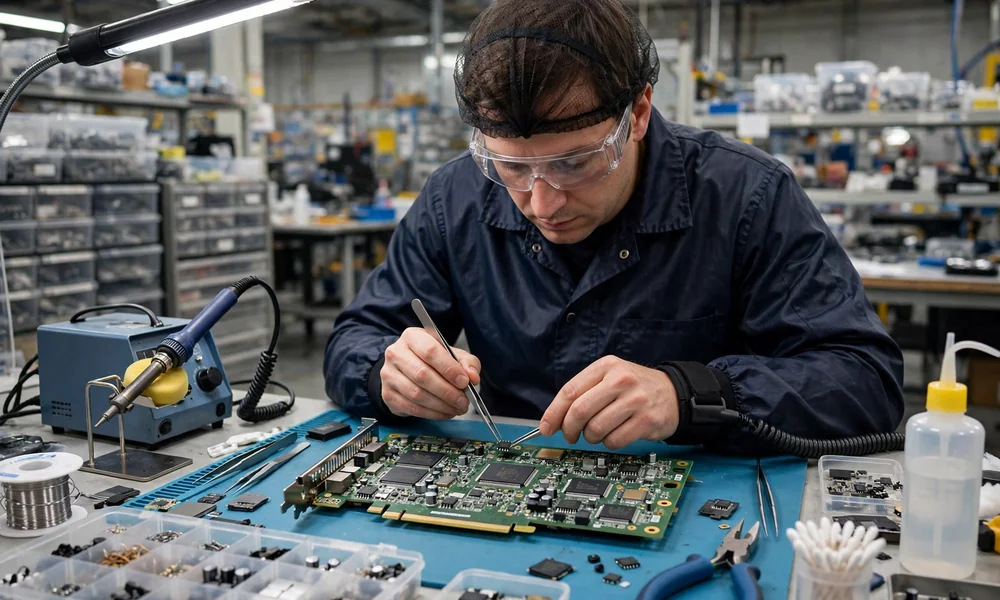
The good dies are packaged — bonded to a small substrate with hundreds of tiny solder balls — and shipped to the graphics card factory. There, a printed circuit board is loaded with components by pick-and-place machines that set thousands of parts an hour: memory chips around the GPU, power regulators, capacitors, and connectors. Solder paste is printed onto the board, the parts are placed, and the board passes through an oven that melts the solder and locks everything in place. A high-end card carries up to 24 gigabytes of video memory, and every chip must sit perfectly, or the card will fail its first test.
Step 5: Fitting the cooler and the fans
A gaming GPU at full load produces as much heat as a small kettle, so the cooler is a machine in its own right. A copper vapour chamber or heat pipes draw heat from the die, and a stack of thin aluminium fins spreads it out for the fans to blow away. Workers fit the cooler with thermal paste — a layer thinner than paper — and bolt it down with an exact torque, because too much pressure can crack the die and too little leaves an air gap that cooks it. Three fans are mounted on top, each balanced to spin at thousands of revolutions per minute without wobbling. The materials chosen for all of this are detailed in gaming GPU materials.
Step 6: Testing, stressing, and boxing the card
Every finished card is tested before it leaves the factory. It is plugged into a rig, powered up, and run through benchmarks that push it to full load, while engineers watch temperatures, fan speeds, and power draw. Cards are stress-tested for hours to catch early failures, and any card that crashes or overheats is pulled aside for repair or scrap. Only after passing is the card boxed with its cables and documentation, ready for a gamer’s PC. A small share of cards always fails, which is one reason the best cards cost so much, as why the gaming GPU is so expensive explains.
| Main material | Silicon die on a fibreglass printed circuit board, with copper cooling |
| Transistor count | Tens of billions on a high-end GPU die |
| Die size | Around 400 to 600 square millimetres on flagship cards |
| Video memory | Up to 24 gigabytes of GDDR memory on high-end cards |
| Power draw | Up to 450 watts or more under full load |
| Cooling | Copper vapour chamber or heat pipes, aluminium fins, two or three fans |
| Manufacturing time | Several months from wafer start to boxed card |
| Testing | Every card is benchmarked and stress-tested before shipping |
What Does a Gaming GPU Cost?
A flagship gaming graphics card is estimated at roughly $1,000 to $2,000 at launch, with mid-range cards estimated at $300 to $600. The price reflects the enormous cost of the fab, where a single wafer can cost tens of thousands of dollars to process, and the fact that only a fraction of the dies on each wafer are good enough for the top cards. Prices also swing with demand: when miners or AI companies buy up supply, gamers can pay far more than the launch price. For most buyers, the card is the single most expensive part of the whole computer.
A Rare Fact
The GPU was not invented for games. Graphics chips grew out of the need to draw images on a screen, but the breakthrough came when researchers realised the GPU’s thousands of small cores were perfect for parallel maths — the same kind of maths behind artificial intelligence. Today, the descendants of gaming chips train the world’s largest AI models, and the most powerful GPUs are bought not by gamers but by data centres. The card in a gaming PC is, in effect, a scaled-down supercomputer that happens to be very good at drawing dragons.
The graphics card will never be the part a gamer thinks about while playing. It hides inside the case, fans humming, drawing worlds sixty times a second. But every shadow, every reflection, and every frame that arrives on time comes down to a chip printed with light, tested a hundred times, and cooled by a machine the size of a book. It is the most complex thing most people will ever own — and it started as sand.