The lights come on over the assembly hall long before the sun clears the roofline, and the first thing you notice is how quiet it is. There is no rumble of an engine line, no smell of hot oil drifting across the floor. Instead there is the soft whir of driverless carts gliding between stations, the hiss of a torque wrench, and the low hum of a battery pack being lowered into the belly of a truck that has no engine at all. A bare frame rolls forward on its own conveyor, and by the time it reaches the far end of the hall it will be an electric pickup, ready to tow, haul, and crawl through mud on nothing but stored electricity.
An electric pickup looks like an ordinary truck from the pavement, but almost everything underneath is different. The heavy work is done by a flat battery pack that doubles as the floor, by motors the size of a watermelon, and by software that decides, a thousand times a second, how much twist goes to each wheel. Building one means rethinking the factory as much as the truck, because the most important part of the vehicle is also the most dangerous to handle, the heaviest to lift, and the most expensive thing on the line. This is how that truck comes together, station by station.
How It’s Made
The build follows the same rhythm as any truck plant, but the order of operations is shaped around one rule: the battery goes in early, and everything else is built around it. Six stages carry the truck from bare metal to finished vehicle.
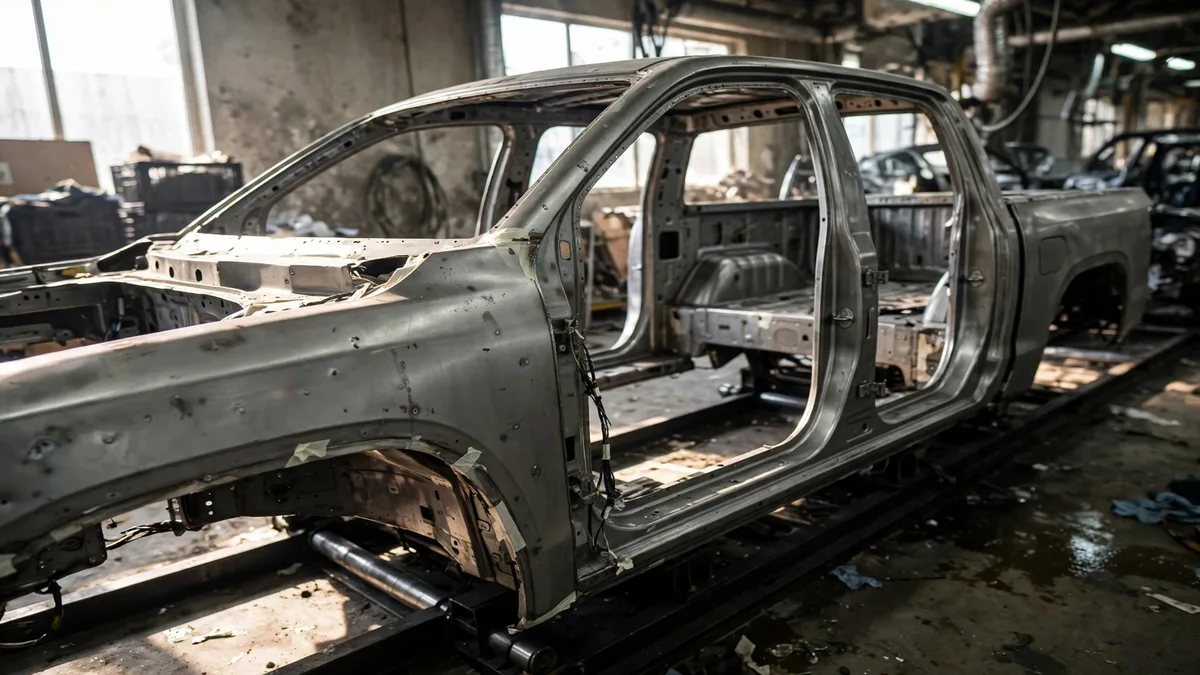
- The skateboard platform takes shape. The truck begins as a flat rolling chassis, often called a skateboard, built from high-strength steel and aluminium. Robots weld the frame rails and crossmembers, then the suspension, steering rack, and brake lines are fitted while the platform is still open and easy to reach. At this stage the vehicle looks like a table on wheels, and that is exactly the point: a flat floor leaves room for the battery and keeps the centre of gravity low, which is why electric pickups feel so planted when they corner with a load in the bed.
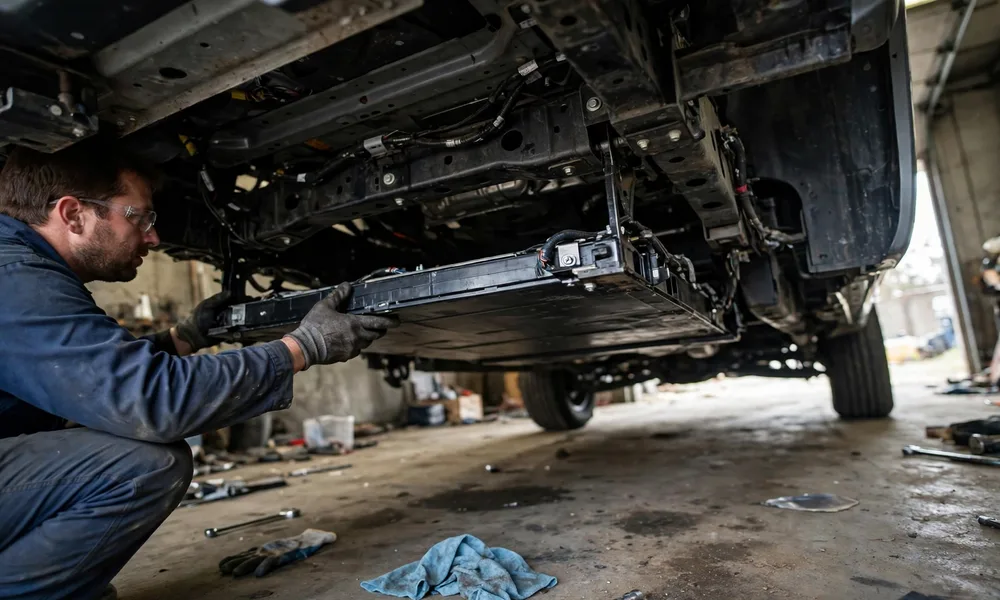
- The battery pack is built and sealed. In a separate clean area, workers and machines stack hundreds of pouch or cylindrical cells into modules, wire them together, and fit cooling plates, sensors, and a crash-resistant case. The finished pack can weigh more than half a tonne, so a crane or lift table lowers it into the chassis from below and bolts it into place. Every seal is checked, because the pack must shrug off rain, dust, and the occasional river crossing, and a single leak can end a very expensive day. The way the pack is assembled, cell by cell, is covered in our guide to how an EV battery pack is made.
- The body and bed are stamped and joined. Meanwhile, presses the size of houses stamp door panels, fenders, and the pickup bed from sheet steel or aluminium. The bed of an electric truck is often a structural part of the body rather than a separate bolt-on box, which adds stiffness and frees space underneath for storage. Robots weld the body shell, workers fit the glass, and the whole shell is dipped, painted, and baked before it is lowered onto the waiting chassis in a moment the line calls the marriage.
- The motors and drive units go in. An electric pickup usually carries one motor at the front and one at the rear, each no bigger than a large toolbox, bolted directly to the axles or to a compact drive unit. There is no gearbox in the old sense, no driveshaft running the length of the truck, and no exhaust to route. Technicians connect high-voltage orange cables, fill the cooling loops, and spin each motor on a test rig before the wheels ever touch the ground. The choice of motor type shapes everything from towing to efficiency, as explained in our guide to the best electric motors for EVs.
- The wiring, screens, and software wake up. With the hardware in place, the truck gets its nervous system: kilometres of wiring, cameras, radar units, and a central computer that controls everything from the headlights to the trailer brakes. The vehicle is powered on for the first time on the line, and engineers load the software that manages the battery, the motors, and the driver assistance systems. A truck that cannot receive updates over the air is already old, so this stage also sets up the connection that will keep the pickup current for years after it leaves the factory.
- Testing, water, and the road. The finished pickup rolls onto a dynamometer, where its wheels spin against rollers while engineers check power delivery, braking, and regenerative charging without moving an inch. Then comes a water bath or spray tunnel to hunt for leaks, a rattle track of cobbles and potholes to shake out squeaks, and finally a short drive on a real road loop. Only when the truck passes every check, from panel gaps to charge port function, does it get its badges, its window sticker, and a place in the yard. The driving experience itself builds on the same ideas as how a luxury electric car works, scaled up for work.
The Numbers That Matter
A spec sheet for an electric pickup hides its real character in a handful of figures. Range matters, but payload, towing, and charging speed decide whether the truck can actually do a working day.
| Specification | Typical figure |
|---|---|
| Battery capacity | 98 to 131 kWh |
| Driving range | 320 to 515 km |
| Maximum power | 430 to 580 hp |
| Payload capacity | 750 to 1,000 kg |
| Maximum towing | 3,500 to 4,500 kg |
| 0 to 100 km/h | 4.5 to 6.5 seconds |
| Fast charging, 10 to 80 percent | 30 to 45 minutes |
| Bed length | 1.4 to 1.8 metres |
What It Costs
An electric pickup is still a premium purchase, and the battery is the reason why. As an estimate, a mainstream electric pickup starts at roughly $50,000 to $60,000, while a well-equipped dual-motor version with the larger battery typically lands between $70,000 and $85,000 as an estimate. The most capable long-range and performance trims can pass $95,000 as an estimate before options. Those figures move with battery prices, incentives, and trim, and they say nothing about running costs, where the picture flips: electricity is usually far cheaper per kilometre than diesel, servicing is simpler with fewer moving parts, and many owners charge at home overnight for a fraction of what a fuel stop costs. Over five years of heavy use, the gap between the sticker price and the total cost of ownership narrows more than most buyers expect.

A Rare Fact
Here is something few owners ever discover: an electric pickup can power a house. Because the battery holds as much energy as a small home uses in several days, many trucks can feed electricity back out through their charge port, running fridges, lights, and tools during a blackout or on a remote job site. Some owners have run an entire house for two or three days from a fully charged truck, and a few work crews now treat the pickup as a silent generator that happens to have wheels. It is the same battery that hauls the trailer by day, quietly keeping the lights on by night.