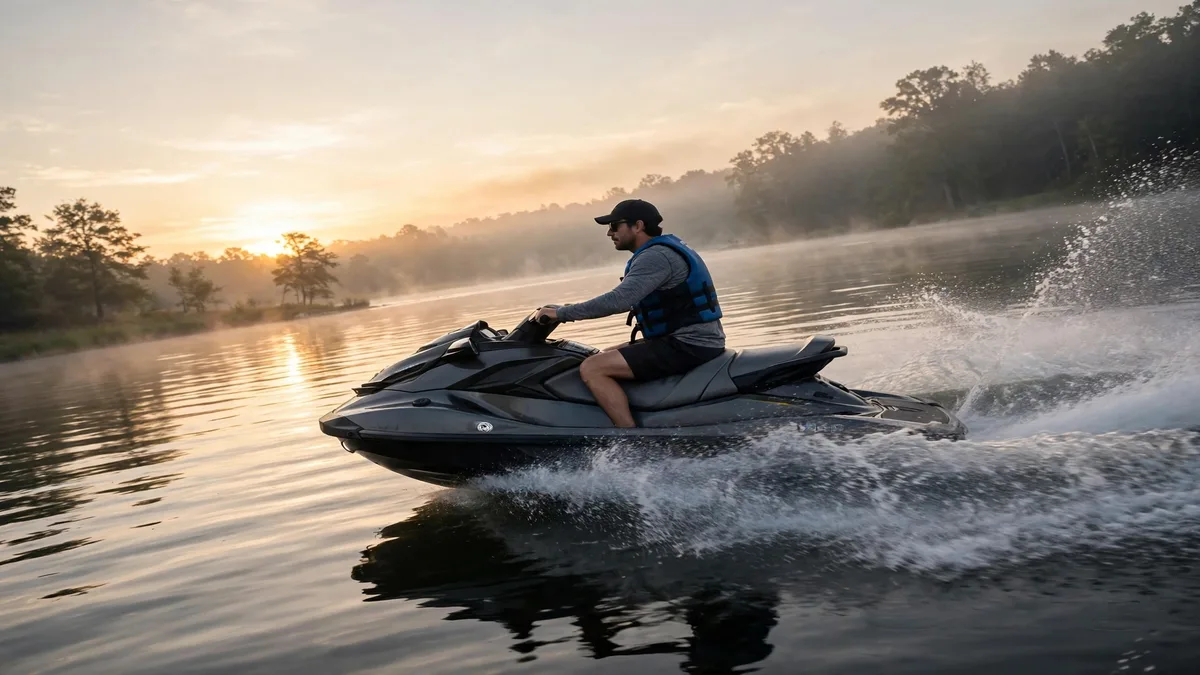
The lake is glassy at seven in the morning, and the only sound is the slap of small waves against the dock. You thumb the starter on the handlebars, the engine catches with a sharp bark, and the little craft trembles beneath you like a dog on a lead. Ease the throttle open and the nose lifts, the hull climbs onto its own bow wave, and suddenly you are skimming across the water at a speed that feels twice as fast as it is, spray stinging your cheeks and the shoreline sliding past in a blur. There is no propeller beneath you, no rudder, no keel. There is only a jet of water, pushed out the back, shoving you forward.
A jet ski, more properly called a personal watercraft, is one of the simplest machines on the water and one of the most fun. It has no exposed propeller to foul on weeds or endanger a swimmer, it can run in water barely deeper than your knees, and it turns by pointing a nozzle rather than by swinging a rudder. Yet inside that compact hull sits a serious piece of engineering: a high-revving engine, a pump that swallows water by the bucketful, and a steering system that only works while the water is flowing. Here is how it all fits together.
How It Works
A jet ski moves by throwing water backwards, and everything else on the craft exists to make that throw as strong and as controllable as possible. Six stages explain the machine from intake to steering.
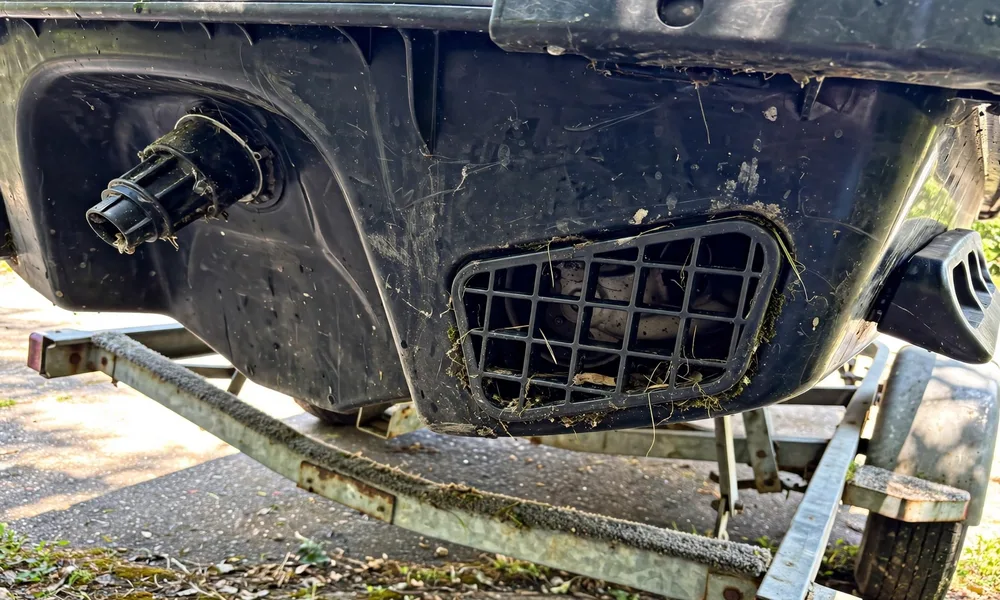
- Water is scooped in from below. Under the hull sits a wide intake grate, a slatted opening that lets water flow in while keeping out rocks, rope, and weed. As the craft moves forward, water is forced into a tunnel that runs through the middle of the hull. The grate is the reason a jet ski can run in shallow water: there is nothing hanging below the keel to strike the bottom, only a smooth hull with an opening that is protected by its own shape.
- The impeller accelerates the water. Inside the tunnel spins the impeller, a screw-shaped fan that looks like a propeller trapped inside a tube. Driven directly by the engine through a driveshaft, it grabs the incoming water and flings it backwards at high speed, building pressure in the tunnel. The impeller is the heart of the machine, and its blades are machined to tight tolerances, because even a small nick from a stone can cost you speed and make the whole craft vibrate.
- The nozzle turns pressure into thrust. At the back of the tunnel, the water is squeezed through a narrowing nozzle, which speeds it up further before it shoots out behind the craft. That jet is what pushes you forward: every litre of water thrown backwards pushes the hull forwards with equal force. The nozzle can pivot from side to side, and that is the whole steering system. Point the jet left and the stern swings right, turning the nose left, and the same trick in reverse turns you the other way.
- The engine provides the power. Most modern jet skis use a compact four-stroke marine engine, often between 1.0 and 1.8 litres, that can spin to seven or eight thousand revs per minute. Some are naturally aspirated and some are supercharged, and the supercharged versions can make more than 300 horsepower from an engine smaller than a car boot. The engine is marinised, meaning its cooling, electrics, and exhaust are built to survive a life soaked in water, and it is cooled by the very lake or sea it rides on. The idea of squeezing huge power from a small marine unit also shows up in the world of electric boats, where our guide to the best electric boat propulsion systems covers the new rivals.
- The throttle and steering work as one system. The handlebars carry the throttle on the right grip and the steering in the bars themselves, and the two are inseparable: without thrust, there is no steering at all. Let go of the throttle at speed and the craft keeps going straight, which surprises new riders who expect it to turn like a bicycle. Modern machines add off-throttle steering assistance and a reverse bucket, a little deflector that drops over the nozzle to throw water forwards and slow or reverse the craft. Learning that the throttle is also your steering is the first lesson every rider learns, and it is the reason practice areas exist. A jet ski is one of the most popular toys a yacht can carry, which is why it appears in our ranking of the best yacht toys and tenders.
- Stability and safety systems keep the rider aboard. The hull is wide and flat for stability at rest, and a lanyard clipped to the rider’s wrist kills the engine if they fall off, so the craft circles and stops rather than speeding away. Many models add braking systems that drop a reverse bucket automatically, cutting stopping distances dramatically, and some offer speed limiters for learners. The seat is shaped to hold two or three riders in a line, and the whole craft is designed to be righted and reboarded from the water by one person. Choosing the right motor for the job matters as much as the hull, as our ranking of the best electric outboard motors shows for the wider world of small boats.
The Numbers That Matter
Jet skis are sold on power and top speed, but the figures that matter most on the water are weight, fuel capacity, and how the craft behaves at low speed around a dock. Typical figures for a modern three-seat model are below.
| Specification | Typical figure |
|---|---|
| Engine size | 1.0 to 1.8 litres |
| Maximum power | 130 to 325 hp |
| Top speed | 85 to 110 km/h |
| Dry weight | 300 to 380 kg |
| Fuel capacity | 60 to 70 litres |
| Rider capacity | 1 to 3 people |
| Length | 3.3 to 3.7 metres |
| Minimum water depth | About 0.6 metres |
What It Costs
A jet ski is one of the cheapest ways onto fast water, though the price climbs steeply with power. As an estimate, a basic recreational model starts at roughly $9,000 to $11,000, while a mid-range three-seat craft with cruise control and a larger engine typically costs $14,000 to $18,000 as an estimate. The supercharged performance models that top 100 km/h can reach $20,000 to $24,000 as an estimate before a trailer, which adds roughly $1,000 to $2,000. Running costs are modest by boating standards: fuel, an annual service, winterising in cold climates, and insurance. Many owners spend more on the trailer, the cover, and the safety kit than they expect, and a surprising number buy a second ski within a year, because riding alone gets lonely.
A Rare Fact
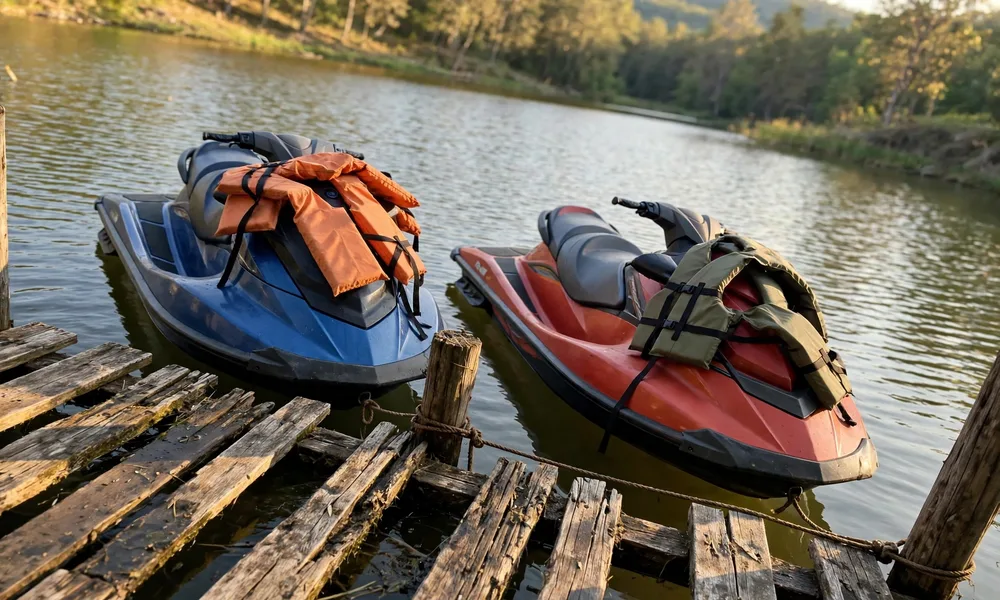
Here is something few riders realise: a jet ski can rescue people, and it is now a standard tool for lifeguards around the world. A small rescue sled towed behind the craft lets a lifeguard reach a swimmer in trouble far faster than a boat or a swimmer could, and the jet drive means there is no propeller to injure the person being rescued. Lifeguard jet skis have pulled people from surf, floods, and rip currents on every continent, and some coastal rescue teams now train on them more than on their boats. The machine built for weekend fun turns out to be one of the fastest ways to save a life on the water.